
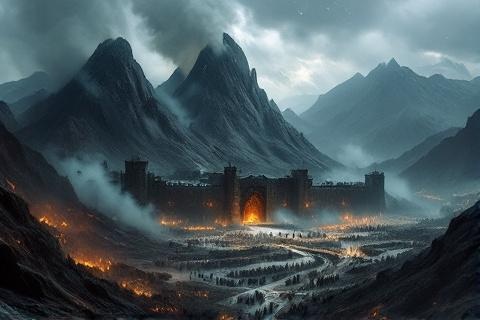
The Siege of Angband
The Longest War of the First Age
A Long Shadow Over the North
The Siege of Angband was the long and patient effort of the Elves
and their allies to hold Morgoth trapped in his hidden
stronghold beneath the dark mountains of Thangorodrim,
and it lasted for nearly four hundred years of the Sun, a span that feels more
like an age of slow pressure than a single war; during this time the
Noldor, the Sindar, and later the
Edain kept watch over the northern wastes of
Beleriand, not in constant open battle, but in an unending
struggle of patrols, skirmishes, and guarded borders meant to keep the Dark
Enemy from breaking forth in full strength once more, for they knew that as long
as Angband stood, no peace was ever truly secure in
Middle-earth.
This long siege shaped most of the history of the First Age
recorded in The Silmarillion, because it created the
setting in which both the greatest hopes and the deepest tragedies of Elves and
Men unfolded, from the bright days when the Noldor raised new realms like
Gondolin, Nargothrond, and Himring
under the shadow of the North, to the dark hours when the fire and armies of
Morgoth finally broke their chains and swept down across the lands; every great
battle, every famous fall of a city, and many of the personal tales of heroism
and doom all trace back to this decision of the Noldor to stand before Angband
and try to contain the first Dark Lord at his very gates.
This article follows that long story from its beginnings to its bitter end,
first looking at how the siege began after the early wars, then turning to the
life of the besiegers in their fortresses and camps, and after that describing
the great turning points such as Dagor Bragollach
and the Nirnaeth Arnoediad, and finally showing how the struggle against Angband
continued in new forms until the War of Wrath, so that
readers can see not only the great battles, but also the quiet endurance, the
shifting alliances, and the lasting legacy of this greatest siege of the First
Age.
How the Siege Began: Origins and Early Pressure
The Siege of Angband grew out of earlier wars in which Morgoth was driven back
to his northern fortress, for after the Noldor returned to Middle-earth and
fought the battles known as Dagor-nuin-Giliath and the Dagor Aglareb, they
pushed the armies of Angband northward, closed many of its outer doors, and
forced Morgoth to stay behind his walls, and then the princes of the Noldor such
as Fingolfin and Maedhros, with their Sindarin allies
and later the Men of the Edain, made a long watch along the northern frontiers,
determined that their great enemy should not again roam freely across Beleriand
as he had in the days before their coming.
At first this siege did not mean a solid wall of warriors around Angband, as
might be seen in a short battle in later ages, but rather a wide and stubborn
policy of pressure, where strongholds and guard-posts were set upon hills and
highlands such as Himring, Ered Wethrin, and the March of Maedhros, and from
these bases riders, scouts, and small companies went out to spy, to raid, and to
drive back any orc-bands that tried to pass, so that Morgoth felt himself
watched and checked in many directions even though large parts of the far north
remained empty wilderness and ice.
This idea of a loose but determined blockade matches Tolkien’s account of a long
period of relative peace after the Dagor Aglareb, when the Noldor grew strong in
the Siege of Angband and their realms blossomed, yet beneath that calm the
threat never faded, because Morgoth was always testing the watch with smaller
attacks, and all that time he was secretly gathering new powers and monsters
until at last he struck back in the Dagor Bragollach, the Battle of Sudden
Flame, which shattered the siege in a moment and proved that the long quiet had
been a preparation for a devastating storm.
Angband and Thangorodrim: The Enemy’s Fortress

Angband itself, as Tolkien describes it, was more than a common fortress, for it
was a vast system of pits and halls of iron delved deep under the cold northern
mountains, first raised in the ancient days when Morgoth built it as a prison
and armory far from his main stronghold of Utumno, and later
rebuilt as his chief seat after the Valar destroyed Utumno;
within Angband there were subterranean chambers without count, dungeons where
countless captives suffered, armouries where orcs and
Balrogs gathered for war, and deep, hidden lairs where Morgoth
kept terrible things such as Glaurung the Father of
Dragons, and all these places were bound together into a dark kingdom below the
earth that no enemy ever fully mapped or understood.
Above this underground realm rose Thangorodrim, the three mighty volcanic peaks
that Tolkien describes as being reared by Morgoth himself over the gates of
Angband, and they stood taller than any other mountains in Beleriand, always
smoking, always black, and pouring out clouds and fumes that darkened the
northern sky; from far away the Elves and Men could see these mountains as a
sign of their enemy’s power, and the slag and ash from Morgoth’s forges helped
to build these peaks higher, so that Thangorodrim became both a natural wall and
a symbol of dread, marking the place where the darkness of the Elder Days was
strongest.
Key features of Angband that Tolkien notes include its great Iron Gates, which
opened onto a plain often filled with the mustering hosts of orcs and worst
creatures, and the deep pits and shafts behind those gates that led down into
the caverns of torment and industry, where Morgoth’s smiths and twisted
Maiar crafted weapons and armor; from the mountain sides and the
roots of Thangorodrim came vents and fissures that breathed smoke, steam, and
sometimes flame, so that even in times of siege the forges never slept, and
Morgoth could belch out rivers of fire and hosts of iron-clad warriors when he
chose to break the bonds of the besiegers.
Who Besieged Angband: The Elves and Their Allies

Many peoples took part in the siege, and first among them were the Noldor, the
High Elves who had returned from Valinor and whose princes such as Fingolfin,
Maedhros, Fingon, and others led the great realms of the north, but also the
Sindar, the Grey-elves who already dwelt in Beleriand, joined in the struggle,
especially those of Doriath under Thingol and later some who
followed Círdan by the Sea, and in time the
Edain, the noble Men who became friends and vassals of the Noldor, entered the
wars, including the Houses of Bëor, Haleth, and Hador, so that the long watch
around Angband was held not by a single folk but by a union of many with
different tongues, customs, and memories.
These different Elven houses and human lords did not all gather in one camp but
spread out along the northern marches in separate strongholds and guarded lands,
each taking a share of the watch, so that Maedhros and his brothers held the
East in the March of Maedhros and at Himring, Fingolfin and later Fingon guarded
the north-west from Hithlum and the Ered Wethrin, the sons of Finarfin ruled in
Dorthonion and Nargothrond, and the Edain settled in lands
like Dor-lómin, Ladros, and Brethil, where they served as
allies and frontier defenders, while further south Thingol of Doriath remained
more hidden, though his power and that of Melian still
influenced the wider war.
Over the long years of the siege, alliances did not stay fixed, because leaders
fell in battle or through dark fate, and new lords rose to take their place,
while Morgoth’s changing threats forced the Noldor to adjust their plans, yet
the central purpose remained the same, to hold Angband in check and deny Morgoth
open passage into the heart of Beleriand, even when quarrels such as those among
the sons of Fëanor or between the Noldor and
Thingol strained the unity of the Free Peoples.
Because of this, many famous names in The Silmarillion are connected to the
pressure against Angband, including Fingolfin who once rode alone to challenge
Morgoth at his very doors, Maedhros the red-haired prince who organized the
March of Maedhros, Finrod Felagund whose wisdom
led to strong alliances with Men, and Hador and his descendants who held the
western passes, along with others like Angrod, Aegnor, and later characters such
as Beren and Túrin, whose
personal stories unfolded against the shadow of Angband and the never-ending war
that it forced upon Middle-earth.
Commanders and Councils
The struggle around Angband was guided by a number of key leaders, chiefly among
the Noldorin princes who had the greatest power and knowledge of war, such as
Fingolfin High King of the Noldor in Beleriand, Maedhros son of
Fëanor who after his torment upon Thangorodrim became more
cautious and far-sighted, Fingon the brave rescuer of Maedhros and later High
King, and Finrod Felagund the wise lord of Nargothrond, and beside them stood
leaders among Men, like Hador Lórindol and his house, and later Húrin and Huor
and other captains of the Edain, who together sought not only to fight
occasional battles, but to direct an ongoing strategy that could hold Morgoth
back for generations.
To coordinate the siege, these leaders held councils and gatherings at certain
times, where they debated how best to place their forces, which passes to guard
with towers and forts, when to send out great raids into the north, and when to
restrain their strength, and though Tolkien does not detail every meeting, he
shows that such planning took place when he describes Maedhros gathering an
alliance before the Nirnaeth Arnoediad, or the princes of the Noldor agreeing
earlier on the general pattern of the Siege of Angband after the Dagor Aglareb,
for they understood that no single house could face Morgoth alone and that
careful choice of watchposts and timing of attacks were vital to keep the Dark
Lord uneasy and contained.
Over the centuries, however, the burden on these leaders grew heavier, because
Morgoth’s creatures did not tire in the same way that Elves and Men did, and
each loss of warriors was slow to replace, while new terrors such as Glaurung or
the growing strength of wolves and other beasts began to shake old plans, and so
the princes and chieftains had to face not only the grief of fallen kin and
subjects, but also the fear that their long effort might fail, a fear that
reached its cruel peak when their carefully laid alliance broke at the Nirnaeth
Arnoediad and the leaders who had long held the siege together were slain,
captured, or scattered.
Siege Life: Camps, Watchtowers, and Supply

Daily life during the Siege of Angband, though less often told in detail than
the great battles, can still be imagined from Tolkien’s hints, for there were
always sentries on high ridges watching the north, scouts ranging the plains to
follow orc-movements, and long supply lines carrying food, weapons, and messages
through the cold lands of Ard-galen and beyond, where winters were harsh and
summers short; Elven patrols and human riders would have spent weeks at a time
outdoors in mail and cloaks, sleeping in small camps or under the open sky,
always alert for sudden attacks, while behind the frontiers craftsmen, farmers,
and miners in the safer lands kept the strongholds supplied so that the watch
could continue unbroken year after year.
The besiegers did not depend only on roving companies, because they also built
and strengthened watch-towers and fortified camps on natural heights, turning
hills and mountain spurs into small fortresses, such as Himring which Maedhros
held against many assaults, and the forts along the March of Maedhros, as well
as guarded passes in the Ered Wethrin and elsewhere, and in these places there
would have been walls, stockades, stores, stables, and halls where warriors
gathered, repaired gear, trained, and took counsel, so that the “ring” around
Angband was made up of many such points of strength linked by roads and paths
and by the alert eyes of the Elves and Men who moved between them.
Life on this long frontier was filled with danger, since Morgoth’s orcs launched
raids both large and small, wolves and other fell beasts roamed the waste, and
even when no enemies were near, the slow grind of years could bring weariness to
heart and body, especially for the mortal Men of the Edain whose lives were
brief compared to their Elven lords; Tolkien shows something of this strain in
the tales of Hador’s house and of those who dwelt in Dorthonion or Brethil,
where constant alarm and the memory of lost kin weighed heavily, and where the
hope that Angband might someday fall had to be renewed in each new generation
that took up the guard.
Dagor Bragollach: The Sudden Flame That Broke the Ring

Dagor Bragollach, the Battle of Sudden Flame, was the great counter-stroke by
Morgoth that at last smashed the Siege of Angband, for after centuries of
seeming patience he released rivers of fire from beneath the slopes of
Thangorodrim that poured across Ard-galen and turned its green plains into a
burned waste called Anfauglith, and behind this wall of
flame came hosts of orcs, Balrogs, and the dragon Glaurung in his full terrible
might, so that the northern defenses of the Noldor, which had stood against
lesser assaults, were in a short time broken and thrown into chaos.
Tolkien’s description in The Silmarillion of this moment is vivid, as he tells
how “the fronts of the Siege of Angband were broken and the hosts of Morgoth
burst forth,” with fire that swept like rivers down from the mountains, and the
defenders were burned or driven from their positions before they could properly
form lines, so that the long peace that many had almost begun to trust came to a
violent end, and suddenly the siege that had felt so firm seemed thin and
fragile against the might that Morgoth had hidden and nurtured in the depths of
his fortress all those many years.
The immediate effects of the Bragollach were disastrous for the besiegers,
because key strongholds such as the highlands of Dorthonion fell or became
impossible to hold, Fingolfin’s realm in Hithlum was cut off and pressed hard,
many of the Sons of Fëanor were scattered from their eastern marches, and the
lands that had fed the armies were burned or overrun, leading to hunger and
confusion, while countless warriors died and many others fled as refugees, so
that the once ordered system of watch and defense collapsed in many places and
the struggle against Angband changed from a confident containment into a
desperate fight for survival.
Nirnaeth Arnoediad and the Unraveling
Not many years after Dagor Bragollach came the Nirnaeth Arnoediad, the Battle of
Unnumbered Tears, when Elves and Men and even some Dwarves gathered in a vast
alliance under the leadership of Fingon and Maedhros to try to strike a decisive
blow against Morgoth and restore some form of siege, yet through betrayal and
the cunning plans of the Dark Lord this greatest effort ended in a crushing
defeat, as Tolkien tells how the hosts of the West were surrounded, their plans
undone, and their leaders slain or taken, so that the hopes that had risen after
the first shock of the Bragollach were dashed more terribly than before.
This defeat allowed Morgoth to become the clear master of almost all of
Beleriand, for with the fall of Fingon and many of the greatest lords, along
with the ruin of the House of Hador and heavy losses among the Noldor, there was
no longer any way to hold a steady, organized line before Angband, and instead
the Free Peoples were broken into isolated groups and hidden kingdoms that could
no longer think of surrounding their enemy, but only of surviving and striking
where they could, while Morgoth felt so secure that he did not even bother to
shut up all his foes, knowing they could not now unseat him by open war.
The cost in that battle, both human and Elven, was deep and lasting, for great
strongholds such as the city of Barad Eithel and the western guard of Hithlum
were lost, the House of Hador was enslaved or scattered, many princes of the
Noldor were slain, and those who escaped, like Turgon of Gondolin and the
survivors who fled to Nargothrond or into the wild woods, carried with them not
only sorrow but the sense that their whole world had been broken, and their
later deeds in hidden havens were shaped by the memory of those unnumbered tears
shed upon the great battlefield north of the Ered Wethrin.
Turning Points After the Siege

After the great defeats that shattered the formal siege, the war against Angband
did not end, but changed into a struggle of scattered resistance, daring raids,
and secret journeys, where individual courage could shine even brighter against
the deepening dark, as when Barahir and his band fought a hopeless guerrilla war
in the ruins of Dorthonion, or when the people of Brethil guarded their forest
against orcs, or later when the warriors of Gondolin made sudden sallies against
Morgoth’s forces, and each of these efforts, though too small to besiege Angband
again, still hindered Morgoth’s plans and kept the flame of defiance alive.
In Tolkien’s tales there are key episodes that renewed hope or shifted the
balance for a time, such as the great deed of Beren and
Lúthien who, with the aid of Huan and others,
penetrated to Angband itself and took a Silmaril from
Morgoth’s iron crown, an act that wounded his pride and shook his false sense of
perfect safety, or the later feats of Túrin Turambar who slew Glaurung and thus
removed one of Morgoth’s mightiest servants, and these individual adventures,
though they did not restore the old siege, still showed that Morgoth could be
hurt and even robbed within his own stronghold by those who dared all.
Because of such stories, the Siege of Angband can be seen not only as the early
centuries of formal blockade, but as the whole long theme of resisting Morgoth’s
northern fortress throughout the First Age, a theme that continued until the
Valar finally answered the pleas of Eärendil
and brought the Host of the West to Middle-earth in the War of Wrath, when
Angband was at last besieged in full might and thrown down forever, so that from
the first guards on Ard-galen to the last assault by the powers of Aman, the war
around Angband remained the central thread of conflict in the Elder Days.
The Cost: Lives, Cities, and Memory
The human and Elven cost of the long war around Angband was terrible, for many
great houses fell or were greatly diminished, such as the royal line of
Fingolfin which lost its kings in lonely duels and on bloody fields, the House
of Hador which was enslaved and broken after the Nirnaeth, and the Houses of
Bëor and Haleth which suffered losses in Dorthonion and elsewhere, while cities
and strongholds like Minas Tirith on Tol Sirion,
Nargothrond, and finally Gondolin were betrayed or overwhelmed, and the number
of unnamed lives taken in skirmishes, raids, and famines caused by war was
beyond counting.
Tolkien does not only list these disasters, he also shows the grief and
endurance of those who survived, such as Morwen and Rían waiting in sorrow, or
the proud survivors of Doriath wandering homeless after its fall, or the remnant
of Gondolin led by Tuor and Idril making their perilous escape, and in each of
these stories there is both deep sadness and a firm will to go on, for even when
their homes and kindred were lost, many of the Free Peoples refused to submit to
Morgoth fully, choosing hardship in exile over comfort under his shadow, and
this stubborn hope gives the tales of the First Age much of their emotional
power.
These wounds left by the struggle with Angband did not fade when the fortress
was finally destroyed, because the memory of fallen realms and ruined houses
shaped the later histories of Elves and Men, so that Númenórean kings looked
back to the heroism and suffering of their Edain ancestors, while the remaining
Elves of Middle-earth carried with them the stories of Gondolin, Nargothrond,
and Doriath into the Second and Third Ages, and even in The Lord of the
Rings, the echoes of that older war can be felt in the
songs and laments of characters who remember that the fight against
Sauron was not the first long war that their peoples had
endured.
Legacy: How the Siege Shaped Middle-earth

In the long view of Tolkien’s legendarium, the Siege of Angband is of great
importance because it fixed Morgoth as the central enemy of the First Age and
forced Elves and Men to shape their societies and choices around the need to
resist him, leading the Noldor to build strong northern realms instead of
seeking peaceful lives further south, and drawing the Edain into an alliance
that cost them dearly but also prepared them to become the fathers of the
Númenóreans, while the Sindar and other folk had to decide
whether to remain hidden or to join openly in the wars, decisions that would
shape their fates for ages to come.
The breaking and reforming of the siege also led directly to later key events,
because the fall of the northern guard opened the way for Morgoth’s forces to
attack and eventually destroy the hidden kingdoms of Nargothrond and Gondolin,
while the scattering of survivors set characters like Tuor, Idril, Beren,
Lúthien, and later Eärendil on paths that would lead to the raising of new
leaders and the final appeal to the Valar, which brought the War of Wrath and
the end of Angband, yet also the drowning of much of Beleriand, so that the
whole shape of Middle-earth in later ages was changed by the decision to stand
and siege Morgoth in the far North.
On a moral and literary level, Tolkien uses the Siege of Angband and its long
failure to illustrate themes of endurance in the face of almost hopeless odds,
the danger of pride and rash oaths like those of Fëanor’s sons, and the high
cost that must often be paid when free peoples choose to resist a dark power
instead of submitting, for the Elves and Men of the First Age hold their ground
for centuries and achieve many worthy deeds, yet in the end most of their
visible works are destroyed, and only through sacrifice and suffering do they
open the way for later hope, a pattern that echoes in smaller form in the later
wars against Sauron and gives depth and sadness to the beauty of Middle-earth.