

Beren: The Man Who Stole a Silmaril
A Mortal Among Legends
Origins of a Noble House
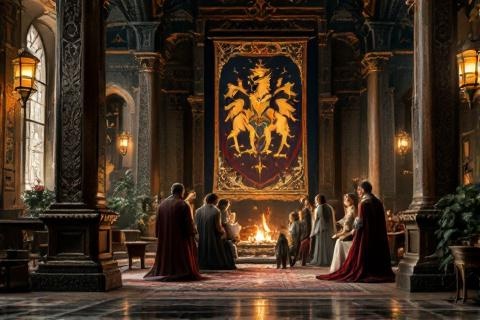
Beren was born into the noble House of Bëor, which held a distinguished place
among the Three Houses of the Edain who allied themselves with
the Elves in the First Age. As the first
Men to enter Beleriand, the House of Bëor was
renowned for their loyalty, wisdom, and strength, establishing deep friendships
with the Noldorin Elves under the leadership of Finrod
Felagund. These early relations would later prove
crucial in Beren's own legendary quest.
As the son of Barahir, Beren was heir to the lordship of Ladros in the highlands
of Dorthonion. The realm of Ladros was granted to the House
of Bëor by the Noldorin King Finrod Felagund in recognition of their faithful
service. Under Barahir's leadership, Ladros served as a crucial northern defense
against Morgoth's forces, though this position would
eventually lead to its downfall.
Beren's lineage traced back to the earliest days of Men in Beleriand, when his
ancestors became the first mortals to cross the Blue Mountains from the East.
Led by Bëor the Old, these pioneers established first contact with the Elves of
Beleriand, particularly with King Finrod Felagund, beginning a lasting alliance
that would shape the history of both races. This heritage instilled in Beren a
deep respect for the Elves and their culture, which would later influence his
fate.
The Last Survivor
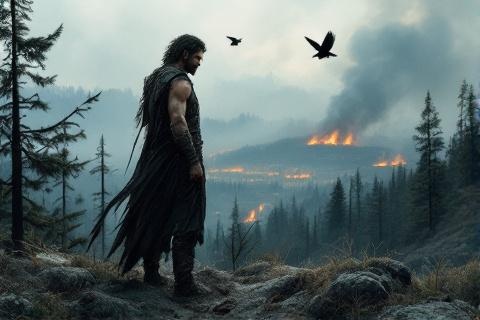
During the catastrophic Battle of Sudden Flame,
known as the Dagor Bragollach, Beren witnessed the devastation of his homeland
as Morgoth's forces overwhelmed the defenses of the northern realms. While his
father Barahir maintained a resistance in Dorthonion, the land was largely
conquered, forcing most of its people to flee. Beren fought alongside his father
and their loyal companions in these dark days, learning the harsh lessons of
survival against overwhelming odds.
After the fall of Dorthonion, the land became known as Taur-nu-Fuin, the Forest
under Nightshade, a dark and terrible place haunted by Morgoth's creatures.
Beren survived alone in this perilous wilderness for four years, becoming a
feared enemy of the orcs. His solitary resistance in this shadow-haunted forest
became legendary, with even Morgoth placing a bounty on his head equal to that
of the High King of the Noldor.
When Morgoth's servants finally cornered and slew Barahir and his band of
followers, Beren emerged from hiding to avenge them. Through cunning and valor,
he tracked down the orc-band responsible for his father's death, recovered the
Ring of Barahir, and exacted his revenge. This
ring, an heirloom of his house and token of Finrod's oath, would later prove
crucial in securing aid for his greatest quest.
Meeting with Lúthien

Following a perilous journey south across the Mountains of Terror, Beren entered
the hidden realm of Doriath, protected by Queen
Melian's magical girdle. Few mortals had ever penetrated
these enchanted defenses, yet Beren's fate drew him through, guided by forces
beyond his understanding. The discovery of this hidden realm marked the
beginning of his greatest adventure.
In the forest of Neldoreth, within Doriath's borders, Beren encountered a sight
that would change his life forever: Lúthien,
daughter of King Thingol and Melian, dancing in a glade beneath the stars. Her
beauty and grace surpassed anything in mortal experience, enhanced by the magic
of her dance and song. This moment became one of the most celebrated scenes in
all the tales of the First Age.
Upon seeing Lúthien, Beren gave her the name Tinúviel, which means nightingale
in the ancient tongue, inspired by her sweet voice and graceful movement. The
name became forever associated with their tale, embodying both the beauty and
the melancholy of their love. Their meeting sparked an immediate connection
between them, transcending the differences of their races.
The love that grew between Beren and Lúthien challenged the established order of
Middle-earth, where unions between Elves and Men were unprecedented. Their
relationship faced opposition from many quarters, most notably from King Thingol
himself, who viewed it as an affront to his realm and his daughter's divine
heritage. Yet their bond proved stronger than prejudice, politics, or even death
itself.
The Quest for the Silmaril
When Beren approached King Thingol to ask for Lúthien's hand in marriage, the
Elven king set what he believed to be an impossible task: to retrieve one of the
Silmarils from Morgoth's iron crown. These jewels,
created by Fëanor, contained the light of the Two Trees of
Valinor and were the most precious objects in all of
Middle-earth. Thingol's demand was meant to send Beren to his death or drive him
away in despair.
With the aid of Lúthien, who refused to abandon him, Beren undertook the
seemingly impossible journey to Angband, Morgoth's fortress in
the north. Their quest was aided by various allies, including King Finrod
Felagund, who fulfilled his oath to Beren's lineage at the cost of his own life.
Through numerous perils and challenges, they managed to penetrate the very
depths of Morgoth's stronghold.
At the gates of Angband, they encountered Carcharoth, the mightiest of all
wolves, bred by Morgoth himself as the guardian of his fortress. The wolf was
more terrible than any beast that had ever walked Middle-earth, and even Huan,
the great hound of Valinor who accompanied them, could not defeat him at that
time. This encounter would later lead to tragic consequences.
In what became one of the greatest feats in the history of Middle-earth, Beren
and Lúthien managed to enter Morgoth's throne room while the Dark Lord and his
court were enchanted by Lúthien's dancing. While Morgoth slept under Lúthien's
spell, Beren cut a Silmaril from the iron crown. However, in his attempt to take
a second jewel, his knife broke, and a shard struck Morgoth's face, awakening
him and forcing them to flee.
Powers and Abilities
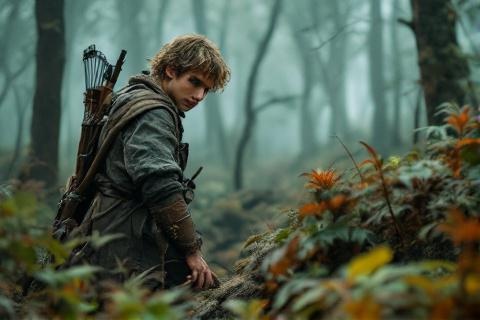
During his years as an outlaw in Dorthonion, Beren developed exceptional stealth
abilities that earned him a fearsome reputation among Morgoth's servants. His
capacity to move unseen and strike without warning made him a legend in the
northern forests, where he survived alone against countless enemies. These
skills would later prove crucial in his quest for the Silmaril.
Through necessity and natural aptitude, Beren mastered the arts of woodcraft and
hunting in the wild lands. He learned to live off the land in the most hostile
conditions, tracking game and avoiding enemies in the shadow-haunted forests of
Taur-nu-Fuin. His profound understanding of wilderness survival allowed him to
persist where others would have perished.
As a warrior, Beren proved himself a skilled swordsman, capable of facing both
orcs and werewolves in combat. His tracking abilities were particularly
renowned, allowing him to hunt down his father's killers and navigate through
dangerous territories. These martial skills, combined with his stealth, made him
a formidable opponent despite being alone.
Throughout his adventures, Beren demonstrated a level of courage and
determination that set him apart from other mortals of his age. His unwavering
resolve in the face of impossible odds, whether surviving alone in Taur-nu-Fuin
or pursuing the quest for the Silmaril, showed a strength of spirit that earned
the respect of even his greatest enemies. This inner strength would become as
legendary as his physical prowess.
Legacy and Influence

Through his marriage to Lúthien and the birth of their son Dior, Beren
established the line of the Half-elven, which would profoundly influence the
history of Middle-earth. This lineage continued through
Elrond and Elros, eventually reaching
Aragorn and Arwen
in the Third Age. The choice between mortality and immortality
granted to his descendants would shape the destinies of both Elves and Men.
The successful quest for the Silmaril inspired later heroes throughout the Ages,
particularly in showing that even Morgoth was not invincible. Beren's
achievements gave hope to those who opposed evil in Middle-earth, proving that
courage, love, and determination could overcome seemingly insurmountable odds.
His legacy influenced many later heroic deeds, including the quests of the Third
Age.
The tale of Beren and Lúthien became known as the greatest story of the First
Age, surpassing all other tales in its blend of heroism, romance, and tragedy.
It encompassed themes of sacrifice, redemption, and the power of love to
transcend all boundaries. The story was preserved in both song and written lore,
becoming a cornerstone of Middle-earth's cultural heritage.
The fates of both Elves and Men were forever altered by Beren's deeds. His
recovery of the Silmaril set in motion events that would lead to the War of
Wrath and the end of the First Age. Moreover, his union
with Lúthien established a precedent for the mingling of the two races, creating
a legacy that would echo through the ages in the stories of their descendants.
Cultural Impact
The story of Beren and Lúthien endured through all the Ages of Middle-earth,
retold countless times in halls both grand and humble. From the courts of Elven
kings to the hearths of mortal men, their tale remained alive in the hearts and
minds of all free peoples. The story gained particular significance in the Third
Age, when their distant descendants Aragorn and Arwen faced similar choices.
Beyond its romantic elements, the tale of Beren and Lúthien became a powerful
symbol of hope for those who faced seemingly insurmountable obstacles. Their
story demonstrated that love could transcend not only social boundaries but the
very nature of creation itself. This aspect of their legend resonated
particularly strongly with those who faced their own struggles against darkness
and despair.
The unprecedented union of Beren and Lúthien served as inspiration for later
relationships between Elves and Men, most notably those of Tuor and Idril, and
eventually Aragorn and Arwen. These later couples drew courage from the example
set by their forerunners, knowing that such unions, though rare and often
tragic, were possible through true love and dedication.
Throughout the Ages, both Elves and Men preserved the memory of Beren and
Lúthien in songs and poems of great beauty and power. The Lay of Leithian, which
told their full tale, became one of the greatest works of poetry in all of
Middle-earth. Their story was particularly treasured in
Rivendell, where their descendants dwelt, and where the tale
held special meaning for those who lived there.