
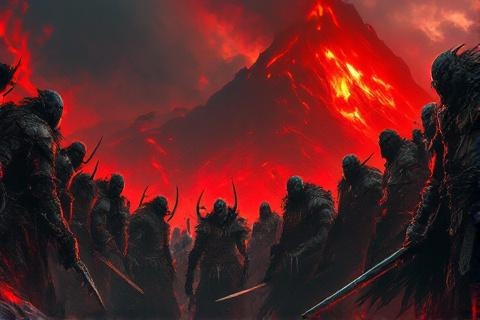
Orcs of Middle-earth: Tolkien's Most Misunderstood Monsters
From Dark Servants to Complex Beings: Unveiling the Truth Behind Orcs
The Dark Origins: From Elves to Orcs
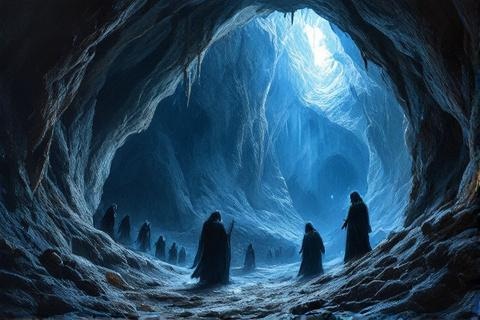
The origin of Orcs represents one of the darkest chapters in the history of
Middle-earth, stemming from
Morgoth's corruption of captured Elves in
the depths of Utumno during the First Age.
According to the Silmarillion, Morgoth, unable to create life himself, took some
of the firstborn Elves and through prolonged torment and dark arts twisted them
into a new, debased form. These first Orcs were created as a mockery of the
Elves, whom Morgoth particularly hated, and were designed to be their antithesis
in every way.
J.R.R. Tolkien wrestled with the question of Orc origins throughout his life, as
evidenced in his letters and various drafts published in Morgoth's Ring. While
the Silmarillion presents the Elvish origin as canonical, Tolkien later
considered alternative theories, including the possibility of Orcs being
corrupted from Men, or perhaps being beasts given semblance of
sentient life through Morgoth's sorcery. In Letter 153, he particularly
struggled with the theological implications of their creation and the question
of their immortality.
The process of creating Orcs involved prolonged exposure to darkness, physical
torture, and spiritual corruption in the lightless pits of Utumno and later
Angband. The Silmarillion describes how Morgoth's power of
corruption seeped into their very being, twisting not only their bodies but
their fëar (spirits) as well. This transformation was so complete that even the
Valar, when they first encountered Orcs, could scarcely believe
they had once been Elves.
The origin of Orcs presents significant theological and moral questions within
Tolkien's Catholic-influenced cosmology. Since Morgoth could not create life
independently, the Orcs represent a perversion of Eru's creation rather than a
truly new species. This raises complex questions about their souls, free will,
and potential for redemption. The matter deeply troubled Tolkien, as expressed
in his later writings, where he grappled with how beings derived from Elves or
Men could be irredeemably evil within a Christian framework.
Language and Communication
The Black Speech was created by Sauron himself during the
Second Age as a unified language for all his servants, particularly the Orcs.
Designed to be harsh and commanding, it reflected the evil nature of its creator
and users. The most famous example of Black Speech appears in the inscription of
the One Ring, though few other examples survive in
Tolkien's works beyond the phrase 'Ghâsh' meaning fire.
Orkish society developed numerous dialects and corrupted forms of speech,
varying by tribe and region. As noted in The Lord of the
Rings, Orcs from different regions often had
difficulty understanding each other, requiring the Common Speech for
communication between groups. The Orcs of the Misty Mountains spoke differently
from those of Mordor, and the Uruk-hai developed their own
variant of these languages.
Orcs displayed a particular talent for corrupting and debasing other languages
they encountered. They took words from Elvish, Mannish, and other tongues,
twisting them into cruel and ugly forms that reflected their own nature. This
linguistic corruption paralleled their physical corruption, creating harsh,
guttural sounds that Tolkien described as being unpleasant to hear and
reflecting their debased nature.
Hierarchy and Social Structure
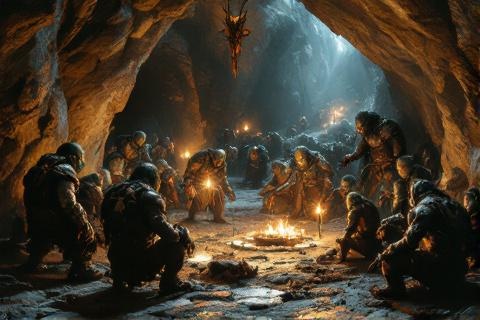
Orcish leadership structures, as seen in The Hobbit with the
Great Goblin of the Misty Mountains, typically centered around the strongest and
most cunning individuals. These chieftains maintained their position through a
combination of physical dominance, cunning, and brutal enforcement of their
will. The Great Goblin's authority over his realm demonstrated how Orcish
leaders controlled vast underground networks and commanded significant numbers
of followers.
Different Orcish tribes established distinct territories throughout
Middle-earth, from the Misty Mountains to Mordor and the northern wastes. The
Lord of the Rings describes various groups such as the Orcs of
Moria, the Mordor Orcs, and the mountain tribes, each
adapting to their specific environments and developing their own
characteristics. These tribes often competed and fought with each other when not
united under a powerful dark lord.
Within Orcish society, physical size and strength played crucial roles in
determining social status and leadership positions. Larger Orcs naturally
dominated their smaller kin, as seen with the Uruk-hai's superiority over
regular Orcs. This emphasis on physical power created a brutally hierarchical
society where violence and intimidation were the primary means of maintaining
order and authority.
Warriors and Weapons
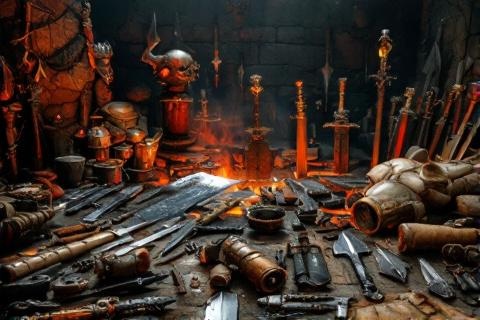
Orcish weapons, while crude by Elvish or Númenórean standards, proved remarkably
effective in combat. The Lord of the Rings describes their weapons as being
black, crude, and often crooked, yet deadly in their purpose. Their smiths
produced serrated blades, heavy spears, and broad-bladed swords designed more
for hacking than skillful swordplay, reflecting their aggressive and brutal
fighting style.
In battle, Orcs employed tactics that emphasized overwhelming numbers and brutal
efficiency rather than honor or finesse. They excelled at ambush warfare and
night fighting, using their superior dark-vision to advantage. The Two
Towers and The Return of the King
detail how they organized into companies and squadrons under the command of
larger, more powerful Orcs, showing a surprising degree of military discipline
when properly led.
The technological capabilities of Orcs included the development of sophisticated
armor and siege equipment, particularly under Sauron's guidance. In the War of
the Ring, they produced siege towers, battering rams, and various engines of
war. Their armor, while often mismatched and ugly, provided effective
protection, typically consisting of black iron plates and rings that could turn
aside normal weapons.
The Uruk-hai: Saruman's Elite
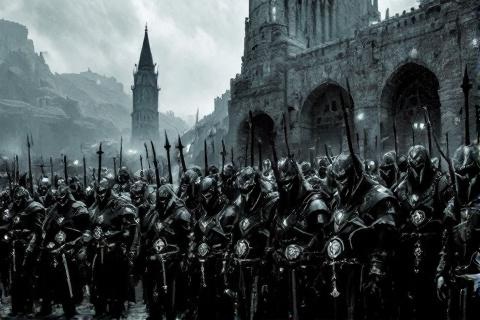
Saruman's breeding programs in Isengard
represented a significant advancement in Orc development, combining Orc strength
with human traits to create the superior Uruk-hai. As detailed in The Two
Towers, these experiments produced warriors who could endure sunlight and
possessed greater intelligence and strength than regular Orcs. Saruman's
scientific approach to breeding demonstrated his corruption, as he sought to
improve upon Sauron's servants through unnatural means.
The Uruk-hai differed from regular Orcs in several crucial ways beyond their
tolerance for sunlight. They were significantly larger, more intelligent, and
better disciplined than their lesser kin. The Two Towers describes them as being
almost as tall as Men, with thick, long arms, and possessing a fierce
intelligence that made them far more dangerous than traditional Orcs.
The Uruk-hai received superior training and equipment compared to regular Orcs,
as evidenced by their distinctive white hand-marked armor and advanced weapons.
They used well-crafted swords, strong bows, and wore heavy armor that protected
them effectively in battle. Their equipment demonstrated Saruman's industrial
capability and his attention to creating an elite fighting force.
During the War of the Ring, the Uruk-hai played a crucial role in Saruman's
military campaigns, particularly in the battles of the Fords of Isen and Helm's
Deep. Their ability to fight effectively in daylight and their superior
discipline made them especially dangerous opponents for the Rohirrim. Their
assault on Helm's Deep nearly succeeded in breaking the fortress's defenses, and
only the timely arrival of Gandalf and Erkenbrand
prevented their victory.
Life in Mordor and Beyond
Daily life in Orcish settlements centered around a harsh existence of labor,
violence, and survival. The Lord of the Rings provides glimpses of their living
conditions through Sam and
Frodo's experiences in Mordor, showing how Orcs
lived in crowded, dirty conditions, often fighting among themselves for
resources and dominance. Their settlements typically consisted of crude
buildings, tunnels, and fortified positions adapted to their need for darkness
and defense.
Orcs maintained an antagonistic relationship with the natural world, reflecting
their corrupted nature. They preferred to defile and destroy rather than
cultivate or preserve, cutting down trees without need and polluting waters.
Their presence in any region typically led to environmental degradation, as seen
in their destruction of the forests around Isengard and the desolation they
created in Mordor.
These creatures demonstrated remarkable adaptability to harsh environments,
particularly excelling in underground and mountainous regions. The Silmarillion
and The Hobbit show how Orcs could survive in the coldest mountains and deepest
caves, creating extensive networks of tunnels and fortifications. Their ability
to endure extreme conditions contributed to their successful spread across
Middle-earth.
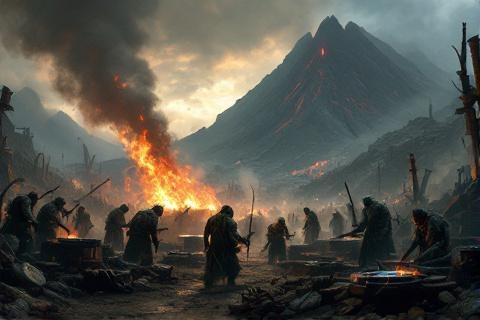
Despite their destructive nature, Orcs possessed significant industrial and
crafting capabilities. They could mine efficiently, forge weapons and armor, and
construct complex machinery. Under Sauron's direction in Mordor and Saruman's in
Isengard, they demonstrated considerable skill in metalworking and engineering,
though their creations typically emphasized functionality over beauty and often
carried a taint of their malice.
Servants of Shadow: The Role of Orcs in Evil's Designs
Throughout the Ages of Middle-earth, Orcs served various Dark Lords, beginning
with their creator Morgoth in the First Age, continuing through their allegiance
to Sauron in the Second and Third Ages. The Silmarillion chronicles how they
formed the backbone of Morgoth's armies in his wars against the Elves and their
allies, while The Lord of the Rings shows their service to Sauron in his attempt
to dominate Middle-earth.
The loyalty of Orcs to their dark masters stemmed primarily from fear rather
than devotion. Tolkien's works repeatedly demonstrate how Orcs served out of
terror of punishment and the promise of plunder rather than any true allegiance.
This fear-based control system meant that Orcish armies could quickly collapse
when their leadership was removed, as seen multiple times throughout the
histories of Middle-earth.
Orcs played a significant role in corrupting and destroying the landscapes of
Middle-earth. Under the direction of their dark masters, they turned fertile
lands into wastelands, beautiful forests into scarred battlegrounds, and clean
waters into poisoned pools. The transformation of Isengard under Saruman and the
desolation of Mordor stand as testament to their destructive impact on the
natural world.
The Question of Free Will
The question of Orc consciousness and free will remains one of the most debated
aspects of Tolkien's legendarium. While they clearly possessed intelligence and
the ability to reason, the extent of their free will and moral responsibility
remained unclear. Tolkien himself struggled with this question, as evidenced in
his letters and later writings, where he contemplated whether Orcs were
irredeemably evil or capable of choosing good.
Throughout The Lord of the Rings and other works, Orcs demonstrate clear
capacity for independent thought and action. Conversations overheard by Sam and
Frodo reveal that Orcs could question orders, form their own plans, and even
express dissatisfaction with their leaders. They showed ability to reason, plan,
and make decisions, though these were typically directed toward evil ends.
The moral complexity of Orcish existence presents one of the most challenging
aspects of Tolkien's mythology. As beings corrupted from Eru's original
creation, they represent both victims and perpetrators of evil. Their capacity
for cruelty and destruction exists alongside their status as creatures twisted
by powers beyond their control, raising questions about redemption, free will,
and the nature of evil itself.