

Dorthonion: The Land of Pines and its Fall into Nightshade
From the High Fells of Beleriand to the Dreadful Taur-nu-Fuin
Introduction: A High Country Named for Pines
Dorthonion first appears in the tales of the First Age as a
high, shadowed region in the north of Beleriand, called the
“Land of Pines” because of the great forests that covered its fells, and it
stands apart from the lower, gentler lands around it as a stern upland where the
sons of Finarfin held their realm before its fall.
This land is not made of soft river valleys or wide meadows, but of a broad,
raised table of ground, a high plateau of fells and ridges that rises in one
great mass above the surrounding country, so that those who climb into
Dorthonion step up into a different world of height and hard stone.
In the writings, its name and nature always return to the same images of tall,
dark trees, keen winds, and a chill, often misty air, for Dorthonion is a place
of altitude and forest where the light is colder and the seasons more severe
than in the southern lands of Beleriand.
This article follows the land itself through time, tracing the shapes of its
hills and cliffs, the look and smell of its pine woods, the quality of its light
and weather, and finally the way its whole mood darkens and turns dreadful when
it becomes Taur-nu-Fuin under the shadow of
Morgoth.
The High Fells and Plateau: Shape of the Land
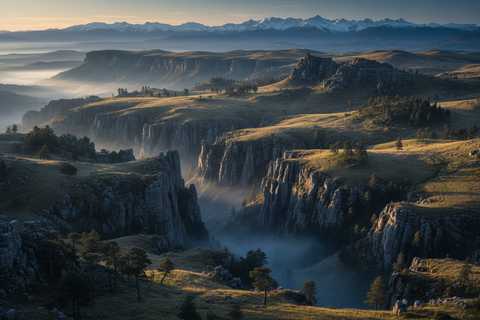
The core of Dorthonion is a great raised table of land, a wide upland that lies
level or gently rolling across many leagues, then ends in sudden steep
escarpments and high edges, so that it forms a clear belt of high country
between the mountains of the north and the broader plains to the south.
Around this plateau the land does not sink gently, but drops away sharply into
ravines and cliffs, and from the outer rim of Dorthonion one can look down into
the lower valleys of Beleriand, seeing rivers far below and forested slopes
falling away into the hazy distance.
While the surface of the plateau can feel broad and open under the sky, this
sense of space is narrowed by the thick stands of pine that cover much of it, so
that the walker moves between columns of trunks and deep shadow even though the
land itself is wide and high.
Because Dorthonion stands so high, wind and weather meet it with little shelter,
and the long ridges and narrow passes shape the air that rushes over them,
giving the whole region a stern, northern character of hard gusts, sudden mists,
and a constant sense of exposure to the cold breath from the north.
The Pines: Forest Character and Texture
The name Dorthonion, meaning “Land of Pines” or “Pine-slope,” is no empty title,
for the pine trees are the chief mark of the land, rising tall and dark, often
close together, their straight trunks climbing toward the light and their thick
needles casting a deep, cool shadow over the hard upland soil.
Descriptions of these woods give them a solemn, even gloomy quality, where the
eye sees long ranks of trunks, grey-brown and silent, and a dim green roof of
needles high above, and little of the bright, dappled sunlight found in the
beechen woods of places like Neldoreth or the birches of
Doriath.
Because the pines drop a thick carpet of needles that choke many small plants,
and because the plateau is exposed to wind and thin soil, the undergrowth is
often sparse, with only hardy shrubs, mosses, and a few tough grasses surviving
in clearings or where rock and root break the ground.
Many trees grow not in soft earth but on stony slopes and broken ledges, their
roots gripping into cracks of bare rock and clinging to outcrops, and this gives
the forests of Dorthonion a windswept, ancient look, as if the trees themselves
have long battled the harshness of that high country.
Light, Wind, and Mist: The Climate of the Fells
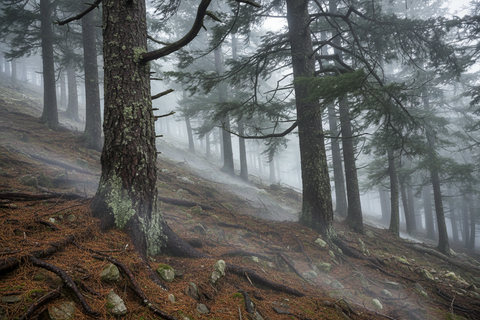
The light over Dorthonion is commonly shown as pale and cold, a low and silvery
brightness that does not warm the land, for the height and its northern position
give it a chill radiance, and between the pines the daylight often seems dim and
distant, as if seen through a veil.
Strong winds sweep across the plateau, unhindered by tall mountains close at
hand, and these winds bend the tree-tops, send dry needles skittering over the
ground, and drive clouds and trailing mists swiftly across the fells, so that
brightness and shadow pass over the land in quick alternation.
Mists and clinging fogs are common in Dorthonion, gathering in the hollows and
folded ground of the uplands, or hanging low between the trunks after rain,
where they blur forms and deepen the natural gloom, and this adds to the land’s
air of secrecy and distance even before the touch of Morgoth’s shadow.
The change of seasons is felt keenly here, for the high air brings harsher
winters with deeper frost and longer snow, while summers, though fair, are short
and mild, so that even in the warmest months there is a freshness and edge in
the wind that reminds all who dwell there that the cold is never far away.
Rivers, Ravines, and Passes: Water and Stone
Around the edges of the plateau many streams rise and small rivers are born, fed
by rain and snowmelt on the high ground, and these waters quickly cut down into
the sides of Dorthonion, carving steep ravines and stone gorges as they hurry
toward the lower lands of Beleriand.
These deep-cut watercourses, along with natural faults in the rock, break the
even line of forest and upland into sudden drops, chasms, and bare cliff faces,
so that the traveler may move for hours under dark boughs and then come at once
to a sheer wall of stone or a yawning cleft where the roots of the land are laid
bare.
Passes across Dorthonion tend to follow the higher, more even fells between
these cuts, but they are narrow and sometimes treacherous, forcing movement into
a few known routes that could be guarded or ambushed, a fact that shaped war and
watch in the days when the princes of the Noldor held the land.
The streams themselves, born in this high, cold place, run with clear, sharp
water that is often icy even in summer, and many of them flow under the shadow
of overhanging pines or between steep, dark banks, where the sound of their
rushing echoes and mingles with the sighing of the trees above.
Homes on the Heights: Halls, Encampments, and Stone
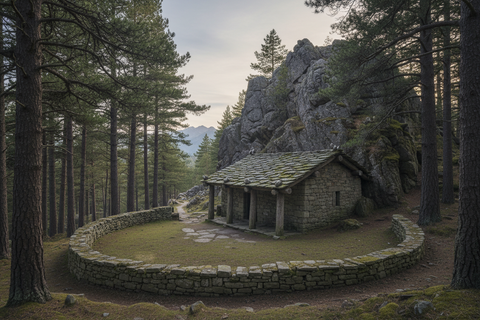
The settlements of Dorthonion were never large or crowded, for the nature of the
land did not lend itself to wide farmlands or busy river towns, and so the halls
and encampments of the Noldorin lords and their people were set in chosen places
on the upland, scattered rather than gathered in deep valleys.
The princes who ruled there, such as Angrod and Aegnor, favored stone-built
strongholds and halls partly hewn from, and partly raised upon, the living rock,
using the cliffs and scarps of the plateau as natural walls and foundations, and
their architecture matched the hard terrain with straight lines, terraces, and
carved steps.
Because the highland weather was harsh, with strong winds and sudden storms, the
sites were chosen and shaped with care, using low roofs, inward-turned courts,
and sheltered courtyards that turned their backs to the worst of the wind, while
still standing close to passes, springs, or vantage points needed for watch and
travel.
Over time, both Elves and later Men left marks upon
the land in the form of stonework half-buried in needles, traces of paved ways,
and small clearings or glades cut into the pine woods, so that long after their
fall one might still find silent ruins and open spaces where once the high folk
of the Noldor walked beneath the trees.
Borders and Neighbors: Where Dorthonion Meets Beleriand
By its very height Dorthonion forms one of the great natural barriers of
northern Beleriand, rising above the neighboring lands and standing as a broad,
stern wall between the plains to the south and the more broken, dangerous
regions nearer to the stronghold of Morgoth in the north.
From the rims of the plateau, watchers could look far, seeing in some directions
the distant shapes of other mountain chains, such as the Ered Wethrin, and in
others the rolling lowlands and river-vales of Beleriand, so that Dorthonion is
both commanding in view and somewhat cut off, like an island of high ground in a
sea of lower country.
The character of the neighboring regions could be read like a map from these
heights: to one side stretched greener, more fertile lands, with wider rivers
and softer woods, while to another lay rougher fells and darker hills, and far
off, beyond all, the shadow of Thangorodrim and the
broken North, setting the stern mood of the frontier.
At its edges, Dorthonion does not end in a single clear line but passes through
zones of change, where cliffs drop and streams burst from the rock into their
first valleys, where the tall pines thin or give way to other trees, and where
travelers feel the land’s tone alter from high, hard upland to either gentler
lowland or more desolate waste, marking its boundaries in stone, water, and
wood.
Taur-nu-Fuin: The Night-Haunted Forest
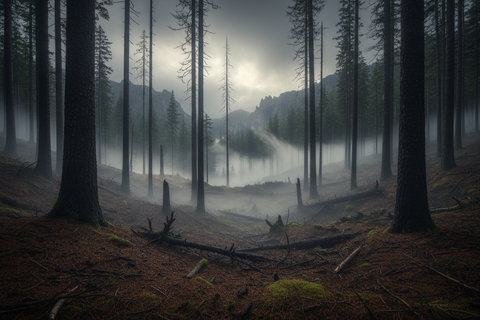
After the great breaking of the Siege of Angband and
the ruin of many realms in the Dagor Bragollach,
Dorthonion fell under the power of Morgoth, and its old name was laid aside as
it became known as Taur-nu-Fuin, the “Forest under Night” or “Forest of Night,”
a grim and haunted place where few dared to tread.
Though the shape of the land remained the same, with its fells and escarpments
and the same great sweep of pine woods, the mood of the place changed utterly,
for in the tales the light that once lay cold but fair upon its heights becomes
almost quenched, leaving deeper shadows among the trunks and a heavy silence
that feels like a weight upon the spirit.
The trees and other plants are remembered as darker and more twisted, their
trunks blackened in memory and their boughs hanging heavy, while mists and foul
vapors creep low among the hollows and cling to the slopes, so that even in day
there is a dim, grey darkness like the edge of a nightmare.
In this later name of Taur-nu-Fuin, the focus is no longer on the pines or the
beauty of the upland but on the smothering gloom that covers it, for the forest
is defined by a sense of unending night, fear, and enchantment, more like a
vast, living shadow than a land open to the clean light of the sky.
Legacy in Stone and Silence: How the Place Reads on the Map
In the maps and commentaries preserved by J.R.R. Tolkien and later set forth by
Christopher Tolkien, Dorthonion keeps its place in the layout of Beleriand as a
high, pine-clad tableland in the north, its outline standing firm even as other
names and details shift in the long history of the author’s revisions.
These later texts often hint at or mention ruined stonework, old roads, and
forgotten clearings, reminders that this stern land was once a guarded realm of
the Noldor, and though it lies in ruin, its ridges, ravines, and broad upper
fells can still be traced by anyone who studies the maps and imagines walking
there in thought.
The double naming of the region, first as Dorthonion and then as Taur-nu-Fuin,
becomes part of its lasting identity, showing how the same geography can bear
very different meanings, as the land itself does not move, but the power that
holds it and the stories told of it shift from high, cold beauty to terror and
corruption.
In the end, when readers remember this place from the Elder Days, they often
recall not single battles or deeds but the strong impression of the landscape
itself, with its endless pines, grey fells, drifting mists, and broken cliffs,
which together form one of the most somber and powerful settings in all the
tales of Beleriand.