
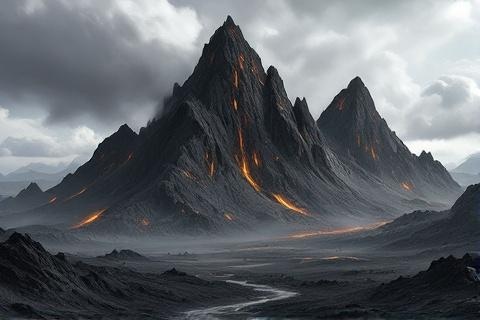
Thangorodrim: The Tyrannous Peaks of Morgoth's Dark Fortress
Unearthing the History of Middle-earth's Most Terrifying Mountain Range
The Tyrannous Peaks — an overview
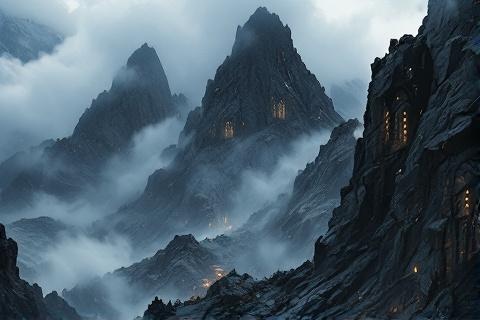
Thangorodrim is described as three huge peaks that rise together in a single,
fused mass above Angband, the secret and terrible fortress of
Morgoth in the far north of Beleriand.
Rather than being a long mountain chain, it is one vast block of tortured rock
with three heads, standing like a crown over the hidden stronghold. The triple
summits give a sense of unnatural design, as if they were shaped on purpose to
stand over the gates of the enemy. In Tolkien’s writings, these peaks are never
far from the idea of Angband itself, and readers quickly learn to connect the
sight of Thangorodrim with the underground pits, prisons, and forges that lie
below. The mountains and the fortress together form one great work of terror,
made to dominate the land and the stories of the First Age.
Again and again, Tolkien describes Thangorodrim as immense, black, and piled up
by Morgoth to cap his stronghold in the north. The peaks are not ordinary
mountains raised by slow natural powers, but a heaving up of broken rock and
slag from the depths of Angband. In The Silmarillion it is
said that Morgoth “threw up great mountains of defense” about his fortress, and
these become Thangorodrim, the dark crown of his power. Their darkness is not
just a matter of color, but also of mood, for they seem burned and blasted, with
no softness of green slope or shining snow. By making the mountains the direct
work of the first Dark Lord, Tolkien gives them a heavy sense of purpose and
cruelty, as if the land itself has been twisted into a weapon.
The presence of Thangorodrim shapes how the north of Beleriand is imagined, for
the peaks stand as a fixed mark on the horizon that characters can see from
great distances. From the plains of Ard-galen in earlier days, or from the later
wasteland of Anfauglith, they rise like a wall against the
sky, always reminding the Free Peoples that Morgoth’s power still endures. Even
from coastal regions such as the Falas, or from the marches of
Dorthonion and Hithlum, the black tips of
the triple peaks can sometimes be glimpsed in clear weather. In this way the
mountains become a constant, oppressive presence, a visible symbol of dread that
anchors many scenes and journeys in the First Age, and a reminder that the
shadow in the north cannot easily be escaped.
Where Thangorodrim stood in Beleriand
Thangorodrim stands in the farthest north of Beleriand, directly above the
hidden halls and iron gates of Angband, which lie tunneled into the roots of the
mountains. The fortress spreads below like a vast underground city of pits,
mines, and armouries, while the peaks rise above it as though they are part of
its outer shell. In Tolkien’s geography this region marks the limit of the
habitable lands for Elves and Men, for beyond
Angband lie only more icy wastes and the northern seas. The position of the
mountains thus marks not only the seat of Morgoth’s strength, but also the edge
of the known world in the First Age. To travel north toward Thangorodrim is to
move closer to the heart of darkness and to the end of all safe roads.
From many regions of Beleriand the triple peaks form a steady landmark that does
not change with the seasons or with the rise and fall of realms. When the
Noldor first return to Middle-earth, they
see Thangorodrim from afar and understand that they have reached the land of
their great enemy. From the broad plains before Angband, which later become the
burning desert of Anfauglith, the mountains tower like a cliff against the
northern sky. Even from as far off as the shores of the Falas,
Círdan and his people know their outline,
and the dark line of the peaks often appears on the skyline in maps and
descriptions of journeys. This constant visibility turns Thangorodrim into a
grim reference point for all who move through Beleriand.
On Tolkien’s maps of the First Age, Thangorodrim serves both as the visible
crown of Angband and as a key marker that helps readers and characters
understand distances and directions. Placed in the upper center of many
reconstructions of Beleriand, the three peaks show where all roads of war and
doom will finally lead. Their position reminds the reader that most of the great
battles against Morgoth were fought somewhere in front of those dark mountains,
on the plains that stretch south from their feet. As a piece of visual design on
the map, Thangorodrim anchors the northern part of the world in the imagination,
just as it crowns Angband itself in the story.
Shape, stone, and the smoking vents
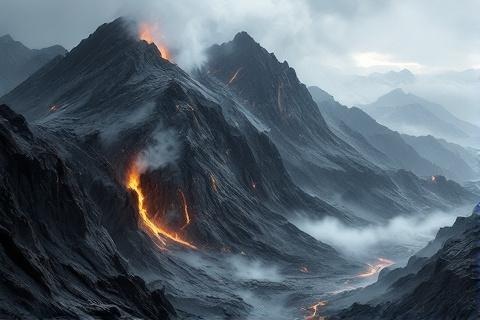
The three summits of Thangorodrim do not stand far apart like separate mountains
in a range, but instead rise together from one massive root, forming a tight
cluster of towering heads. Tolkien’s descriptions give the sense of a single,
compact block of stone, out of which three great peaks thrust upward like claws
or horns. This makes Thangorodrim seem more like a fortress-shaped mountain than
a natural chain, and it adds to the impression of deliberate construction by
Morgoth. The triple form also allows the peaks to be recognized at once, for few
other mountains in Middle-earth share this strange, many-topped outline.
Whenever Thangorodrim is mentioned or drawn, this cluster of three rising points
is one of its most striking features.
The material of Thangorodrim is depicted as black, rough, and cruel, more like
slag and broken ore than smooth cliff or shining crag. In The Silmarillion it is
said that Morgoth cast up mountains as defenses, and readers can imagine him
using the waste of his mines and forges to heap these heights about Angband. The
slopes are hard and sharp, with little sign of weathering or gentle curves.
There is a sense that the stone has been hammered and tortured, not lifted by
slow natural powers. The dark color and harsh texture make the mountains look
dead and fire-scorched, as if no clean snow or green moss ever touches their
sides, and this harshness helps embody the cruelty of their maker.
In several passages Tolkien mentions smoke, fumes, and vapors issuing from the
region about Angband, and it is easy to imagine vents and fissures on
Thangorodrim’s slopes where such clouds and faint fiery glows escape from the
forges beneath. Though he does not give a technical description of each crack
and opening, the image of a mountain under which countless furnaces blaze
suggests that the rock is full of hidden shafts. At times the skies above the
peaks are darkened by reek and smog, hinting at the ironworks and fire pits of
the Balrogs and orcs far below. Through these
unseen vents the mountains seem to breathe out the spirit of Angband, exhaling
smoke and red light that stain the northern sky and deepen the sense of dread
around Thangorodrim.
The outer faces of Thangorodrim are dominated by cliffs, jagged terraces, and
steep ridges, leaving almost no room for gentle slopes or soft soil on the
higher flanks. The rock rises in sudden drops and knife-edged spurs, making
climbing nearly impossible save where Morgoth’s servants have cut paths or
carved steps. Any ledges that exist are narrow and sharp, more like walls and
ramparts than like natural benches. The absence of grass, earth, and snow on
these upper surfaces adds to the impression that the whole mass is harsh and
lifeless. This broken, towering shape turns the mountains into a natural
fortress even before any building-work of Angband is added, and it makes the
peaks themselves seem like a part of Morgoth’s defenses.
The roof over Angband: terraces and hidden gates
The three peaks of Thangorodrim rest directly above the deep halls, prisons, and
armories of Angband, so that much of the fortress lies buried under their
gigantic weight. Tolkien states that Thangorodrim was “thrown up” above Angband,
suggesting that the fortress already existed in some form beneath the ground and
that Morgoth later heaped rock upon it as a shield. The Iron Mountains around
Angband form the broader northern barrier, but Thangorodrim is the most visible
portion, rising like a lid over the greatest pits of Morgoth’s realm. Beneath
this lid stretch miles of tunnels, strongholds, and forges where countless orcs,
Balrogs, and other creatures of evil dwell. The mountains and the fortress thus
form a single system, with the stone serving as both wall and roof for the dark
kingdom below.
Though Tolkien does not give a full architectural plan of Thangorodrim’s upper
reaches, hints in the texts suggest that Morgoth’s servants have cut terraces,
roadways, and outworks into the high slopes. References to the “ramparts” of
Thangorodrim and to approaches to the gates of Angband imply carved paths and
fortified ledges that watch over the plains in front. From these high stations,
orcs and other servants could spy on the lands of their enemies and prepare for
sudden raids and great battles. These man-made, or rather Morgoth-made, features
blend with the natural steepness of the rock, turning the whole mountain front
into a layered defense of walls, ditches, and high platforms. The upper works of
Thangorodrim thus function as both observation posts and barriers that must be
passed before any attacker can even reach the main gates.
Seen from above, the vast mass of Thangorodrim acts like a shielding roof that
hides the true size and shape of Angband from all eyes on the surface. Most of
the fortress lies underground, protected from the sight and weapons of its
enemies by the sheer depth of stone. Forges, breeding pits, and great dungeons
stretch far below, connected by countless passages that twist under the mountain
roots. The weight of Thangorodrim makes any attempt to break in from above seem
hopeless, for the attacker would have to cut through a mountain before even
reaching the upper halls of Angband. This design mirrors Morgoth’s own nature,
for he hides his fears and strengths in secret darkness under thick cover, and
only reveals what he chooses to show through the iron doors and fire-lit gates
at the mountain’s base.
Towers, battlements, and carved stone
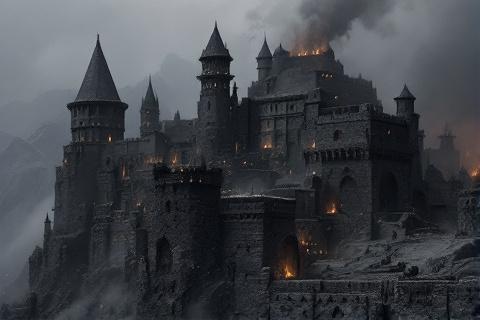
At the top of Thangorodrim’s ridges and along its sharper spines, Tolkien’s
descriptions suggest artificial work in the form of battlements, walls, and
watch-towers cut into the rock. Though he does not give detailed measurements,
the texts often speak of the “walls” and “ramparts” of Angband and its
mountains, which implies a joining of stone and craft. Morgoth’s servants
clearly shaped parts of the outer heights into defensible positions, adding
parapets and fighting platforms where orcs and other creatures could stand
guard. These perched structures complete the impression that Thangorodrim is, in
part, a built fortress as well as a mountain, with the highest lines of rock
converted into a continuous wall of war.
The buildings and defenses on Thangorodrim are presented not as graceful castles
perched lightly on a mountain, but as harsh extensions of the mountain itself,
made of black stone and iron. Tolkien often describes Angband and its works as
iron and steel, rough and unadorned, and it is natural to imagine that the
towers and walls of Thangorodrim are forged and carved to match. They cling to
the rock rather than rise above it, giving the sense that they have grown out of
the dark stone like metal thorns. This union of natural height and crafted
cruelty makes the defenses seem more solid and permanent than ordinary
buildings, and it shows how completely Morgoth has mastered and twisted the land
around his stronghold.
Seen from a distance, the towers and battlements of Thangorodrim do not recall
the fair cities of the Eldar, such as Gondolin or Tirion,
with their shining spires and clear lines. Instead they look brutal and
functional, shaped for war rather than beauty. Many accounts call them dark and
dreadful, with no mention of ornament or grace. Their angles are sharp and
heavy, and they hold no windows to let in light or air, only slits and openings
meant for arrows, spears, and sudden assaults. The construction reflects
Morgoth’s mind, which cares nothing for art or harmony, only for power and fear.
In this way the architecture of Thangorodrim becomes a physical sign of the
moral difference between the Enemy and the Free Peoples of Middle-earth.
From certain approaches, especially across the plains that once were Ard-galen,
the upper walls and outworks of Thangorodrim appear like a row of black teeth or
iron ribs along the skyline. The natural ridges of the mountains, cut and
crowned with battlements, give the whole outline a jagged and threatening look.
When armies of Elves and Men marched to war in the Dagor
Bragollach or the Nirnaeth Arnoediad, these “teeth”
of Thangorodrim loomed ahead, as if the world itself were about to devour them.
Artists and mapmakers often pick up this image, drawing the peaks and their
battlements as sharp, up-thrust bars that bite into the sky. This visual
language reinforces the idea that Thangorodrim is not only a place, but a symbol
of cruel strength ready to strike down all who come near.
A shadow that stretched across the land
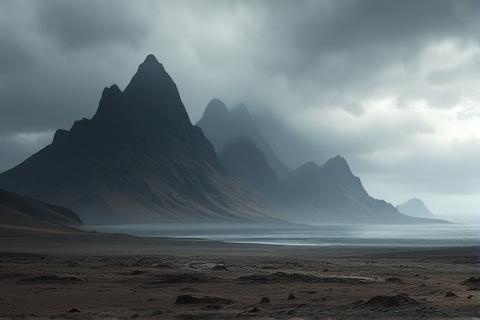
Because of their enormous height and northern position, the peaks of
Thangorodrim cast long shadows over the lands immediately to the south, and the
stories suggest that the regions near Angband are often wrapped in gloom. Even
before the plain of Ard-galen was burned and turned into the slag-field of
Anfauglith, the mountain’s presence made the north feel dark and menacing. After
the Dagor Bragollach, when rivers of fire poured from Angband, any remaining
hint of brightness in that country was swallowed by smoke and shadow. The
spreading darkness that falls from the mountains works as both a physical and
symbolic sign that the reach of Morgoth’s evil stains the land. To stand in
those shadows is to feel cut off from the Light of the West
and from the safer realms farther south.
The triple summits of Thangorodrim break the skyline so completely that from
many coasts and plains in Beleriand they dominate any northern view, even when
seen from far away. On clear days their jagged tops stand stark against the sky,
marking the center of Morgoth’s realm. When the mariners of Círdan sail along
the western shores, or when the riders of Hithlum look northward across the
plains, their eyes are drawn unavoidably to these dark crowns. The mountains
thus control more than just the ground at their feet; they also rule the line
where sky meets earth. This constant intrusion into the view makes the sense of
being watched or threatened by Angband almost inescapable for many of the
peoples of Beleriand.
In Tolkien’s narratives and in later illustrations based on his work, the
silhouette of Thangorodrim is often treated as an emblem of oppression, standing
for the power of Morgoth even when the story is not actually set in the far
north. Characters may remember the sight of the peaks from earlier journeys, or
dream of them as the image of their fears. The triple, jagged outline becomes a
kind of brand stamped upon the mind, linking the physical fortress to themes of
slavery, darkness, and war. When readers encounter the description of those
shapes on the horizon, they understand at once that the shadow of Angband lies
near. In this way the mountains function both as a real landmark in the tale and
as a recurring sign of the unseen evil that weighs on all the lands of the First
Age.
Flora, climate, and the blasted slopes
On the upper slopes of Thangorodrim, the descriptions suggest little or no plant
life, for the rock is bare, burnt, and often dusted with ash from the fires
below. No forests climb these heights, and there are no meadows or streams like
those that soften other mountains in Middle-earth. Instead, the higher reaches
seem dead and hostile, suitable only for the feet of orcs and other servants of
Morgoth. Even lower down, where the land begins to flatten toward the plains,
trees grow thin and stunted, if they grow at all. The natural beauty often found
in Tolkien’s landscapes is almost absent here, replaced by the marks of fire,
smoke, and long years of war.
The climate around Thangorodrim is usually portrayed as cold and harsh, yet also
choked with smoke and winds that carry dust and soot from the endless forges of
Angband. Even before the plain of Ard-galen was burned, the air of the north is
said to be chill and sharp, and after the great battles it becomes fouled by the
reek of burning and the mists of poison. The winds sweeping down from the Iron
Mountains and Thangorodrim are not clean mountain breezes but bitter, laden with
grit that stings the eyes and darkens the sky. Such air is hard to breathe for
those not hardened by life in the pits, and it mirrors the spiritual corruption
that spreads from Morgoth’s realm over the northern lands.
Closer to the base of Thangorodrim the land remains harsh and lifeless, yet
there is a gradual change as one moves farther south and away from Angband’s
immediate shadow. In earlier ages the plain of Ard-galen stretched before the
mountains as a wide, green land, though it lay under the threat of sudden
attack. After it was turned into the burning desert of Anfauglith, even that
fragile life was destroyed near the mountains, and only far to the south did the
land recover its grass and forests. This change from ash and slag at the foot of
Thangorodrim to living countryside in distant regions like Dorthonion, Hithlum,
and East Beleriand shows how Morgoth’s direct influence poisons the soil and air
around his stronghold. The nearer one draws to Angband, the more the world
itself seems wounded and barren.
Names, language, and meaning in Tolkien's words
The name Thangorodrim appears in Tolkien’s major First Age writings, most
notably in The Silmarillion, where it is consistently used for the three mighty
peaks above Angband. It also appears in related texts published by Christopher
Tolkien in The History of Middle-earth, showing that the idea of these mountains
was present in his father’s legendarium from early on, though some details
shifted over time. The constancy of the name attaches a clear identity to the
place, so that whenever readers hear of Thangorodrim, they immediately connect
it with the dark crown of Morgoth’s northern fortress. This unity of name and
image helps hold together the many different episodes that take place across the
long history of the First Age.
Tolkien’s language choices for Thangorodrim and its descriptions give the
mountains a powerful sense of weight, hardness, and cruel domination. In his
invented languages and in English, he often uses words that suggest heaping up,
burden, and tyranny when speaking of Morgoth’s fortress and its crown. Phrases
such as “great mountains of defense,” “reared at his command,” and “iron hells”
link the peaks to images of oppression and forced labor. The very sound of the
name Thangorodrim, with its harsh consonants and heavy rhythm, seems to echo the
clanging of forges and the grinding of rock. Through this careful choice of
words, Tolkien turns the mountains into more than a setting; they become an
active symbol of Morgoth’s crushing rule.
In The Silmarillion, references to Thangorodrim emphasize its dual role as both
a real geographic feature of the north and a powerful symbol of the shadow over
Beleriand. The peaks are mentioned at key moments, such as the return of the
Noldor, the battles of the Dagor Bragollach and the Nirnaeth Arnoediad, and the
suffering of captives like Maedhros, who is hung upon the face of the mountain.
These stories use Thangorodrim to mark physical distance and danger, but they
also use it to show how close or far the Free Peoples are from the heart of
their enemy’s power. Even in the end, when the War of
Wrath brings down the mountains and breaks Angband
forever, the fall of Thangorodrim is described with special force, showing that
its destruction marks the final overthrow of Morgoth’s visible might in
Middle-earth.
How Thangorodrim appears in Tolkien's maps and descriptions
On Tolkien’s surviving maps of Beleriand, Thangorodrim appears clearly in the
northern sector as three close-set peaks, marking the exact surface position of
Angband buried beneath. The triple mountains stand a little south of the full
line of the Iron Mountains, projecting downward into the lands of Beleriand like
a dark spear point. This placement tells the reader that while Morgoth rules all
the far north, his true seat and strongest hold lie under these three peaks. The
maps thus give a visual key for understanding the geography of the wars of the
Jewels and the long siege that the Noldor laid before Angband.
The written descriptions in The Silmarillion and related texts work together
with these maps to fix Thangorodrim in the reader’s mind as a single,
unmistakable feature of the First Age landscape. Travelers often use it as a
reference point, saying that they journey north toward the mountains, or that
they can see the dark peaks far away when the air is clear. Battle-fields, such
as those of Ard-galen and later Anfauglith, are described in relation to their
distance from the feet of Thangorodrim. This steady connection between words and
images makes the mountains feel real and solid, standing in the same place no
matter how the tides of war and time shift around them.
Even when the main action of a story takes place far from Angband, readers
frequently encounter Thangorodrim as a point of orientation or as a remembered
sight from earlier journeys. Characters in Hithlum, Dorthonion, and even beyond
the Ered Wethrin measure their position and danger by how far they are from the
triple peaks. When Fingolfin rides alone to challenge
Morgoth, he rides across the plain directly toward Thangorodrim, and that
terrible silhouette grows ever larger before him. In this way the mountains act
as a constant reference point not only for physical movement across Beleriand,
but also for the movement of the story toward its greatest conflicts, always
drawing the eye and the tale back to the dark heart of the north.