
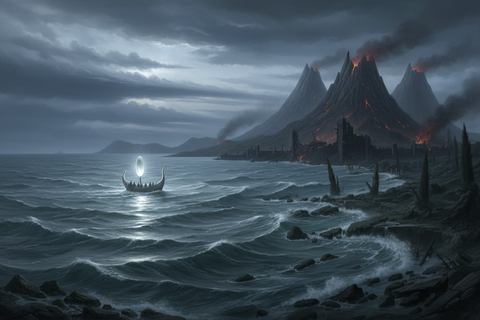
Of the Ruin of Beleriand
Cataclysm and the End of an Age
Introduction: The Last Great Cataclysm
The chapter “Of the Ruin of Beleriand” describes how the long and bitter wars of
the First Age, which began with the return of the
Noldor to Middle-earth, reached their
last and most terrible conclusion in a single, world-changing conflict that no
kingdom could escape. It draws together the scattered struggles of
Elves and Men, the rise and fall of their hidden
realms, and the slow wearing down of Morgoth’s power, until events finally
gather into one final storm. In this account the reader sees how centuries of
siege, betrayal, and endurance end not in a quiet victory but in a vast upheaval
that breaks both the power of the Dark Enemy and the very shape of the land
where the wars were fought.
At the heart of this chapter stands the War of Wrath,
when the Valar at last came forth in open might from the Blessed
Realm to overthrow Morgoth, and in that
coming much of fair Beleriand was broken and drowned beneath
the sea. The tale follows the great host that crossed the sea, the clash with
the armies of Angband, and the ruin that followed when powers
almost beyond the understanding of Elves and Men contended in the North. As
mountains were thrown down and the deeps of the earth were stirred, rivers
changed their courses and coasts collapsed, so that what had been the stage of
the Silmarillion’s earlier tales passed away and a new world-shape emerged from
the wreck.
Because of these events, the story shows not only the fall of an enemy but also
the reshaping of the fate of entire peoples and of the map itself, clearing the
ground for all later Ages of Middle-earth. The destruction of Beleriand
scattered its survivors, drove Men and Elves to new shores, and led to new gifts
and new dooms, such as the rising of Númenor out of the sea
and the founding of Lindon in the West. The Ruin of Beleriand
therefore acts as a great turning point, closing the heroic yet tragic wars of
the First Age and opening the long shadowed history that the reader later finds
in The Lord of the Rings.
Long Years of Loss: How Beleriand Came to Ruin
For many generations before the end, the Noldor, the Sindar, and
the Edain had stood against Morgoth from hidden or fortified
strongholds such as Hithlum in the North,
Nargothrond beside the Narog, Doriath
behind the Girdle of Melian, and the secret city of Gondolin
in the Encircling Mountains. From these places, often unknown to their enemies,
they launched raids, guarded their borders, and held back the darkness that
poured out of Angband. Each realm had its own leaders, customs, and hopes, yet
all alike were bound in a long resistance, trusting in secrecy, courage, and
sometimes in proud confidence that their walls and enchantments would keep them
safe from the Dark Power.
As the years passed, great battles shattered that fragile balance, especially
the Dagor Bragollach, or Battle of Sudden Flame,
when Morgoth broke the long Siege of Angband with
rivers of fire, and later the Nirnaeth Arnoediad, or Battle of Unnumbered
Tears, when a last great union of Elves and
Men was broken and scattered. These defeats not only slew countless warriors but
also burned forests, tore up fields, and filled the land with fire and smoke,
leaving many regions desolate and empty. Refugees fled in wandering bands, and
the once fair and populated lands of Beleriand became scarred with slag-heaps,
fens, and ruin, so that even before the final war much of the country was
already a place of sorrow and loss.
By the time Eärendil the Mariner chose to
risk the ancient Ban of the Valar and sail into the West, many of the fair Elven
realms had already fallen, been betrayed, or sat trapped within tightening
circles of enemies, and the hearts of both Elves and Men were weighed down by
grief. Gondolin had been revealed and destroyed, Doriath had been broken from
within and pillaged from without, and Hithlum lay under the heel of those who
had served Morgoth in battle. Few now believed that the Eldar alone could
overthrow the Dark Enemy, and so Eärendil’s voyage became not a proud venture
but a last attempt born from desperation, when almost all other roads had
failed.
Eärendil's Voyage and the Plea to the Valar
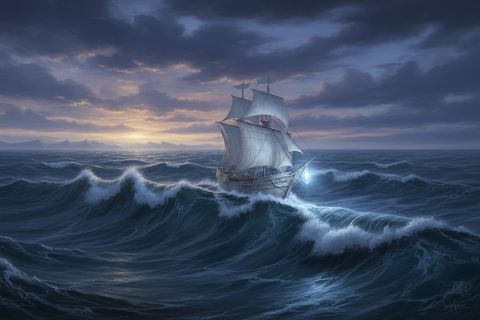
Eärendil the Mariner, descended from both the Eldar and the Edain, built his
white ship Vingilot and at last sailed through many perils into the far West,
bearing upon his brow a Silmaril won by
Beren and Lúthien, so that
its holy light might be his token before the Valar. Again and again he had
turned back from the Shadowy Seas and bewildering enchantments that guarded
Aman, yet in the end the shining jewel gave him passage through shadows and
gloom. In this journey he did not come as a conqueror but as a messenger,
risking his life and the anger of the Powers in order to plead for mercy on
those who still struggled in Middle-earth.
His voyage stands as the final and most daring call for aid after long centuries
of failure, grief, and distrust among Elves and Men, who had often quarreled
amongst themselves even while Morgoth profited by their division. Many embassies
had never been sent, and many prayers had gone unanswered, for the Valar had
chosen to abide in their own land after the great rebellion of the Noldor.
Because of the long chain of broken oaths, needless wars, and proud choices, the
Eldar and the Edain could no longer heal their world by their own strength, and
so Eärendil’s appeal became the last small bridge between the Hither Lands and
the Blessed Realm.
At length, after toil and wandering, Eärendil came to the shores of Aman and
reached Tirion and Valimar, where never before had any mortal
man stood, and there he and Elwing his wife made their plea before Manwë and the
other Valar. The sight of one who was of both Elf and Man, and the story of the
wounds of Middle-earth and the ruin of Beleriand, moved the hearts of the
Powers, who remembered also their ancient charge from Ilúvatar to guard the
world. As a result, the Valar resolved to forgive much of the rebellion of the
Noldor and to send forth a great host to overthrow Morgoth, and Eärendil himself
was appointed to sail the skies with the Silmaril as a sign of hope to those he
had left behind.
The Coming of the Valar: Dawn of the War of Wrath

Because of Eärendil’s plea and the pity it awakened, the Valar gathered their
strength and that of many of the Eldar who had never left the West, mustering a
host greater and more terrible than any force that had yet moved in
Arda, and they resolved at last to carry the war into
Middle-earth itself. No longer would they stand apart while Morgoth laid waste
to Beleriand and twisted both land and living things to his will. Thus began the
War of Wrath, in which the Powers stepped out of their guarded land and came as
open foes to the first Dark Lord, ending the long delay that had forced the
Noldor and the Edain to stand alone for so many years.
The host that came across the sea was vast beyond counting, led by Eönwë, herald
of Manwë, and aided by the might of Ulmo, who had long cared for the waters of
Middle-earth, while in the heights the airs also moved at the will of the Valar.
Great ships crossed on seas tamed for a while from their wildness, and on the
shores and plains of the North they threw back the legions of Orcs
and other creatures that poured from Angband. As they advanced, storms of power
shook the heavens, and the deep places of the earth quaked, so that mountains
cracked and ancient ice and stone were ground under the feet of this host.
Though Morgoth had bred countless Orcs, dragons,
Balrogs, and many other monsters, and though he sent them out
in great waves to drive back the invaders, the might of the Valar and the Eldar
of Aman far outweighed his strength, and his servants were beaten back again and
again. Yet even in their victory, the Valar and their allies wrought great ruin,
for their clash with Morgoth’s power tore at the very roots of the land and
stirred ancient fires beneath the ground. Cities and strongholds were swept away
in the turmoil, and many who had survived long under shadow perished as the
world around them broke apart, so that the triumph came with heavy cost and
sorrow.
The Breaking of Angband and Thangorodrim
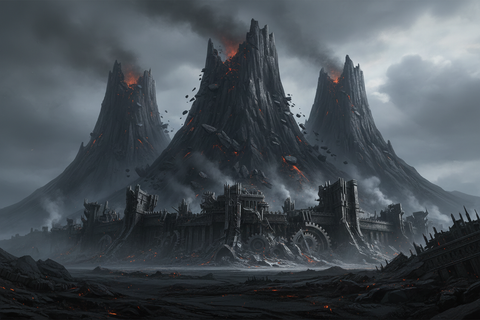
In the end the tide of battle rolled all the way to Angband, Morgoth’s vast
fortress in the North, which for ages had belched forth smoke, fire, and armies
of darkness over Beleriand, and there the host of the Valar laid siege with a
strength that no wall or pit could endure. The iron gates were broken, pits and
mines were found and cleared, and the ancient forges and slave-halls where
countless captives had labored in fear were emptied and thrown down. Long-hidden
horrors were uncovered and destroyed, and the dungeon-kingdom that had once
seemed unassailable was humbled and crushed until nothing of its proud security
remained.
Above Angband had towered the three peaks of
Thangorodrim, great volcanic mountains whose ash and
fumes had darkened the skies and whose very sight from afar brought dread to the
hearts of the free peoples, but in the convulsions of the last struggle these
titanic towers were broken and cast down. The earth groaned and split, and under
the might of the Valar and the downfall of Morgoth’s power, the mountains
crashed into ruin. The toppling of Thangorodrim signaled that no visible sign of
Morgoth’s proud reign would stand, and the memory of their fall remained in
legend as a picture of his utter defeat.
When Angband was laid waste and Thangorodrim shattered, Morgoth himself was
taken, bound in chains once more, and the land that had borne the weight of his
tyranny was left torn and bleeding from the sudden violence that destroyed his
strongholds. The overthrow stripped him of all earthly defense and ended his
direct rule in the world, yet the release of such power and the breaking of such
deep-set foundations sent shockwaves across Beleriand. Hills sank, valleys rose,
and the scars of battle opened old weaknesses in the earth, preparing the way
for the even greater ruin that followed when the seas came in.
The Sinking of Beleriand: Sea and Stone
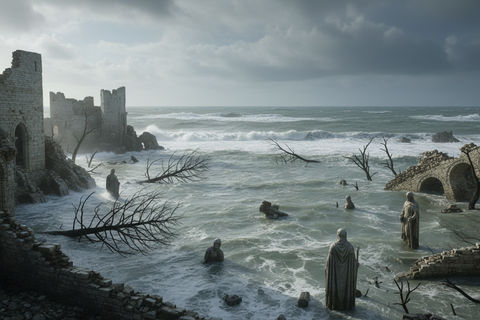
At the close of the War of Wrath, when Morgoth had been cast out beyond the
Walls of the World, the wounds dealt to the land bore their final fruit, and
much of Beleriand began to sink under the rising seas, so that rivers, plains,
and entire regions were swallowed. The great River Sirion, which had once run
wide between green shores and through the hidden vale of its mouths, was drowned
along with the land about it, and many lesser streams vanished altogether.
Familiar paths and crossings disappeared, and the fair landscapes that had
formed the setting of earlier tales in The Silmarillion
were lost beneath the waves, their memory preserved only in song and story.
Not all of the western lands were taken by the sea, for some portions of the far
North and West endured, though often changed by the upheavals that had shaken
their roots. The highlands that would later be known as Lindon remained, though
cut by new bays and inlets, and some islands, broken fragments of the old coasts
and hill-lands, still rose above the waters off the new shoreline. These
surviving pieces of Beleriand became the last visible links to the drowned
country, and on them the remnant of the Eldar and a few of the Edain would later
dwell or pass by on their own journeys over the sea.
The cataclysm sent cities, fortresses, and forests into the deeps, so that
ancient halls like Nargothrond’s caverns and the ruins of hidden realms lay
buried under water, and the tall beeches and oaks of lands such as Doriath were
replaced by the rolling surface of the ocean. Where once there had been leagues
of green country stretching east and west, there now lay a new western
shoreline, jagged and unfamiliar, which would endure into the Second and Third
Ages. Thus the physical memory of the First Age was almost erased from the
world’s surface, leaving only a changed coast and scattered heights to mark
where Beleriand had been.
The Fate of Men: Reward and Dispersal
Among the Edain, the Houses of Hador, Bëor, and Haleth had suffered terribly in
the wars, yet a number of their people survived the Ruin of Beleriand, though
they found themselves bereft of their homelands and long-tilled fields. Those
who had once dwelt in Dor-lómin, Estolad, Brethil, and other
regions saw their lands either drowned, laid waste, or taken by other powers,
and they became wanderers who sought new refuge under the protection of the
Valar’s host or in the few remaining safe lands. Their courage in the shadow of
such loss and their loyalty in the wars against Morgoth became part of their
lasting heritage, remembered even as they left the places where those deeds had
been done.
In recognition of the faithfulness of the Edain, and moved by their great labors
and suffering in the long struggle against Morgoth, the Valar later raised from
the sea a new land for them, the fair island of Númenor in the great western
ocean. This island was given as a gift to be a home and a reward, rich in soil
and beauty, lying between Middle-earth and Aman, though not close enough for the
Edain to reach the Blessed Realm. There the descendants of the Three Houses were
gathered and given a longer span of life and greater knowledge than other Men,
so that Númenor became a new bright hope for humankind after the darkness of
Beleriand’s fall.
Yet not all Men went to Númenor or shared in its gift, for some of the Edain
chose to remain in Middle-earth, either out of need, unwillingness to depart, or
because they were scattered and never came to the summons. These remaining Men
settled in the surviving lands, mingling with other peoples or wandering in
small groups, and from them arose many later lineages, both noble and fallen.
Their memories of the First Age, though fading and often turned into legend,
shaped their tales and customs and would later influence kingdoms such as
Arnor and Gondor, which traced part of their
blood back to those few who had walked in Beleriand before it sank.
Elves, Survivors, and New Havens
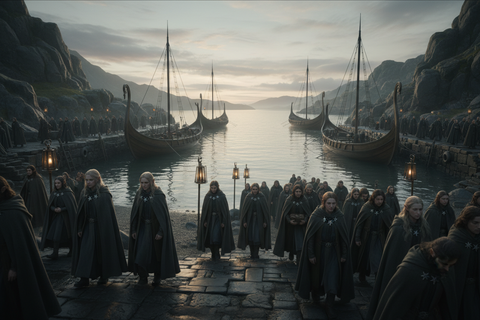
After the War of Wrath, many of the Elves who survived the ruin were gathered at
the new western shores, where harbors and shipyards were made, and from there a
great number were borne over the sea to the West, to Tol Eressëa or directly to
the Blessed Realm. Some went gladly, weary of grief and war, longing at last to
see again the light of the Trees’ reflection in Valinor or to find healing among
their kin who had never left. Ships passed back and forth under the guidance of
Círdan and by the permission of the Valar,
and the first great westward movement of the Eldar from Middle-earth began,
thinning their numbers in the Hither Lands.
Still, not all of the Elves departed, for many were bound by love of
Middle-earth or by duties they would not abandon, and these remained to found
new realms on what land was left, such as Lindon, ruled by Gil-galad, the High
King of the Noldor, with Círdan keeping the Havens. In these places the memory
of Beleriand was especially strong, since from Lindon one could almost look out
toward where the lost lands had once risen above the waves. From such havens,
Elven-ships would later sail both to Númenor and in much later days to the Grey
Havens of the Third Age, keeping open the road between the
fading Elder Days and the later world.
With the drowning of Beleriand and the death or departure of so many princes and
lords, the fabled houses of the Noldor and other Elven kindreds were broken, and
the rebellion that had once driven them back from Aman lost its last great
purpose. Fingolfin, Fingon, Turgon,
Finrod, and many others had already fallen, and
those who remained bore heavy burdens of memory and loss. Some, like
Galadriel, chose to remain in Middle-earth with a
different role, while others returned over the sea bearing both sorrow and
wisdom, so that the proud defiance of the Noldor turned to a humbler
guardianship and a slow fading under the new order of the world.
The Silmarils and Their Final Destinies
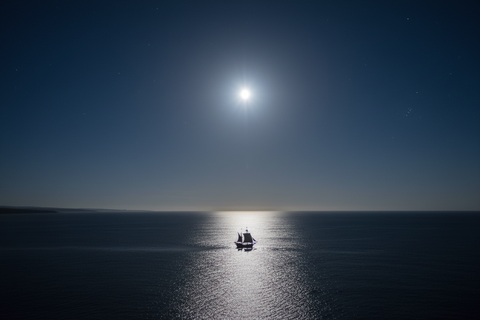
The Silmaril that Eärendil had taken from Middle-earth did not perish in the
tumults but endured, for the Valar, accepting his plea, set him and his shining
ship to sail the skies, and the jewel shone upon his brow as a bright and
unwavering star. This new light, seen by those in Middle-earth as the evening
and morning star, became a sign of hope to Elves and Men, reminding them that
mercy had once answered their call and that the Blessed Realm had not entirely
forsaken them. In the long years that followed, mariners, wanderers, and those
caught in darkness often looked up to the Star of Eärendil and took comfort from
its pure and distant light.
The other two Silmarils remained in Middle-earth and were not destroyed in the
Ruin, but their final histories were filled with sorrow and loss; after the War
of Wrath, Maedhros and Maglor, last of Fëanor’s sons, stole them in a final
attempt to fulfill their dreadful Oath. Yet the jewels burned their unworthy
hands, for by then their claim had become evil, and Maedhros in despair cast
himself and his Silmaril into a fiery chasm in the earth, while Maglor threw his
into the sea and wandered the shores, singing in grief. From that time onward,
one Silmaril lay hidden in the deeps of the earth and the other in the wide
waters, lost to the sight of Elves and Men but still remembered as holy lights
locked away from the world.
Thus the tale of the Silmarils came to its mournful close, bringing to an end
the long chain of oath, treachery, and sacrifice that had shaped so much of the
First Age’s history and had driven the Noldor from Valinor. The jewels had been
the cause of kinslayings, exile, and many battles, and even their final recovery
by Beren, Lúthien, and Eärendil brought both joy and renewed bitterness. With
one Silmaril set in the sky, one buried in fire, and one drowned in the sea, the
story of their making and their loss became a warning about desire and pride,
echoing through later songs as a reminder that not all bright and beautiful
things bring blessing to those who grasp them.
Geography Remade: New Coasts, Islands, and Names

The drowning of Beleriand did more than erase old paths and cities; it changed
the map of the world that later peoples would know, for whole regions vanished
under water and in their place the Great Sea washed new shores. Where a traveler
in the First Age might have crossed long leagues of forest or plain between the
Blue Mountains and the western sea, in later Ages that same
journey would be cut short by bays and gulfs that had never existed before. The
new sea-ways allowed ships to sail where once there had been solid ground, and
from that time forward the western coasts of Middle-earth took on the form
familiar in the tales of Númenor and the Third Age.
Although the land itself was gone, the old names and place-lore of Beleriand did
not completely fade, for Elves in Lindon and elsewhere kept the memory of rivers
like Sirion, Narog, and Gelion, and of passes, hills, and ancient strongholds
that now lay under the waves. In songs, lays, and histories they recorded the
courses of streams, the shape of mountain ranges, and the positions of hidden
cities, so that later lore-masters could speak of them as if they had walked
there themselves. Even when Men heard only echoes or mispronounced names, traces
of that older world lingered, connecting the lands they knew to the drowned
realms beneath the sea.
The western lands that survived, especially Lindon, took on great importance as
the last mainland remnant of Beleriand, while across the sea the island of
Númenor, raised for the Edain, became a dominant power in the Second
Age and a bridge between Men and Elves. From its harbors
Númenórean ships sailed often to the coasts of Middle-earth, including the new
bays and capes that had once formed the edge of Beleriand. Thus the gift of
Númenor and the endurance of Lindon tied the vanished First Age to the unfolding
events of the Second, as memories and alliances reached across both time and
water.
Though the outward shape of the earth had changed, the world continued to carry
signs of the First Age everywhere for those who knew where to look: sunken ruins
under the sea, broken heirlooms and tales among scattered peoples, and above all
the star of Eärendil shining every night in the sky. Some mariners believed they
sailed over the very places where Gondolin or Doriath had once stood, while
certain hills and islands hinted at drowned mountain roots far below. In this
way the changed world was never entirely free of the past, and the visible and
invisible traces of the Ruin of Beleriand reminded all who remembered that
history in Middle-earth stretched back far beyond the borders of their own maps.
Legacy: Why the Ruin Matters in the Legendarium
The Ruin of Beleriand brings to an end the great struggles of the First Age, for
with the War of Wrath concluded and Morgoth cast out into the Outer Void, the
long battles that began with the Flight of the Noldor are finally over, and many
of the heroic houses that had filled those tales meet their doom or depart.
Lineages such as the kings of the Noldor in exile, the rulers of hidden
kingdoms, and the lords among the Edain either fall in battle, pass into the
West, or are scattered in new lands. The story of the Silmarils, which had
driven much of the conflict, also reaches its closure, so that the whole great
web of oaths, quests, and sorrows that define the First Age is drawn tight and
then cut.
At the same time, this ending serves as a beginning, for the conditions of the
Second Age grow directly out of the wreckage left by the Ruin: Númenor rises as
a special reward and testing ground for Men, the Elven havens in Lindon become
centers of wisdom and sea-traffic, and the map of Middle-earth is fixed in a new
form that will persist into later Ages. The survivors of Beleriand carry with
them skills, lore, and memories that shape the kingdoms and alliances of the
future, while the absence of Morgoth as a visible tyrant opens space for other
powers, both good and evil, to emerge. Thus the close of the First Age is also
the sowing of seeds that will later bear both fair and bitter fruit in the tales
of the Second and Third Ages.
Within this story, themes of sacrifice, pride, and doom reach their clearest
expression, for the reader sees how great deeds done in wrath or bound by
unbending oaths can lead to tragic ends even when the original cause seems just.
The Noldor’s rebellion, the Oath of Fëanor, and the
stubborn courage of Elves and Men all produce both moments of shining heroism
and terrible disasters, showing that greatness without humility is perilous. The
Ruin of Beleriand therefore stands as a kind of warning, suggesting that victory
gained through long suffering and pride may still come with a price that no one
intended to pay, including the loss of lands, friends, and even the memory of
once-beloved homes.
Though Beleriand is drowned and many of its peoples are gone, the Ruin does not
pass entirely from the world, for its memory lives on in songs sung in Elven
halls, in the bright star of Eärendil that sailors watch from their decks, and
in scattered tales told around fires in lands that did not exist in earlier
Ages. Even in The Lord of the Rings, echoes of the First Age arise in names like
Gil-galad, in the memory of Númenor’s fall, and in the grief of Elves who
remember more ancient losses. In this way the story “Of the Ruin of Beleriand”
becomes not only the end of a chapter in The Silmarillion but a lasting
background to the whole legendarium, reminding readers that behind every later
event in Middle-earth lies a deeper history of glory, failure, and change.