
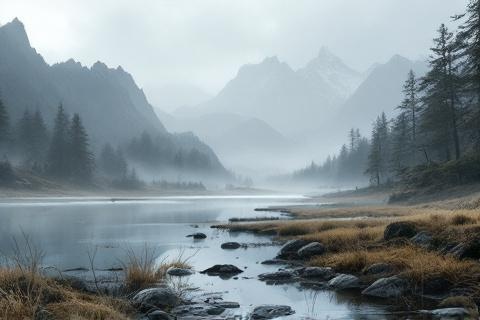
Hithlum: Land of Mist and Shadow
Discover the Lost Noldorin Kingdom of Middle-earth's First Age
Hithlum at a glance
Hithlum is described in The Silmarillion as one of the
chief realms of the Noldor in the far north of
Beleriand, and in the tongue of the Eldar its
name means the “Land of Mist” because of the constant vapors that hang over it
from sea and sky. It becomes the chosen dwelling of
Fingolfin and his people after the Noldor return to
Middle-earth, and from this stern country they wage long
war and careful watch against Morgoth in
Angband. Though it is a land of gloom and chill, it is also a
place of great strength and endurance, and many of the most valiant princes of
the Noldor hold it as their home. The name Hithlum in the lore comes to stand
for both the region and the northern power of the House of Fingolfin during the
long Siege of Angband.
On the maps of the First Age preserved in The Silmarillion and
in Christopher Tolkien’s volumes of The History of Middle-earth, Hithlum lies in
the shadowed north, turned directly toward the Iron Mountains and the dark
fortress of Angband. It stands as a buffer between Morgoth’s realm and the
milder lands to the south, and the Noldor choose it both for its strength of
position and because they desire to keep closest watch on their enemy. The cold
breath of the north sweeps over it, and the region bears the marks of its
nearness to the lands of Morgoth: chill winds, dim skies, and a feeling of
nearness to hidden peril. Even so, it remains firmly outside his power for many
years, a northern shield where the Eldar muster their strength.
The geography of Hithlum is described as low-lying and open, with broad
grasslands and many shallow lakes and pools that collect the waters of the
north. Over these lie the mists that give the land its name, a gray veil that
often blurs the line between earth and sky so that distances are hard to judge.
Far from the greener, more sheltered lands of Doriath or
Nargothrond, its beauty is severe and quiet, marked by the
shifting of fog over water and the soft glimmer of reeds and cold pools. The
unbroken flats, the scattered tarns, and the constant haze together create a
landscape that feels remote and guarded, fitting for the hard war that the
Noldor fight there.
Geography and boundaries
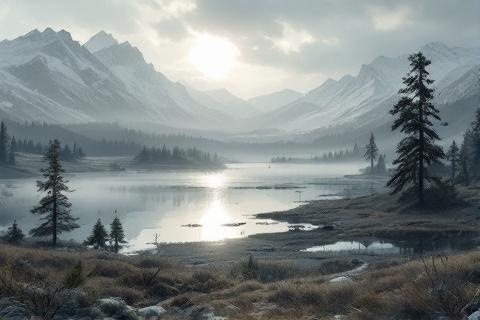
In the tales of the Elder Days, Hithlum is shown as wrapping around the high
northern shores of Beleriand, with its chief inland plain running down toward
Mithrim and the encircling hills. To the west it touches the sea, to the east it
leans toward the plains of Ard-galen, and behind it rise darker highlands that
hide the further north. This position on the northwest of Beleriand gives it
both strength and exposure, for it stands close to Angband yet has access to the
open sea. The Elves who dwell there use its broad reaches to gather and move
their hosts, watching both coast and plain while guarding the passes that lead
south.
The landscape of Hithlum mixes wet and dry, low and high, so that the traveler
passes from level marshy flats to sudden stretches of stony ground and small
wooded rises. Tolkien describes it as a place of cool grasslands, reed-filled
pools, and stands of hardy, dark-leaved trees that cling to better soil in
higher spots. These woods are not deep like the forests of Doriath but more like
broken copses and sheltering groves that give cover from the wind. Along the
coasts, the land grows rough and rocky, with cliffs and boulder-strewn beaches
facing the gray waves, and the people of Hithlum learn to live with a land that
never fully softens.
To the north and northeast of Hithlum rise the cold fortress-lands of Morgoth,
hidden behind the Iron Mountains, so that the rim of the world seems to darken
in that direction, while to the west the land breaks open toward the sea and the
great western waters. The Eldar in Hithlum know that beyond those eastern and
northern horizons lie Thangorodrim and the furnaces of
Angband, and this shapes their watch and their fear. At the same time, the
western opening gives them some hope and a sense of escape, for beyond the sea
lie the lost West and the memory of Valinor. Thus Hithlum
stands between darkness and the faint remembrance of light, exposed to both the
threats of the north and the storms of the western ocean.
Within Hithlum itself lies the notable plain and lake-country of Mithrim, a
central feature of the realm often mentioned in The Silmarillion. Here the great
lake of Mithrim and its surrounding plains break the seeming sameness of grass
and fog, giving the land a kind of broken rhythm of water and shore. The Noldor
encamp first by this lake when they arrive in Middle-earth, and it becomes a
place of mustering and memory for them. The reflective waters, the open fields
around, and the sheltering hills to the north and south make Mithrim both a
landmark and a heartland, tying together the harsher parts of Hithlum with a
slightly softer center.
Climate and the mists
The climate of Hithlum is described as cold and stern, and the tales always
picture it with gray skies and an air heavy with mist and chill. Even in days of
peace and watch, the warmth of the sun seems thin there, struggling through
clouds that hang low over the plains. The air carries the touch of the north,
and the winters bite hard, with hoar-frost on the reeds and ice forming on the
shallower pools. This constant coolness shapes the lives and defenses of those
who dwell there, for they must be ready for long seasons of gloom in which
growing things struggle and fires burn low but steady.
The mists of Hithlum are not only from the sky but also from the sea and the wet
ground, and Tolkien often links the land with the image of fog lying over grass
and water. Sea-borne vapors drift inland along the coasts and spread out over
the flatlands, while damp rises from the many pools and lakes, so that even on
still days a veil seems to hang over the earth. Sound is dulled and distance is
hidden, and riders from the high halls must peer long before they see shapes
moving across the land. This quiet, fog-draped world gives Hithlum an air of
secrecy, as if it hides both its people and their enemies until they are almost
at hand.
Light in Hithlum rarely falls in bright, sharp beams as it does perhaps in
Gondolin or on the slopes of Dorthonion;
instead, it tends toward a pale, even glow that spreads through the mist and
softens shadow. Morning and evening blend into long gray hours in which color is
muted and outlines blur, and even noon may seem like a late, cold day elsewhere.
Shadows in such air are gentle and few, more like dim stains than sharp lines,
and the details of stone, reed, and armor lose their edges. This gives the land
a strange beauty in which everything appears distant and quiet, as if wrapped in
thought, and it matches well the patient, watchful temper of the Noldor who rule
there.
The Plains of Mithrim and waters
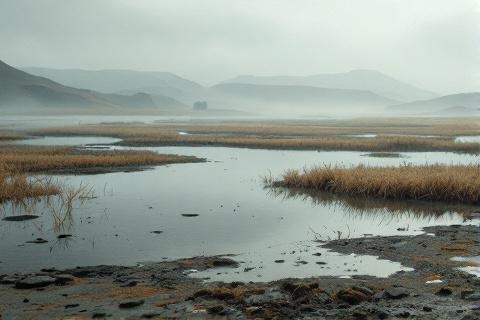
Within this realm lies Mithrim, shown in the legends as a broad, open plain
ringed by hills and dotted with many shallow lakes and reed-choked pools. It is
on these plains that the host of Fingolfin first sets its encampments after
crossing the Grinding Ice, and the wide spaces allow their hosts to spread out
and recover from their terrible journey. The lakes and pools lie scattered like
pieces of broken glass in the grasslands, their wetlands hosting birds and
rushes while the firmer ground between them bears the tents and later houses of
the Noldor. Though the land seems simple at first, those who know it learn the
pattern of firm and soft ground, the safe paths between waters, and the hidden
hollows where one may take cover from the wind.
The lakes of Mithrim are often described as dull and gray, reflecting the
overcast skies above and the distant outlines of the enclosing hills. When the
fog lifts a little, the surfaces of these waters show the dark shapes of
northern ridges and the faint light of a pale sun, but even then they seem cold.
In times of peace, the Elves may look out over these lakes and see calm, but the
tales also remember them as mirrors of sorrow, for the wars of the Noldor and
the coming of Men bring grief to this land. The lakes stand as
silent witnesses, their surfaces holding the faint, blurred images of armor,
banners, and later the ruins that follow defeat.
The shorelines around Mithrim’s lakes and pools are seldom gentle, sandy
beaches; instead they are muddy, stony, or lined with coarse reeds and rushes
that can bear the chill brackish water. Low grasses and tough plants grow where
they can, clinging to soil that is often waterlogged or thin. The Elves and Men
who dwell here must choose their camps and later their houses carefully, placing
them on firmer ground a little raised above the level of the waters. In many
places the wet ground will not hold heavy building, and so the edges of
settlement follow these irregular shores like beads strung along a winding line
of safer land.
Because of the many pools and the sponge-like soil between them, much of
Mithrim’s floor is treacherous to travelers and riders who do not know the ways.
The ground gives underfoot, carts sink, and horses stumble unless they keep to
narrow bands of higher, drier earth, where rock breaks through or old
river-banks stand a little above the plain. Over time the folk of Hithlum learn
to build their camps and roads on these raised mounds and stony hummocks,
turning natural islands in the wet ground into safe places for dwellings,
watch-posts, and paths. This pattern of water and land shapes the daily
movements of armies and messengers, making control of these dry routes a key
part of the defense and life of the realm.
Mountains and the northern outlook
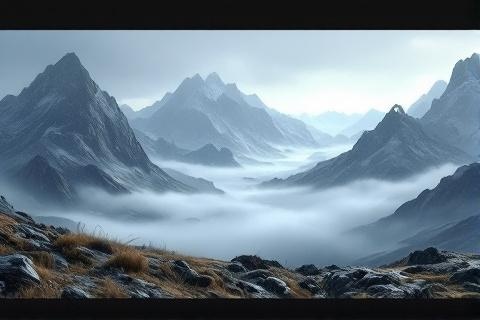
When one looks out from the plains of Hithlum toward the north, the flat horizon
is often broken by long lines of dark, jagged hills and mountains that stand
like a wall against the sky. In the lore these distant heights mark the edges of
the more terrible north, behind which rise the Iron Mountains that hide Angband
and Thangorodrim. Even when cloud or mist covers their upper slopes, the lower
lines of those ridges can often be seen as darker bands beyond the plains and
lakes, reminding the watchers in Hithlum of the dangers that lie beyond. Against
the pale light of the region, these highlands appear even more grim, and they
make the northern sky seem heavy and threatening.
On clearer days, when the winds shift and the low mists draw back for a time,
the silhouettes of the northern mountains grow sharper and more defined, carving
cruel shapes against the cold sky. The watchers in the high halls and on the
hilltop towers can then see the distant peaks more plainly, reading the weather
and looking for any sign of movement from the lands where Morgoth reigns. Such
days are rare and often short, and the Elves know to use them well, for the
coming of new mists may again hide both friend and foe. In these brief hours of
greater clarity the whole mood of Hithlum shifts a little, becoming more tense
as the true outline of the world shows itself beyond the fog.
The mountains and the higher ridges that ring and border Hithlum do more than
mark the horizon; they guide the winds and shape the patterns of light and
shadow that fall across the lowlands. Cold air spills down from the high places,
flowing along valleys and over the plains, bringing sudden gusts and long,
steady breezes that drive the clouds and mists. At times these winds carve lanes
of clearer air through the fog, opening brief views across Mithrim or toward the
sea, and at other times they heap the vapors into thicker banks that swallow the
land. Shadows from the ridges lengthen far out over the flats at morning and
evening, adding to the sense that Hithlum lies under the watch of taller,
sterner guardians.
Strongholds and settlements
Because the lower parts of Hithlum lie so often under mist and damp, the lords
of the Noldor choose high ground and rocky promontories for their strongholds,
seeking places that rise above the fog. Fingolfin and later Fingon establish
their halls and fortresses not in the marshy plains but in the more solid
northern and western uplands, where they can look out across Mithrim and toward
the dark north. These strongholds are not scattered towns but focused seats of
power, each commanding a wide region of open country with small, spread-out
dwellings and camps beneath their gaze. The choice of such sites is both a
matter of defense and of daily life, since higher ground offers drier air and
more reliable footing for stonework.
On these chosen heights the Noldor raise halls and tall watch-towers, often on
exposed ridges where strong winds can strip away or thin the fog, giving clear
views in many directions. The towers serve as eyes for the realm, standing above
the low mists and allowing the watchers to see across Mithrim, out toward the
western coasts, and, as far as they can, toward Angband’s hidden gates. Even
when the plains are lost under gray vapors, riders can signal between these
heights with fires or banners, keeping the defenses linked. The design and
position of these towers show the constant readiness of the Noldor for war and
their wish to leave no blind corner in the lands they guard.
Wherever the ground of Hithlum rises even a little above the wetlands,
settlements gather on that firmer soil, forming clusters of houses and
store-halls along ridges, hilltops, and lake margins. These are not close-packed
cities like Tirion of old but more like small citadels and hamlets, each using
the natural shape of the land to gain advantage. A long ridge may carry a row of
dwellings and barns, while a rounded hill may hold a tight ring of houses around
a central court or tower. Along the better shores of Mithrim’s lakes, piers and
fish-houses stand where the water deepens near solid ground, and boats can be
hauled up away from the mud.
Because of the harsh climate and damp soil, builders in Hithlum favor sturdy
stone and seasoned timber, materials that can resist long winters, steady
moisture, and sudden northern squalls. The Noldor are masters of craft, and
their masons lay thick walls, often sloping or buttressed, to shed water and
stand firm against wind, while their carpenters roof halls with strong beams and
layered shingles or tiles. Doorways are set slightly above the ground on steps
or platforms to keep out the wet, and hearths are wide and deep to provide
steady heat. Over time these buildings take on a weathered look, streaked by
rain and mist, but they remain sound, built more for endurance than for delicate
beauty.
Roads in Hithlum cannot simply cut straight across the plains, or they would
sink and vanish in the marshes, so the folk lay them carefully along the lines
of natural strength in the land. Stone-paved causeways cross the wettest
stretches, raised just enough to stay above standing water, and where possible
the tracks follow the crests of ridges and old riverbanks. In drier seasons the
paths seem like long, narrow spines across the flats, but in times of rain or
flood they may be the only safe routes for riders and wagons. Control of these
roads is vital both for defense and for trade within Hithlum, since whoever
holds them can move swiftly from one stronghold to another while others must
struggle through the bogs.
Rulers and the landscape of power
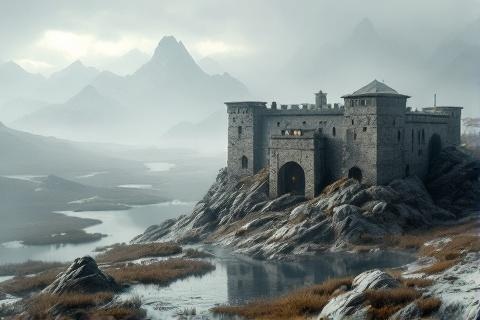
The greatest halls of Hithlum, including the royal dwellings of Fingolfin and
later Fingon, stand on the highest and most defensible ground, looking out over
the endless mists below. From these heights the lords can see the rolling plains
of Mithrim, the flicker of campfires, and the dim line of the northern hills,
and they can send forth riders swiftly along the ridges. These halls are not
hidden like Gondolin but openly visible, symbols of Noldorin strength set like
crowns upon the land. Their position also places them closer to the cold of the
upper air, so that they feel even more the breath of the north, but this is a
price the Noldor willingly pay for clear sight.
Such seats of rule are made not only for dwelling but also for war, and they are
therefore heavily fortified, with walls, towers, and strong gates that can
resist sudden attack. From their battlements the guards keep watch across
Mithrim and toward Ard-galen, looking for signs of movement from Angband or the
lands of their allies. Signal fires can be lit to warn distant settlements, and
courtyards and mustering-fields within the walls give space for gathering
warriors and preparing their arms. In these fortified halls the great councils
of the Noldor are held, where Fingolfin and Fingon plan their watch over Morgoth
and later their desperate strokes against him.
The character of Hithlum itself, stark and unyielding, is reflected in the style
of its houses and halls, which tend more toward austerity and strength than
toward jewel-like richness. While the skill and love of craft of the Noldor
ensure that the buildings are fair, their beauty lies in clean lines, fine
stonework, and careful joining rather than in bright colors or delicate
ornament. Decoration is often carved into the stone in the form of simple knots,
star-patterns, and heraldic devices, echoing the firm and patient spirit of the
people who live there. Inside, the halls are lit by firelight and lamps that
throw a warm glow onto the pale stone, giving comfort in the long gray seasons
outside.
People, craft and daily life shaped by place
The folk of Hithlum, whether Noldor or later the Men of the House of Hador who
serve them, must shape their crafts around a land that is both cold and damp for
much of the year. Carpenters learn to choose and season timber that resists rot,
and they build tight-framed houses that keep out drafts and hold heat.
Stonemasons lay solid foundations that will not sink in soft ground, and they
use drain channels and raised thresholds to turn away standing water. Weavers
and cloth-makers focus on warm cloaks, heavy tunics, and thick blankets,
spinning wool and other fibers into garments that can withstand long hours in
mist and wind.
Where Mithrim’s lakes and the coasts of Hithlum are reachable, fishing becomes
an important part of life, adding to the food that can be gathered from the
sparse fields and flocks. Boats of wood are built with care, sturdy enough to
handle chill lakes and the sometimes stormy coastal waters, and nets and lines
are made for taking fish and other water-creatures. The people also gather reeds
for thatching and for simple craftwork, and they use the lakes as paths for
travel where the shorelines permit. These waters, though cold and often somber,
help sustain the realm, especially in harsh seasons when crops are thin and
herds cannot feed many.
Because the ground is often waterlogged and the winters can be long and gloomy,
the people of Hithlum devote much skill to building secure paths, bridges, and
causeways, and to storing food and fuel. Engineers and road-builders raise long
embankments of stone and earth to carry tracks across boggy ground, adding
culverts to let water pass beneath without eroding the road. Within their halls
and storehouses they keep dried meats, grains, smoked fish, and bundles of
firewood for the dark months when hunting and gathering are poor and travel is
dangerous. These preparations allow the realm to endure long sieges and harsh
seasons, when even the sun seems to forget Hithlum.
Over time, the quiet, misty isolation of Hithlum shapes the spirit of its
inhabitants, encouraging a way of life marked by reserve, endurance, and
self-reliance. Unlike the more merry folk of the warmer southern lands, the
people here grow used to long hours indoors by the hearth, serious councils, and
patient watch. Yet this does not mean that they lack warmth or friendship;
rather, their bonds are deep and tested by hardship, as seen in the loyalty of
the House of Hador to Fingolfin and Fingon. The land itself seems to teach them
to be steadfast and to hold to their oaths, standing firm like the stone ridges
above the mist.
Flora, fauna, and the plain's atmosphere
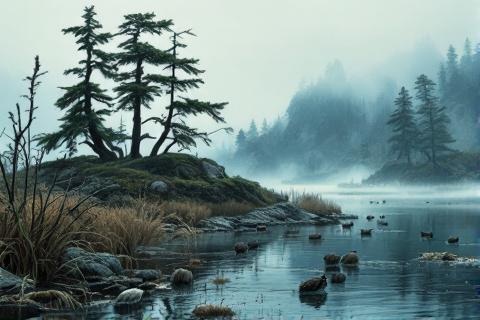
The plants that manage to thrive in Hithlum are tough and suited to cold and
wind, so that the countryside is marked by low, wind-bent conifers, scrubby oaks
and birches, and large beds of reeds around the lakes and marshes. Along the
coasts grow salt-tolerant grasses and hardy shrubs that can cling to rocky soil
and withstand the spray of the sea. In sheltered hollows and on some of the
higher, drier slopes, stands of darker pines and firs give a deeper green to the
land, though they never form the vast forests seen elsewhere in Beleriand. These
hardy growths provide timber, firewood, and limited forage, but the people know
that the land will never be rich in crops without great labor.
The beasts and birds of Hithlum must also endure chill and damp, and so its
wildlife, while not abundant, is well suited to the climate. Waterfowl of many
kinds haunt the lakes and reed-beds, their cries echoing through the mists,
while in the higher meadows and rough uplands hardy grazing animals pick what
they can from sparse grass. Along the shores of the sea and the larger lakes,
wary creatures such as seals or fish-eating birds may be seen, quick to dive or
flee at the approach of Elves or Men. Predators are fewer here than in richer
lands, but wolves and other hunters sometimes come down from the north, drawn by
the herds and flocks kept by the folk of Hithlum.
Under the low roof of mist that so often covers the plains of Hithlum, sound
behaves in strange ways, carrying farther or more clearly than one might expect
in clearer air. The calls of waterfowl, the flapping of wings, and the quiet lap
of waves on stony shores seem louder and closer, while the distant movements of
riders or carts may be heard before they are seen. This amplifying hush gives
the land an eerie stillness, as if it is always listening, with small sounds
standing out against a background of muffled silence. Both scouts and hunters
learn to move with care, knowing that careless clatter can betray them across
half a mile of fog.
To those who walk its paths, Hithlum feels not only bleak in sight and sound but
also intensely physical and close, with every step and touch marked by the
presence of water and cold. Stones and tree-bark are slick beneath the hand,
reeds brush wetly against leggings, and fine droplets of mist cling to hair,
skin, and clothing until they sparkle faintly in any stray light. Armor and
tools must be kept well oiled to resist rust, and fires are treasured for the
dry warmth they bring after long hours in the open. In this way the land
impresses itself on the bodies and senses of its people, reminding them at every
moment of the chill, gray world they inhabit and must master.
Legacy on the map of Middle-earth
When one studies the maps of Beleriand drawn by Tolkien and later published by
Christopher Tolkien, Hithlum stands out clearly as a distinct region in the far
northwest, framed by its plains, its great lake of Mithrim, and the high places
where the Noldor build their strongholds. It is separated from other lands by
both natural barriers and distance: eastward lie Ard-galen and the dreadful
Thangorodrim, southward the more varied lands of Beleriand proper, and westward
the open sea. Within its borders the pattern of lakes, marshes, and ridges gives
it a recognizable form, so that its outline in the stories is as clear as its
political importance. Over and over, tales of councils, musterings, and battles
in the early wars against Morgoth return to this corner of the world.
The essence of Hithlum in the narratives lies not just in its position but in
its mood: a country of grey fog, cold and pale light, and broad, almost empty
plains broken by raised, defensible heights where the strongholds stand. This
sense of openness combined with a few crucial points of strength makes it both a
natural shield against the north and a place of constant watchfulness.
Characters who dwell there, such as Fingolfin, Fingon, and later the Men of the
House of Hador, are shaped by this environment of wide horizons and lonely
bastions, and their courage seems all the greater against such a backdrop. The
mists, the lakes, and the high towers together create an image of solemn
endurance that runs through all the stories set in Hithlum.
After the ruin of Beleriand in the War of Wrath, when
the seas break in and the lands of the north are drowned or changed beyond
recognition, Hithlum as it was in the First Age disappears from the later maps
of Middle-earth. In the tales of the Second and Third Ages the reader no longer
hears of Mithrim or of Fingolfin’s halls, for those places lie beneath the waves
or have been remade beyond the memory of Elves and Men. Yet in the histories
preserved by the Eldar, and in the songs that tell of the fall of Fingolfin, of
Fingon, and of Húrin and his house, Hithlum endures as a remembered land. It
remains a place of mist and shadow in the mind, a lost northern kingdom where
great valor once stood facing the darkness of Morgoth.