
The Breaking of the Fellowship
Division, Temptation, and New Paths
Prologue: The Road to Parth Galen

After leaving the golden woods of Lothlórien, the
Fellowship travels southward by boat along the great River
Anduin, moving steadily toward the agreed meeting place at
Parth Galen below Amon Hen. The company
is smaller now, since Gandalf fell in Moria, and their way
feels less certain even as the current bears them along. They pass between high,
dark banks and shifting shores, often silent as they row or drift, drawing
closer to the point where they must at last choose their road, either toward
Mordor or toward safety. The river becomes both their path and
their barrier, carrying them away from the beauty and protection of Lothlórien
and toward a harsher world. All know that Parth Galen will not just be a
stopping place but the crossroads of their mission and their fellowship. In
Tolkien’s text, this slow river journey lays the quiet groundwork for the coming
break, as they are carried, almost helplessly, toward decision and division.
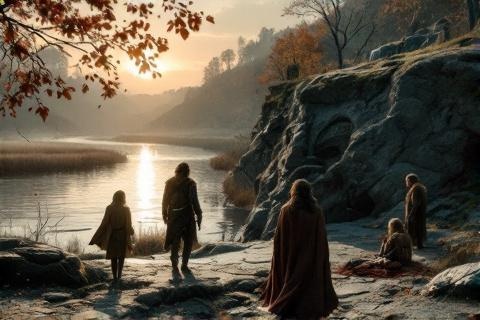
As they near Parth Galen, the landscape shifts into a place of strange beauty
and quiet menace, with the silver-banked Anduin running broad and strong between
wooded slopes and marshy shores. On one side rise low bushes and reedy flats,
where the land seems half-drowned and treacherous, and on the other climb
steeper green knolls crowned with trees. Above all towers Amon Hen, the Hill of
Sight, its slopes covered in forest except for the bare summit, where ancient
stonework gleams pale against the sky. From the river the hill seems to lean
over the water, watching, and the sound of falls and distant waters fills the
air. This setting of smooth river, boggy banks, and looming height creates a
natural stage for the breaking of the Fellowship, with water offering escape yet
also cutting them off from easy retreat.
Though the land appears calm, the mood among the companions is heavy with
weariness, mixed hopes, and a deep, wordless unease. They long for rest after
many days in the boats, their muscles aching and their minds dulled by the
steady effort of rowing and watching. Some hope that at Parth Galen they may at
last turn away from the Shadow and go home or to their own lands, while others
feel the dark East drawing them on. The loss of Gandalf still sits like a stone
in their hearts, and without his guidance doubts have begun to grow. In the
book, Tolkien notes that they delay speaking about their choice of road, and
this silence adds to the sense of strain, since unspoken fears and wishes fester
beneath the surface. Under the peaceful sounds of river and forest lies the
growing tension that will soon break them apart.
Amon Hen: The Hill of Sight

Amon Hen, whose name in Sindarin means the Hill of Sight, is an ancient
watch-hill that stands above the western shore of Anduin opposite its twin, Amon
Lhaw, the Hill of Hearing. At its summit is a high stone seat set on a circular
platform reached by many worn steps, laid there in the days when
Gondor was younger and its northern borders stronger. From this
Seat of Seeing, the Stewards and their captains once looked out over the vast
lands of the realm to guard against enemies and watch the movement of peoples.
By the time of the War of the Ring, the hill and its seat
are half-forgotten, but the power of clear sight that lives there has not wholly
faded. The very name Amon Hen reminds the reader that this is a place meant for
vision and judgment, and that those who climb it may glimpse more than ordinary
eyes can bear.
The summit of Amon Hen is described in the book as a place of broken stonework,
half-ruined yet still impressive, where ancient masons once built with care.
Around the hilltop lies a ring of crumbling parapet, overgrown with grass and
moss, and from its gaps one may look out over woods, river, and distant plains.
The Seat of Seeing itself stands at the center on a high dais, reached by broad
steps cut from the rock, and from there the view commands almost the whole world
around: the curving Anduin, the dimming blue of far mountains, and the hazy East
where Mordor lies. Stony ledges drop away down the hill, where trees cling to
the slopes and paths run twisting through the woods. The height feels lonely and
exposed, filled with winds and wide silence, giving anyone who sits there the
sense of standing between many choices, where the land itself presses on the
mind.
In the lore of Gondor, it is known that one who sits upon the Seat of Seeing at
Amon Hen may perceive things far off with unusual clarity, almost as if the mind
is sharpened by the place itself. Tolkien shows this when
Frodo, still reeling from Boromir’s pressure, climbs
to the summit and, after putting on the Ring, experiences a strange double-sight
that blends the hill’s natural gift with the Ring’s perilous power. He is drawn
there not by clear intention but by a mixture of fear, need, and the silent pull
of a place made for decision, feeling that from such a height he might gain
guidance. The seat seems to promise understanding at a time when everything in
the Fellowship is confused, so Frodo hopes it will help him see the right
course. Yet the clarity that comes is mixed with terror, since to see more in
Middle-earth often means to see the Enemy and the danger
more plainly.
Because of this, Amon Hen becomes not only a geographical location but also a
spiritual testing ground, where the physical vantage point mirrors a deeper
moral crossroads. Frodo’s struggle on the hill is not only with distance and
direction but with the question of who should bear the burden of the Ring and
how. The Seat of Seeing reveals not only lands and armies but also the weight of
choice, stirring in Frodo both hope that he might be guided and fear that he is
already seen by Sauron. The clarity gained there pushes him
to a hard decision: to leave his friends in order to save them and the Quest.
Thus the setting itself aids the trial, for on a hill built for watchfulness and
judgment, the most important judgment of the Fellowship’s journey is made, and
the unseen powers of Middle-earth seem to press upon the hobbit’s heart.
Tensions Within: Small Frictions, Deep Roots
By the time the Fellowship reaches Parth Galen, strain has quietly built up
among its members because of their different aims, their homesickness, and the
constant unseen pressure of the Ring. Some, like Boromir,
feel the urgent need to defend their own countries above all, while others, like
Legolas and Gimli, are caught up in old rivalries and new
loyalties that pull them in several directions at once. The
hobbits long for the Shire even as they bravely
go on, and Aragorn wrestles with doubt about
whether to lead Frodo into Mordor or seek another path. Over all hangs the Ring,
a small object that bends wills and darkens thoughts, even when no one speaks of
it. The company is still outwardly united, but Tolkien lets the reader sense
that their hearts are no longer all turned the same way, and this quiet division
will soon break into action.
The background of each member feeds into this growing tension and shapes what
each believes should happen next. Boromir of Gondor is heir to a Stewardship
that has fought Mordor for generations, so the idea of a weapon that might save
his city haunts him and overwhelms the distant hope of destroying the Ring in
secrecy. Legolas, coming from the Woodland Realm, knows the
spread of shadow in Mirkwood and looks toward the wider struggle of Elves
against the failing of their world, while Gimli, son of Glóin, carries the
memory of Dwarven losses and the stubborn pride of his people.
Aragorn bears the hidden claim of the kings of Númenor,
feeling both the pull of his duty to Gondor and the fear that he might fail if
he takes up that role. The four hobbits bring with them the small, homely
concerns of the Shire, which make the scale of the war seem even more terrible
and far away. These varied histories mean that when they think about the Ring,
they do so through different lenses of duty, fear, and hope.
Exhaustion adds a sharper edge to these differences, and the distant fear of
Mordor, growing stronger as they journey south, makes every small disagreement
feel more dangerous. Long days on the river and many nights with little rest
leave tempers frayed and judgment clouded, so that ordinary worries become heavy
burdens. Boromir’s hints that the Ring should be used no longer sound like
random thoughts but like the opening of a crack in the group’s trust, and
Aragorn’s uncertainty weighs more upon him the nearer they come to the choice of
roads. Even Merry and Pippin, usually light-hearted, feel the gloom and do not
know what future awaits them. Tolkien shows how a great company can be undone
not only by open battle but by Weariness and Fear working slowly within, so that
when the moment of crisis comes, they are no longer strong enough together to
resist. The Breaking of the Fellowship grows from these long, hidden pressures,
not from a single sudden quarrel.
Boromir's Temptation and the Attempt to Take the Ring

Boromir’s change does not happen in a single instant but grows slowly from his
pride in Gondor, his desperation to save his city, and his deep fear of Mordor’s
rising strength. As Captain of the White Tower and heir to Denethor, he has been
raised to see himself as a defender of Men against the Shadow, and
his long journey from Minas Tirith to Rivendell shows his
courage and determination. Yet that same zeal becomes a weakness when he learns
of the Ring, for he cannot accept that such a mighty weapon should not be used
in Gondor’s aid. The memory of Ithilien overrun, of
Osgiliath broken, and of the Great River watched by enemies
drives him to believe that only some sudden stroke of power can save his people.
Tolkien writes him as a noble man under pressure rather than as a villain, so
that the reader understands how the Ring seizes on his fears and turns them into
a craving for control.
The confrontation between Boromir and Frodo takes place in the quiet woods above
Parth Galen, after Boromir has spoken passionately at the group’s council and
then follows Frodo alone. At first he talks calmly of Gondor’s need, but soon
his tone changes, and he begins to argue that the wise course is to take the
Ring and use it as a weapon, rather than cast it away in some hopeless venture.
When Frodo refuses, Boromir’s frustration breaks through his self-control; he
advances on Frodo, calls him foolish, and declares that he will have the Ring.
In the struggle that follows, he seizes at Frodo and knocks him down, and for a
brief, terrible moment he comes close to taking the Ring by force. Frodo’s
terror and Boromir’s wild words show that the Fellowship’s trust has snapped,
even before Boromir fully grasps what he has done.
Frodo’s response in that desperate moment is to slip the Ring on his finger,
vanishing from Boromir’s sight and fleeing up the slopes toward Amon Hen, as
Tolkien describes in careful detail. Once invisible, Frodo does not find safety
but instead feels the Ring’s will pressing harder upon him, pulling his mind
toward the Eye in Barad-dûr. On the Seat of Seeing he is caught in a strange
vision, where he looks far and wide across Middle-earth, seeing armies, lands,
and the dark smoke of Mordor. At last he feels the Eye searching for him, nearly
finding him, and hears the command to surrender the Ring. His terror is so great
that he throws himself off the seat and rips the Ring from his finger, choosing
in that moment to resist the Enemy. This inward battle shows that, even as
Boromir falls outwardly into temptation, Frodo is fighting his own war against
the Ring’s power, alone and shaken.
As soon as the madness leaves him, Boromir is struck with crushing remorse and
shame, realizing that he has betrayed his oath to protect Frodo and endangered
the whole Quest. He calls after Frodo in agony and weeps, and his later words to
Aragorn admit plainly that he tried to take the Ring. Tolkien is careful to show
that Boromir’s fall is not that of a simple villain delighting in evil, but of a
good man twisted by fear and pride, who then repents. This makes his later stand
against the Orcs and his death more moving, because the reader
sees it as an attempt to atone for what he has done. Boromir’s weakness is very
human: a wish to save his homeland quickly, even at a moral cost, and an
unwillingness to trust in patient, hidden courage. The Ring exploits these flaws
but does not erase his basic nobility, so his story becomes a tragedy of
temptation and partial redemption, not a simple slide into darkness.
Frodo's Choice: Alone or Together
After escaping Boromir and feeling almost crushed by the Ring’s power on Amon
Hen, Frodo reaches the painful conclusion that the Fellowship itself has become
too dangerous a place for the Ring. He realizes that even the best of his
companions are not safe from its lure, and that if the company stays together,
the Ring may lead them into quarrels, betrayal, or capture. He also remembers
Elrond’s warning that the Ring must travel in secret and that open war and great
powers cannot protect it. The shock of Boromir’s attack shows him that their
love and courage, while real, are not enough to shield the Ring from its own
corruption. In the quiet after his vision on the Seat of Seeing, Frodo
understands that if he remains with the group, the danger to them all will grow,
and so he must consider a path that seems almost impossible: going on to Mordor
without them.
From this insight comes Frodo’s plan, described clearly in the book, to leave
the others and slip away by boat so that he can travel alone to Mordor. He tells
himself that by going alone he will spare his friends the deadly burden and the
terrible choices that the Ring brings. The thought of parting from
Sam, Merry, and Pippin hurts him deeply, but he
believes that keeping them near will only lead to their suffering or
enslavement, since the Enemy will hunt the Ring-bearer no matter who is with
him. Frodo’s resolve is not harsh or cold; he cries as he thinks of them, yet he
still turns his mind toward the dark road. In choosing solitude, he tries to
live out the counsel given at Rivendell, that the Ring-bearer must walk a path
of secrecy, not of open valor, trusting more in hiding and endurance than in
swords.
To carry out his decision, Frodo turns to secrecy and stealth as his chief
tools, using the hill and the shadows of the river-bank to hide his movement. He
goes down from Amon Hen quietly and circles back toward the boats at Parth
Galen, keeping out of sight among the trees and bracken. In Tolkien’s telling,
he moves with the skill gained on earlier journeys, remembering how Aragorn
taught them to leave little sign of their passing. Once at the water’s edge, he
tries to push off alone, planning to cross to the eastern shore and then creep
southward along the secret ways. He does not announce his departure, call a
council, or demand obedience, because he knows that the others would insist on
going with him. In this way, Frodo turns from the shared counsel of the
Fellowship to the lonely craftiness of a hunted creature, beginning the next
phase of the Quest in quiet, almost unseen motion.
Samwise Gamgee: Loyalty and the Pursuit
Sam discovers Frodo’s absence not by chance but because his heart has been
uneasy, and he has watched his master closely, fearing he might slip away. When
Frodo does not return from his walk, Sam feels a sudden shock and dread, as if a
door is closing before he can reach it. He knows Frodo well enough to guess that
the Ring-bearer might try to break off alone rather than endanger his friends.
Fear of being left behind and of Frodo walking into peril alone stirs him to
immediate action, and he rushes down through the woods, calling and searching,
even when he is not sure where to go. This mixture of terror and stubborn love
drives him more than any great plan or knowledge; he simply cannot bear the
thought that Mr. Frodo might leave without him.
Sam’s steadfastness shines most brightly when he learns, almost by accident,
that Frodo indeed planned to go on alone, and yet he refuses to accept that
plan. At the shore, when he sees the boat moving away, he plunges into the
water, nearly drowning because he cannot swim, just to reach Frodo before the
river takes him. Once Frodo hauls him aboard, Sam speaks with plain, homely
courage, insisting that Frodo is not going to Mordor by himself while Sam can
still help. He reminds Frodo of his promise to Gandalf in the Shire, when he was
caught listening at the window, that he would stick with the Ring-bearer. Sam
does not argue with strategy or speak of high duty; he simply refuses to abandon
his friend. Frodo, moved by this loyalty, relents and accepts that if he cannot
protect his companions from danger, he can at least accept this one companion
freely given.
In the book, Tolkien shows Sam tracking Frodo in his own clumsy yet determined
way, following broken branches and hobbit-sized prints down toward the river,
until at last he bursts through the reeds and sees the departing boat. That
final chase, ending with the two of them reunited in the narrow craft, turns
Frodo’s flight from lonely despair into a partnership of shared resolve. Along
the river path and on the water, their tears and brief argument settle into a
quiet agreement: they will go together into Mordor, trusting not in strength of
arms but in each other’s loyalty. From this point on, the Quest of the Ring is
no longer the charge of a mixed company of great ones, but of one small hobbit
and his gardener, whose stubborn faithfulness becomes one of the central
strengths in the War of the Ring. The breaking of the Fellowship thus gives
birth to a smaller, stronger bond that will endure even into the darkness of
Mordor.
The Capture of Meriadoc and Peregrin

Merry and Pippin, left behind on the western shore when Frodo flees and Sam
follows him, are quickly swept up in the confusion and terror that follows
Boromir’s break and the coming of the Orcs. While they search for Frodo or wait
for news, the attack falls upon them suddenly from the woods above Parth Galen,
as companies of Orcs sent by Saruman and Mordor converge.
In the chaos, the two younger hobbits are separated from Aragorn and the others,
and they find themselves driven through the trees by shrill cries and arrows.
Overwhelmed by noise and fear, they still try to stay together and to remember
what they have seen and been taught since leaving the Shire. Their part in the
Breaking is not chosen but forced upon them by the wild tide of battle that
sweeps down from the hills.
Despite their small size and lack of great weapons, Merry and Pippin put up a
brave struggle against their pursuers, using whatever courage and craft they
have learned. The book makes clear that they are not simply carried off without
resistance; they run, dodge, and even draw swords when they can. Yet the Orcs,
larger in number and far more ruthless, soon overpower them, knocking them down
and binding them hand and foot. Their capture is rough and brutal, and they are
treated as mere baggage, to be dragged away as quickly as possible. Bound and
gagged, they are carried off toward the east and south, away from the river and
into the open lands of Rohan, not knowing whether any of their friends have
survived or will come after them. Their helpless journey begins as one more
bitter result of the Fellowship’s sudden scattering.
The taking of Merry and Pippin forces a hard choice on Aragorn, Legolas, and
Gimli, who discover signs of the attack and must decide whether to search for
Frodo or to chase the captors of the hobbits. Aragorn realizes that they cannot
both guard the Ring-bearer and rescue the prisoners, and when he finds Boromir
dying, the captain’s last words tell him that the Orcs carried off the two young
hobbits. Faced with this knowledge, Aragorn chooses to honor Boromir’s final
struggle and to rescue Merry and Pippin if he can, even though it means letting
Frodo go his own way. This decision breaks any last possibility that the
Fellowship might re-form as a single group. Their unity of purpose gives way to
separate missions, driven by loyalty to different members and by the needs
thrust upon them by events.
In the greater story, the capture of Merry and Pippin becomes far more than a
simple loss, as it draws them into Fangorn Forest and into the paths of
Treebeard and the Ents. Tolkien later shows that their presence among the Ents
helps rouse that ancient race to march against Isengard, a
turning point that weakens Saruman’s power. Their journey as captives leads them
through Rohan’s plains, opening the way for their meeting with King Théoden and
their roles in the war in the West. What begins at Parth Galen as a tragedy and
a sign of the Fellowship’s failure becomes one of the key threads by which the
Free Peoples gain unexpected allies. Thus the breaking of the company scatters
its members into places where they can stir great events that would never have
happened had they all stayed together.
Aragorn, Legolas, and Gimli: The Immediate Pursuit
Aragorn, Legolas, and Gimli, finding signs of the Orc raid and learning from
Boromir’s last words that Merry and Pippin have been taken, decide swiftly to
track the captors rather than search the whole area for the missing Frodo.
Aragorn has glimpsed Frodo’s intention to go alone and understands that to chase
him would only hinder the Ring-bearer’s purpose. Instead, he sees that the two
young hobbits are helpless prisoners in the hands of ruthless enemies, who will
likely kill or torment them if not followed. The three remaining companions
accept that they cannot do everything at once and must choose one thread to
seize. With heavy hearts but clear resolve, they gather what gear they can carry
and set off at once across the slopes and down into the plains, beginning the
long chase that will later earn them the name of the “Three Hunters.”
Tolkien spends careful words describing the tracking skills of the three,
showing that they bring different strengths to the hunt that together form a
powerful team. Aragorn, who has long wandered the wild as a Ranger, reads the
ground like a book, noticing broken blades of grass, faint footprints, and signs
of dragged burdens. The text even mentions his knowledge of smithcraft and lore,
which helps him understand the gear and habits of Orcs as he sees dropped tokens
and abandoned gear. Legolas uses his Elven sight to scan far distances, watching
for movements or smoke on the horizon, and can hear and see in the dark better
than any Man. Gimli, though shorter-legged, has a strong sense for broken earth
and stones, and his endurance in rough places makes him a reliable follower.
Together they interpret the faint marks left by the Orc company as it drives its
prisoners across the land, making decisions without rest or guidance from any
other leader.
The choice to pursue the Orcs at such speed comes with a painful cost, for it
means that the remnants of the Fellowship must accept their division into
smaller, fighting groups, each with separate goals and hopes. No longer does the
company travel with a single aim of guarding the Ring; instead, these three now
chase after friends in peril, while Frodo and Sam bear the Ring alone toward
Mordor. The idea of a single, united Fellowship of Nine is broken and cannot be
repaired. Aragorn in particular feels the grief of this, since he was bound by
his word to protect Frodo, and yet he must now let the Ring-bearer go where he
himself cannot safely follow. This shift from one common Quest to many urgent
needs changes the nature of the story from a shared pilgrimage to a set of
intersecting journeys.
From the first days of the chase, there are signs that their pursuit will lead
them far across Middle-earth and into broader conflicts than they first
expected. They pass from the wooded slopes of Emyn Muil out
onto the green fields of Rohan, a kingdom they have only heard about until now,
and see smoke and signs of war already spreading. Orc tracks and the marks of
many feet hint that Saruman’s forces are moving in strength, not only after the
hobbits but against the People of the Horse. The three hunters begin to realize
that their rescue mission is bound up with the coming battles between Rohan and
Isengard, and that they are being drawn into the wider war of the Ring. What
began as a desperate run to save two small hobbits becomes the path by which
Aragorn will meet King Théoden, claim his lineage more openly, and step onto the
stage of great events that shape the fate of Men.
Boromir's Death and the Funeral on the Great River

Boromir’s last stand takes place on the wooded slopes above Parth Galen, where
he faces the onrushing Orcs in defense of Merry and Pippin. After his earlier
fall into temptation, he returns to the role of protector, blowing his great
horn to call for aid and standing between the hobbits and their attackers.
Tolkien describes him fighting bravely, slaying many enemies around him, even as
more pour in from the trees. He shields Merry and Pippin as long as he can, but
the Orcs close in and the hobbits are eventually overwhelmed and dragged away.
Boromir, pierced by many arrows, collapses at last, surrounded by the bodies of
foes he has slain. His resistance does not save the prisoners, yet it shows that
his heart has turned back to his first duty, to guard the weak, and his courage
in this final battle redeems much of his earlier failure.
When Aragorn, Legolas, and Gimli at last find Boromir, he is sitting with his
back to a tree, his sword still in his hand, and his body riddled with
black-feathered arrows, while the broken horn of Gondor lies by his side. The
sight moves them deeply, and Aragorn kneels by his friend as Boromir speaks his
final words. With failing breath, Boromir confesses that the Orcs took the
halflings and admits that he tried to take the Ring from Frodo, crying that he
has failed. Aragorn comforts him, saying that he has conquered and few have
gained such a victory, and promises that Minas Tirith shall not fall. In this
brief exchange, Boromir’s guilt and Aragorn’s forgiveness mingle with the sorrow
of a fallen comrade. His death strengthens Aragorn’s resolve and marks the end
of an old order in Gondor, making space for the return of the king.
The funeral of Boromir is one of the most solemn and moving scenes at the river,
as the three survivors prepare his body with honor and set him adrift on the
Anduin. They wash his wounds, lay him in one of the Elven boats from Lothlórien,
and array him with his sword at his side and his cloven horn at his feet. They
pile his lap with the weapons of the Orcs he slew, so that his enemies will go
with him into the West as a sign of his valor. Then they push the boat out into
the current, and it glides away, turning slowly as it is carried down between
the green banks, until it passes out of sight, still upright and noble. This
quiet act of farewell allows Aragorn, Legolas, and Gimli a moment of grief and
reflection amid the rush of events, and gives Boromir a burial fitting his rank
and courage. Later, in Ithilien, Faramir will see the boat drifting down to the
sea, learning of his brother’s fate through this strange river-borne message.
This scene at the river connects directly to Tolkien’s larger themes of
redemption and the heavy cost of pride, for Boromir’s end shows that a person
may fall and still rise again through repentance and self-sacrifice. His earlier
insistence on using the Ring to save Gondor came from both love and pride in his
people, yet that pride blinded him and opened him to the Ring’s whisper. In
defending Merry and Pippin to the very last, he spends his life to protect the
weak instead of seeking power for himself. The high words Aragorn speaks over
him, and the honor the company gives his body, mark that his true nature was
noble, even if he stumbled. Tolkien seems to say through Boromir that even the
greatest of Men are flawed, and that the road back from failure runs through
confession, courage, and a willingness to die for others. The cost is terrible,
yet the memory of Boromir’s stand becomes a spur to his companions as they face
their own temptations later in the tale.
Wider Consequences: Military and Moral Ramifications
With the Fellowship broken and its members scattered, Sauron and his servants
must now contend not with a single company carrying the Ring, but with several
different groups moving in various directions and stirring resistance on many
fronts. Although Sauron does not at first know where the Ring has gone, his
enemies have spread in such a way that they threaten his plans in many places:
in Rohan, in Gondor, and even in his dealings with Saruman. Frodo and Sam slip
eastward toward Mordor, hidden from his gaze, while Aragorn, Legolas, and Gimli
draw attention with their bold movements across Rohan. Merry and Pippin, carried
into the affairs of Isengard and Fangorn, help awaken powers that Sauron has
neglected or overlooked. The dark lord may have wished for the Ring-bearer to be
isolated, but the scattering of the Fellowship actually creates a net of trouble
that weakens the foundations of his strength.
Strategically, the loss of Boromir is a heavy blow to Gondor, since he was both
a mighty warrior and the favored son of Denethor, respected by the people of
Minas Tirith. His death leaves Faramir as the remaining son, one whose gentler
wisdom Denethor does not at first value as much as Boromir’s boldness, leading
to further strain within the Steward’s House. The division of the Fellowship’s
armed strength means that their skills and weapons are spread across several
theaters: Aragorn and his friends bring aid to Rohan and later to Gondor; Merry
and Pippin help in the fall of Isengard; Frodo and Sam carry the true weapon,
the Ring, straight into the heart of the Enemy’s land. This scattering forces
the Free Peoples to fight a more complex war, with no single leader holding all
their power together. Yet it also prevents Sauron from crushing them all in one
stroke, since their efforts emerge in different times and places.
Morally, the breaking of the Fellowship marks a turning point where each
surviving member must accept personal responsibility rather than relying on
group unity or the guidance of a single leader. Frodo must walk into Mordor
without the open support of warriors and wise ones; Sam must decide each day to
keep his promise and continue. Aragorn must lead without Gandalf’s counsel,
embracing his fate as a possible king and captain in a world already aflame with
war. Legolas and Gimli must carry their new friendship into realms where Elves
and Dwarves do not yet trust one another, showing by their loyalty what
reconciliation looks like. Merry and Pippin, separated from their elders, must
grow quickly into roles that require courage, wit, and a willingness to stand up
before kings and Ents alike. In this way, the breaking forces each character to
step forward on a new path, contributing to the War of the Ring through
individual choices that together shape the final outcome.
Origins and Importance: Why the Breaking Happened
The breaking of the Fellowship at Parth Galen has roots that run deeper than the
single scene of Boromir’s temptation, reaching back through the long exhaustion
of the journey, the corrupting influence of the Ring, and the urgent fears that
each member holds for home. Since leaving Rivendell, the company has faced
Moria, the loss of Gandalf, the hard climb and descent through wild lands, and
many nights of uneasy rest. All this weariness gnaws at their resolve and makes
the Ring’s whispers more dangerous. The Ring, carried by Frodo but felt by all
who draw near it, works slowly to highlight every fear: fear of Gondor’s fall,
of Elven fading, of Dwarven loss, of the Shire’s ruin. In the end, the breaking
comes when these hidden burdens become too great to bear together, especially
when no guiding figure like Gandalf stands among them to absorb some of the
strain.
Boromir’s failing can only be fully understood when placed within the cultural
and historical context of Gondor and the Men of the West, who have long resisted
Mordor almost alone. From his youth, Boromir has been told that his city is the
last strong wall against the darkness, that its people must stand firm or all
will be lost. The heritage of Númenor, the pride of the Men of Westernesse, and
the tales of ancient glory feed in him a fierce desire to uphold his house and
his land. When he hears of the Ring, he sees it not as a cursed object to be
cast away, but as a sudden hope, a mighty weapon that might restore Gondor and
strike dread into Sauron. This desire is not evil in itself, but it blinds him
to Elrond’s wisdom and to the danger of trying to master the Ring. In Boromir,
Tolkien shows how noble traditions and a rightful love of country can become
dangerous when mixed with impatience for quick victory and unwillingness to
accept a path of humility.
The place where the Fellowship breaks, Amon Hen, is itself part of the testing,
for as a Seat of Seeing it sharpens both external sight and inward struggle. On
its summit, Frodo’s vision ranges wide, and he sees both the strength of the
Enemy and the frailty of the Free Peoples’ defenses. Such clarity of danger
naturally stirs in him a terrible fear, and in someone like Boromir, the same
clarity of threat would likely feed an urgent desire for any weapon that might
change the odds. Amon Hen becomes the stage where insight and temptation
collide: the hill shows the peril plainly, while the Ring offers a false
solution. The clearer the peril, the stronger the wish for power to escape it,
and so the very quality that once made Amon Hen a wise watch-post now makes it a
dangerous place for the Bearer of the One Ring. The environment and the inner
drama mirror each other, turning the hill into a crucible for choice.
Taken together, these strands show that the Breaking of the Fellowship is both a
tactical disaster in the short term and a vital narrative turning point that
opens new storylines necessary for the War of the Ring to reach its end.
Tactically, the company loses unity, strength, and guidance, and several members
are left wounded, captured, or wandering in hostile lands. Yet from this
scattering arise the journeys that move the tale forward: Frodo and Sam toward
Mount Doom, Aragorn toward the kingship of Gondor, and
Merry and Pippin toward the awakening of the Ents. The disaster forces each
thread of the story to unfold in its own direction, increasing the scale and
richness of the world’s response to Sauron. Tolkien uses this breaking to shift
from a single-quest narrative into a woven tapestry of battles, councils, and
hidden struggles, all of which are needed to bring about the final fall of the
Dark Lord.
Themes and Legacy: Division, Temptation, and New Paths

Across these chapters, Tolkien weaves several major themes: the corrosive lure
of power, the quiet strength of small loyalties, and the surprising way that
division can lead to new and unpredictable sources of hope. The Ring represents
power that promises safety and victory yet eats away at trust and honor, as
shown in Boromir’s fall and in Frodo’s terrible vision on Amon Hen. Against this
stands the steadfast love of characters like Sam, whose loyalty to Frodo matters
more than any grand plan or weapon. The breaking of the Fellowship looks like
failure, yet it allows these small acts of faithfulness to stand out more
clearly. The scattered companions find that hope does not only come from great
councils and mighty armies, but from friendships, promises, and courage shown in
lonely places. In this way, the story suggests that while power divides and
tempts, loyalty and humble love can work quietly to heal what has been broken.
The long-term legacy of the breaking becomes clear as the scattered members of
the Fellowship move into their new roles across Middle-earth. Merry and Pippin,
dragged unwillingly from Parth Galen, end up in Fangorn Forest, where their wit,
curiosity, and hobbit plain-speaking help to stir Treebeard and the Ents to
march against Isengard. Later they stand in Isengard’s ruins before Gandalf and
Théoden, linking the strands of Rohan, Orthanc, and the Shire.
Frodo and Sam, crossing the Emyn Muil and the Dead Marshes, press slowly but
surely toward Mordor, carrying the true heart of the war in their small hands.
Aragorn, following the call of need in Rohan and later in Gondor, takes up his
tests as a leader of Men, from the Hornburg to the Paths of the Dead and the
final challenge before the Black Gate. Each path, set in motion by the sundering
at Parth Galen, proves essential to the defeat of Sauron and the healing of the
West.
In the end, the Breaking of the Fellowship crystallizes Tolkien’s idea that even
when human and hobbit unity seems to fail, the results can still give rise to
courage, sacrifice, and alliances no one could have predicted. The Fellowship
does not march together to the gates of Mordor, but its members carry the memory
of their shared journey into every place they go, shaping their choices and
drawing others to their cause. Their failure to remain as one company becomes
the seed of a greater, more varied resistance, involving Ents, Rohirrim,
Gondorians, and many others. The grief of their parting is real and costly, yet
it is not the end of hope. Through this breaking, Tolkien shows that the road of
goodness is not always smooth or united, but that broken paths can still lead to
victory when walked with steadfast hearts and a willingness to lay down one’s
life for friends and for a world worth saving.