
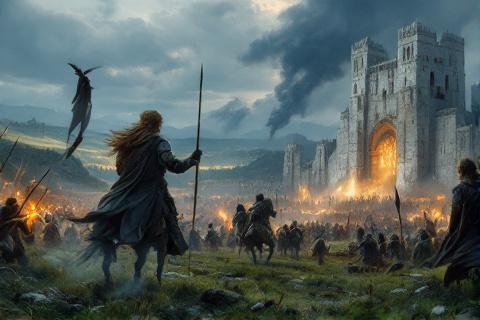
The Battle of the Pelennor Fields
The Turning Point of the War of the Ring
Overview: The Battle at a Glance
In The Return of the King, the Battle of the
Pelennor Fields is told as the great clash before the
walls of Minas Tirith, when Sauron's
armies cross the Anduin and lay siege to the chief city of
Gondor, and all seems close to ruin until help arrives from
Rohan and from the south; the fields that had once been green
and guarded by the Rammas Echor become crowded with siege towers, engines, and
dark hosts, and as the city burns and the Great Gate is broken, the struggle on
the Pelennor decides not only the fate of Minas Tirith but the direction of the
whole War of the Ring, turning a desperate defense into a costly but vital
victory for the West.
The story in the book follows a chain of sharp moments on which hope rises and
falls: first the long siege, with great stones and fire hurled into the city,
then the sudden sounding of the horns of Rohan and the charge of the Rohirrim at
dawn, followed by the death of King Théoden beneath the shadow of the Lord of
the Nazgûl, the astonishing slaying of the Witch king by Éowyn and Merry before
the shattered body of their king, and at last the arrival of black ships upon
the river that seem to bring new enemies but instead reveal
Aragorn and his allies, who land on the Harlond
and sweep into the battle from the south at the last possible moment.
Though the dead are many and Minas Tirith is wounded, the outcome of the
Pelennor fight breaks the might of Sauron's first great stroke, destroys his
chief servant, shatters a large part of his armies, and lifts the siege from
Gondor, which allows Aragorn, Gandalf, and their allies to move from mere
survival to bold strategy and to plan the desperate march to the Black
Gate that will draw Sauron's Eye away from
Frodo and Sam as they
creep toward Mount Doom.
The Setting: Minas Tirith and the Pelennor Fields

Tolkien describes Minas Tirith as a shining White City built upon a great
out-thrust spur of Mount Mindolluin, with seven levels of streets and courts
rising one above another, each surrounded by a high wall and reached by a single
gate that turns from level to level, so that from afar the city seems like a
mountain of stone with its pinnacle crowned by the citadel and the White Tower
of Ecthelion, a place of ancient kings that still holds some of the dignity of
Númenor even in its fading days.
Before the city stretches the Pelennor, a wide ring of land fenced long ago by
the Rammas Echor, where farms, orchards, and small homesteads once lay among
green fields used to pasture horses and cattle and to gather the levies of
Gondor, and Tolkien notes that this plain, though once fair and useful, becomes
in the story a place trampled by marching hosts, where the quiet life of workers
and herds is suddenly crushed under war as surely as crops under iron boots.
Around the outer edge of this ring stands the Rammas Echor, a long earthwork and
wall built in the later days of Gondor to shield the Pelennor and its people,
which the enemy breaches and overruns as the siege advances, so that the
defenders are driven back step by step until they must abandon the outer farms
and retreat to the main city walls while Sauron's engines and legions push up to
the very gate of Minas Tirith.
Tolkien paints the scene of battle with strong images drawn from within the
story world: smoke from burning houses and siege fires drifting across the
fields, dark and scarlet banners of Mordor and its allies
rising against the pale sky, the towers and rams crawling toward the ruined
Great Gate, and the causeway before the gate clogged with wreckage, dead men and
beasts, and broken gear of war, showing how the once ordered road to the city
becomes a blackened and bloodied approach that tells of the ferocity of the
assault.
The Opposing Forces: Armies, Leaders, and Numbers
On the side of Gondor stand the men of Minas Tirith and the nearby regions that
have answered the call, along with the garrison organized under Gandalf's
counsel when Denethor's strength of will fails, and although Faramir returns
with his rangers from Osgiliath sorely wounded and unable to
fight further, their hard delaying action has already bought precious days for
the city, while other companies from outlying fiefs such as Dol Amroth bring
knights and foot soldiers who hold key points of the walls and the main gate as
long as they can.
Sauron's host, drawn from many dark corners of Middle
earth, is described as a huge and mixed army of
Orcs, great trolls, and various Men such as the
Haradrim with their brazen standards and mighty war elephants called mûmakil,
along with Easterlings and Variags of Khand, and they march under Black Banners
and under the unseen will that rules from Barad dûr, driving forward great siege
engines, battering rams such as the dread Grond, and high towers on wheels that
move slowly toward the walls like metal and wood monsters.
Among those who guide the fate of the field are leaders whose choices shape the
battle: Denethor, the Steward of Gondor, whose use of the
palantír sinks him into despair and nearly robs the city
of his command; Gandalf, who becomes in practice the chief defender within the
walls; King Théoden of Rohan and his nephew Éomer, who ride to Gondor's aid and
lead the Rohirrim in their charge; the Lord of the Nazgûl, or Witch king of
Angmar, who directs Sauron's assault and personally comes against the gate and
the king of Rohan; and later Aragorn, who arrives by river with unexpected
allies and turns defeat into sudden victory.
Tolkien never gives a full count of soldiers on either side, and the reader is
instead made to feel the odds through description: the hosts of Mordor seem like
gathering storm clouds or waves that cannot be numbered, while Gondor's
defenders are described as few and weary, their captains forced to make hard
choices at every gate, and until the Rohirrim appear and Aragorn's ships are
seen upon the river, all within Minas Tirith speak as if they face certain
defeat against a foe that has prepared this attack for many years.
The Siege Begins: Sauron's Assault on the White City

The attack from Mordor begins not with a single blow but with long hours of
bombardment, as huge stones and other missiles are hurled over the walls by
catapults and engines, some of them set on fire so that they burst into flame
when they land, and these flaming missiles start many blazes in the city while
Orcs howl and beat drums outside and dark clouds spread from the East to cover
the sun, making the defenders feel as if even the sky has joined their enemy.
At last the Great Gate of Minas Tirith, long thought unbreakable, comes under
direct assault when the enemy brings forward Grond, a monstrous battering ram
shaped like a wolf's head made of steel, hauled by great beasts under the orders
of the Witch king, and after many strokes that shake the city it breaks the gate
in a roar and shower of wreckage, so that Orcs and trolls can pour into the
first level of the city and fierce fighting begins in the lower circles where
the defenders must fall back street by street.
During the mounting crisis Denethor, who has been secretly using a palantír and
has seen a twisted image of Sauron's strength without knowing the whole truth,
sinks deeper into despair and convinces himself that all is lost, and this inner
collapse leads him to abandon command, to order the retreat of the guard from
the gate, and finally to attempt to burn himself and his wounded son Faramir in
the tombs of the House of the Stewards, an act that nearly costs Gondor its heir
and that shows how despair can be as deadly as any sword on the field.
In the midst of this, Gandalf moves tirelessly along the walls and through the
streets, taking over what leadership he can, placing men where they are most
needed, quelling panic with sharp words, and sending swift riders and messengers
to seek news of Rohan and other allies, yet the narrative makes clear that he
fights a delaying battle and that even his courage and wisdom cannot hold the
city forever if help does not come soon.
Théoden, Éomer, and the Riders of Rohan
Far away in Rohan, the call for aid sent by Gondor reaches
Edoras, and Théoden King, now restored in mind and strength
after the breaking of Saruman's power, gathers his
captains, including Éomer and the household guard, to muster the riders, so that
soon the green fields about the city are filled with armed horsemen and their
spears, while standards are prepared and the people who remain behind stand
weeping and singing as they watch their defenders ride away toward an uncertain
fate.
The Riders of Rohan mount their famous horses, small and strong and swift, whose
endurance has long been praised in the tales of the Mark, and as the host moves,
banners ripple in the wind, most notably the royal standard that bears a white
horse running on a field of green beneath a flowing border of gold, while the
sun gleams on bright helms and burnished spearpoints, turning the column of
riders into a moving river of green, white, and gold.
Throughout this mustering and march Tolkien places great weight on Théoden's
renewed leadership and on the spirit of the Rohirrim, who ride not just out of
treaty obligation but out of loyalty and love for their king, and the text shows
Théoden reflecting on age, honor, and the chance to win a last fair renown,
while the songs and words of the riders speak of courage in the face of likely
death rather than hope of easy victory.
The whole movement of this Rohirric host is shaped in the story as a decisive
ride that will strike like a hammer blow at Minas Tirith's enemies, and though
they are delayed by the need to find a hidden path to avoid the enemy's pickets,
their arrival upon the Pelennor is clearly meant by the author to be the sudden
cavalry stroke that breaks the siege at the moment when the city stands nearest
to ruin.
The Charge of the Rohirrim

When at last the host of Rohan reaches the hills above Minas Tirith, they arrive
at dawn and find the Pelennor already filled with the dark mass of Sauron's
armies and the city wrapped in smoke and flame, and then Théoden orders the
riders to form their lines and blows his great horn, and with a cry that rolls
like thunder over the battlefield the Rohirrim charge down the slopes, their
spears lowered, hooves pounding, and for a brief time the plain that had once
seemed as peaceful as parts of the Shire becomes the track of a storm of horses
that sweeps straight toward the ranks of the enemy.
The first shock of the Rohirrim's attack smashes into the outer lines of Orcs
and Southrons, bringing down many and scattering others, and the narrative tells
of Haradrim lords falling before the spears of Rohan and of even the great
mûmakil being forced back or slain amid the confusion, yet the text also admits
that the riders pay dearly for their courage because they are few compared to
the countless troops of Mordor and must keep charging again and again into
hostile lines bristling with spears and arrows.
By drawing so many of the enemy away from the walls of Minas Tirith and forcing
them to turn and face this new threat on the field, the charge of the Rohirrim
gives Gandalf and the defenders within the city a much needed breathing space,
since fewer engines and companies can now be directed against the gates and
lower circles, and Sauron's captains must divide their attention between siege
and open battle in a way that slows and weakens their once steady pressure.
Tolkien lingers in his description on the sight of the Rohirrim riding beneath
their golden banners, with the morning light catching their helms, the green
fields rolling under them, and the king in the forefront like an old yet mighty
warrior of song, and this image of horsemen streaming over the Pelennor becomes
one of the most vivid and beloved passages in the book, echoing older heroic
literature while still feeling fresh and rooted in the world of Middle earth.
The Witch-king and the Fall of Théoden; Éowyn and Merry

As the struggle on the Pelennor deepens, the Lord of the Nazgûl, who commands
Sauron's forces from a great winged creature, swoops over the Riders and over
the city, crying in a harsh voice that can be heard far across the field, and
his presence brings a cold dread that makes many men waver, for he is the Witch
king of Angmar, the chief of the Ringwraiths, and he seeks to
break not only walls but the hearts of those who resist him.
In the midst of the battle, as Théoden rides in the forefront, a great shadow
falls upon him when the Witch king descends, and his mount Snowmane is struck
and falls, crushing the king, and though his men drive back the foe for a moment
and raise his banner again, it is clear that he is dying, and his last words to
Merry and to those about him are full of nobility and regret, making his passing
both heroic and deeply sorrowful.
Near Théoden stands a warrior of Rohan named Dernhelm who is in truth Éowyn, the
king's niece, disguised in armor, and with her is Merry the
hobbit, who has ridden secretly with the host, and when the
Witch king comes against them and speaks proud words about the futility of
resisting him, Éowyn throws aside her helmet to reveal her face and declares
that she is no man, while Merry creeps behind and strikes the Ringwraith with
his barrow blade from the Barrow downs, breaking the spell that shields him and
allowing Éowyn's sword stroke to pierce the unseen sinews and bring him down in
a shattering, unseen death.
This moment fulfills the old prophecy spoken in the book that no living man
would kill the Witch king, since it takes the joined courage of a woman of Rohan
and a small hobbit from the Shire to end his long shadow, and Tolkien uses it to
show that in this war, fate and victory do not rest only in the hands of great
kings and wizards but also with those who seem small or overlooked, whose
steadfast hearts can change the course of events.
Aragorn's Arrival and the Fleet from the South

While the battle rages at Minas Tirith, Aragorn has already taken a more hidden
path to come to Gondor's aid, for he travels the Paths of the Dead under the
mountain with Legolas, Gimli, and the Grey Company of
Rangers, there summoning the Oathbreakers, the Dead Men of Dunharrow who once
betrayed Isildur, and he leads this ghostly host against the corsair fleets of
Umbar at Pelargir, where their mere presence terrifies the sailors so greatly
that resistance collapses and the ships fall into Aragorn's hands.
After dismissing the Dead and freeing them from their curse, Aragorn mans the
captured Corsair ships with allies from southern Gondor, such as the men of
Lebennin and Lamedon, and then sails up the Anduin with a fresh host that is
loyal to the West, steering the black vessels toward the smoke covered fields
before Minas Tirith, so that from the shore the ships at first appear to be new
enemies arriving to complete the city's ruin.
When these ships draw near to the landing place at the Harlond and their banners
suddenly change from the symbols of Umbar to the royal standard of Elendil and
Aragorn himself, the armies of Mordor are thrown into confusion and fear, for
they had expected allies from the south and instead find themselves struck in
the rear by a strong and eager force that charges ashore and falls upon them
while they are already hard pressed by Gondor and Rohan.
In the story Aragorn's arrival is shaped as the last and greatest of a series of
sudden turns, coming when the battle still hangs in the balance, and the
narrative makes clear that his timely stroke not only saves Minas Tirith from
possible ruin but also reveals him more fully as the long awaited king, a leader
who can appear in the blackest hour as a bringer of hope.
The Turning Tide and the Final Push
With the Rohirrim carving their way through the enemy on the field and Aragorn's
men rushing from the Harlond against the rear of Sauron's host, the captains of
Gondor seize their chance, and under leaders such as Imrahil of Dol Amroth and
Éomer they rally surviving companies and push outward from the city gates to
join the fight on the open Pelennor, turning what had been scattered resistance
into a unified counterattack that begins to drive the enemy back.
Sauron's vast army suddenly finds itself caught between the stone walls of Minas
Tirith, from which defenders now sortie with new heart, and the fresh forces
that have landed from the south, while the Rohirrim still harry their flanks,
and this compression breaks the order of his battle, so that many Orcs and Men
try to flee toward the river or back toward the ruined Rammas Echor as the once
steady ranks twist into knots of isolated groups that are overrun and destroyed
in detail.
The result is a rout that ends the siege in a single day, though only after
bitter fighting, and the book tells how great numbers of the enemy fall upon the
fields or are drowned in the river, while others throw down their weapons and
try to escape eastward, leaving their engines and towers smashed or abandoned,
and when the sun finally shines again through the lifting clouds it does so upon
a field heaped with slain and scattered gear, and upon a city that has survived
but is deeply scarred.
Because this victory has crushed the largest assault Sauron has yet launched
against the West, and because his greatest captain has been destroyed and much
of his strength spent, the leaders of the Free Peoples can now consider not just
defense but a desperate offensive, and so they plan the march to the Black Gate
as a feint to draw the Eye, knowing that the true hope still lies far away with
Frodo and Sam, who must use this new distraction to reach Mount Doom and
complete their hidden task.
Aftermath: Burials, the City, and Healing

Once the fighting ceases, attention turns to the dead and wounded on the
Pelennor, and the Rohirrim in particular gather around the body of their fallen
king Théoden, who is laid on a bier with honor, his banner shrouding him, and
though he will later be borne back to Rohan for burial in the tombs of the kings
at Edoras, on the field itself his people sing laments in the tongue of the Mark
and speak of him as a true horse lord who found a noble end in battle after
escaping the long shadow that had clouded his mind.
Within the city, word spreads of the fate of Denethor, whose madness and burning
in the House of the Stewards are seen as a grim but also relieving end to a rule
that had grown harsh and joyless, and while his death is tragic, it removes the
weight of his despair from Gondor, allowing room for new hope, and Faramir,
rescued from the pyre by Gandalf and the faithful Beregond, lies in a deep fever
but lives, preserving the line of the Stewards for a time until Aragorn can
claim the throne.
Among the wounded are Éowyn and Merry, both struck down by the Black Breath and
by their own injuries after the slaying of the Witch king, and they, together
with Faramir and others, are carried to the Houses of Healing, where Aragorn
arrives quietly and uses his royal gift of healing with athelas, fulfilling the
old lore that says the hands of the king are the hands of a healer, and as they
slowly wake and recover, the text suggests that the city itself begins a kind of
healing through their restored spirits.
Though Minas Tirith still bears the marks of fire and battle, with broken gates,
ruined houses, and many graves newly dug upon the Pelennor, the mood after the
victory holds both deep mourning and a strong sense of deliverance, as bells
ring, banners are raised once more on the White Tower, and people speak with
cautious hope of a day when the king will return and the scars of war will fade,
even as they cannot forget the heavy price that has been paid.
Origins and Importance: Tolkien's Writing and the Battle's Legacy
When crafting the Battle of the Pelennor Fields, Tolkien drew on his long study
of ancient and medieval history and literature, especially Northern heroic
stories and Old English verse, and he wove into the siege and open battle a
blend of tactics, heraldry, and personal valor that feels like a real event in a
distant age, yet placed within his own legendarium at a point where many threads
meet, so that the battle becomes not just a spectacle but a moment charged with
the weight of ages in Middle earth.
Readers and scholars have often noticed in the Pelennor scenes echoes of real
world experiences, such as the massive artillery bombardments and siege warfare
that Tolkien knew indirectly through the First World War, as well as older
examples of great cavalry charges and desperate defenses of cities, but in the
story these influences are shaped around constant themes like courage in the
face of overwhelming odds, the danger of despair shown in Denethor, the quiet
heroism of small figures such as Merry, and the bitter cost of even a just war,
which is never hidden behind glory.
Within the larger structure of The Lord of the Rings,
the Battle of the Pelennor Fields marks the highest point of Sauron's open
assault and also the beginning of his decline, since after this he never again
gathers such a host or such confidence, and the victory here allows Aragorn and
the other leaders to gamble on the bold move toward the Black Gate, which would
have been impossible if Minas Tirith had fallen or if the strength of Gondor and
Rohan had been wholly spent.
Literary critics often point to this episode as the central military climax of
The Return of the King because it brings to a head the journeys and inner
struggles of several key characters, including Théoden's return to honor and his
chosen death in battle, Denethor's fall through pride and despair, Éowyn's
search for meaning and her breaking of the Witch king's power, Merry's growth
from shy hobbit to proven warrior of the king, and Aragorn's first clear
emergence as a commanding kingly figure in the eyes of Gondor.
The importance of the Pelennor Fields has carried into later adaptations in
film, art, and fan retellings, where its cavalry charges and duels are often
highlighted, yet the deepest emotional force in Tolkien's original comes not
only from the grand images but from his careful attention to small acts of
bravery, grief, and mercy amid the ruin, reminding readers that even in the
greatest battles it is the choices of individual hearts that give lasting
meaning to victory or defeat.