

Saruman: The White Wizard's Fall from Grace
Power, Betrayal, and the Corruption of Wisdom
Introduction: Why Saruman Matters
Saruman began as the chief of the Istari, the Order of Wizards
sent to Middle-earth, yet by the end of The Lord of the
Rings he stood as a dark warning about how pride can
twist even the wisest being, for he moved from honored counselor and leader of
the White Council to a bitter, broken figure whose voice no longer held power
and whose plans lay in ruins, showing that greatness of mind alone cannot
protect someone who chooses ambition over duty and self over the common good.
His story is shaped by three linked themes that run through the history of the
Third Age: the hunger for power that leads him to rival
Sauron, the betrayal of trust that shatters alliances with
Gandalf, Rohan, and the Free Peoples, and
the corruption of wisdom as his wide learning and sharp intellect slowly bend
away from service and toward control, so that the very gifts that once made him
a defender of Middle-earth become the tools of his downfall and the cause of
much suffering.
This article follows Saruman from his origin as Curumo the Maia
in the service of Aulë, through his work as Saruman the White and head of the
White Council, into his slow moral decline at Orthanc, his defeat in the War of
the Ring, and his petty tyranny in the Shire, and by tracing
this path it aims to show how his character develops, how his choices affect the
wider story, and why his final end, small and spiteful, carries lasting
importance as one of Tolkien’s clearest examples of a great power brought low by
its own choices.
Origins: Curumo, a Maia of Aulë
Long before the Third Age, Saruman began as Curumo, one of the
Maia, spirits created by Ilúvatar, and in the writings gathered in Unfinished
Tales and The Silmarillion he is
said to have been associated with the Vala Aulë, the master of
craft and substance, which meant that from the start he shared something of
Aulë’s love of making and skill with materials, a bent of mind that later showed
in his interest in devices, engines, and the deep lore of the physical world.
When the danger of Sauron grew again in Middle-earth after the downfall of
Númenor, the Valar chose several Maiar to go as the Istari,
the Wizards, and Curumo was one of the first selected, at the bidding of Aulë,
to help the peoples of Middle-earth resist Sauron’s return, not by open force
but by counsel and patient struggle, so that they might rally themselves against
the Shadow instead of becoming dependent on a display of divine power.
Curumo took on the form of an old man and became known in Middle-earth as
Saruman, or Curunír, and he arrived in the West of Middle-earth as a figure of
age and dignity in white robes, walking among Elves and
Men as a traveler and counselor, gathering knowledge, and earning a
place of honor among those who feared the darkness gathering in the East.
His early purpose, as Tolkien explains in the essay on the Istari, was not to
rule others or command armies but to advise, encourage, and teach, accepting the
limits that the Valar placed on the Wizards: they were forbidden to match Sauron
in open power or to bend wills by force, and were instead meant to lead by
example, by wisdom, and by humble service, which makes his later turn toward
domination a clear violation of the mission he once accepted.
Saruman’s Rise: Head of the White and the White Council
Among the Istari, Saruman was named Saruman the White, and in that office he
held the chief place in the Order, a status that led naturally to his becoming
head of the White Council, the group of the Wise that included
Elrond, Galadriel, and later
Gandalf, and in this role he set policy for how they would oppose Sauron, at
first appearing as the strongest champion of open resistance even when he
counseled caution or delay.
His authority rested on more than title, because he was deeply respected for his
mastery of craft and lore, especially those things that touched on the making of
objects, the working of stone and metal, and the studies of ancient devices, and
he spent long years searching libraries and histories so that when he spoke
about the ancient world others often deferred to his judgment, believing his
care for detail and the sharpness of his mind to be a great strength.
Because of this knowledge and his place at the head of the Council, many rulers
of the Free Peoples trusted him and relied on his advice, from the Elven lords
to the Stewards of Gondor, and for a long time he was seen as one of the main
leaders in the struggle against Sauron, which made his hidden change of heart
and secret rivalry with Gandalf far more dangerous when it was finally revealed.
Characteristics: The Voice, Craft, and the Mind of a Maker
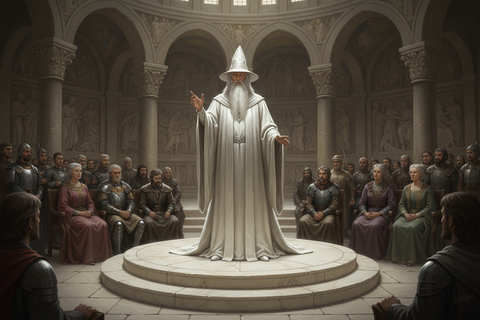
One striking feature of Saruman in The Two Towers is his
voice, which Tolkien describes as smooth and persuasive, changing in tone to
meet the needs of each listener, and this voice could sway councils, calm anger,
and even confuse enemies, so that when he spoke at Isengard
after his defeat, those hearing him felt the pull of his words and had to fight
to remember their own purposes, which shows how his power rested as much in
speech and manipulation as in any outward show of might.
From Aulë he had gained a love of craft and building, and in Middle-earth
Saruman used this bent to become a teacher of arts and skills, taking interest
in the ways of smiths and masons, in the shaping of stone and the forging of
metal, and though these gifts were not evil in themselves, his growing desire to
control all making in his reach led him to twist the crafts of Isengard toward
weapons and engines of war rather than works of beauty or simple use.
Saruman’s hunger for knowledge led him deep into the study of rings, ancient
powers, and guarded lore, and in The Council of Elrond Elrond explains that
Saruman spoke at length about the making of the Rings of Power, even when others
hesitated, which suggests that Saruman had gone further than most in exploring
matters that were dangerous, for in seeking to master secrets that others
feared, he drew close to the very paths Sauron had once taken, although at first
he claimed this was only to understand the enemy better.
Over time, the same intelligence and patience that once served his high office
turned inward and hardened into pride, so that he began to see himself as the
most capable mind in Middle-earth, and he moved from careful planning for the
common good to subtle schemes for his own advantage, counting himself wiser than
the Valar who had set limits on his power and quietly reshaping his plans to
seek the One Ring for himself, showing how slow self-exaltation can corrode even
the strongest duty.
Orthanc and Isengard: The Fortress That Changed
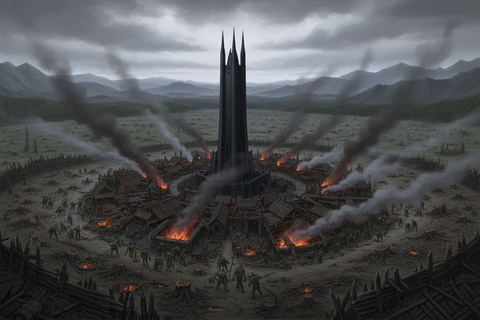
Saruman chose Orthanc as his stronghold, a black tower of incredible hardness
and smooth stone that stood at the center of the ring of Isengard near the
southern feet of the Misty Mountains, and in The Two Towers Tolkien describes it
as a peak of rock shaped long ago by the men of Gondor, unbreakable by ordinary
means, with four sharp pinnacles and walls that even the Ents could not crack,
which made it a symbol of his desire for high, unassailable power.
Isengard was once a fair place with trees, grass, and running water, a green
circle fed by streams, but under Saruman’s rule it was transformed into a
landscape of rings of bare earth, great pits, and furnaces, for he felled the
trees to feed his fires, dug deep into the ground, and turned the once peaceful
valley into a war factory, and when Merry and Pippin describe what they saw, the
reader feels the shock of how far the land has fallen from its older beauty.
Within these pits and halls, Saruman gathered industry and strange devices,
building smithies and workshops where iron and fire ruled, forging weapons and
shaping new defenses of stone and metal in place of the natural defenses of
trees and hills, and in the end Isengard became a place where nature itself was
seen only as raw material for works of power, instead of a partner or gift,
which reflects how Saruman’s mind moved away from harmony with Middle-earth
toward control through force and machinery.
The Palantír: Seeing-stone and the Turning Point

One of Saruman’s greatest tools, and a hidden source of both strength and
danger, was the Orthanc-stone, a palantír or
seeing-stone, which he used to look far across Middle-earth and gather news, and
since the stones were ancient relics of Númenor with great power, his skill in
using it allowed him to gain knowledge more quickly than almost anyone else,
feeding his sense that he could master events by secret watching.
Yet this same stone became the heart of his peril, because at some point Sauron
also gained control of another palantír in Mordor, probably the
one from Minas Ithil that became Minas
Morgul, and through the lawful operation of the stones
their minds met, so that Saruman, who thought to spy on his enemy, instead found
Sauron’s will pressing upon him, offering fear, threats, and hints of alliance,
until his freedom of mind was weakened and his plans began to turn in the
direction Sauron desired.
The long habit of looking through the stone and dealing in secret visions slowly
warped Saruman’s judgment, drawing him away from open counsel with the Wise and
leading him onto a path where he weighed every choice by how it helped him gain
power, and even when he hoped to betray Sauron in the end and take the Ring for
himself he had already become enmeshed in a pattern of thought shaped by the
Dark Lord, which shows how close attention to evil, even in order to master it,
can open a door to corruption.
From White to Many-Coloured: Ambition and New Names

In his famous confrontation with Gandalf at Orthanc, Saruman reveals that he no
longer calls himself White but claims to be Saruman of Many Colours, and he
shows a robe that appears white but changes as it moves into a shimmering play
of hues, which Gandalf rejects as a breaking rather than a deepening of the
white, and this change in name and dress symbolizes his belief that he has gone
beyond simple purity into a clever, complex wisdom that need not follow old
rules.
Saruman’s speech in that scene also makes it clear that he has claimed new
authority for himself, arguing that the old order is over and that the Wise must
now seek power, not only counsel, and he even invites Gandalf to join him in
ruling those they once served, turning the former meaning of his office on its
head, because he now sees himself as above the limits laid upon the Istari and
free to reshape the plans of the Valar according to his own clever designs.
From this new self-image flowed concrete actions: he began to build armed
strength in secret, to fortify Isengard, to send out spies and agents, and to
search for the Shire and the Ring, so that his energy turned from careful
guidance of others to the pursuit of power as a prize, and once he crossed that
line he moved steadily toward open war against Rohan and covert bargaining with
Mordor, seeking a share in the dominion he once vowed to prevent.
Weapons, War, and the Cost of Craft
As Saruman bent Isengard toward war, he bred large and cruel soldiers and
altered strains of Orcs and Men to serve his designs, and in The Two Towers the
Uruk-hai of Isengard appear as stronger, taller Orcs that can move in daylight
and march long distances, which suggests that he experimented with crossing Orcs
with Men or changing their breeding, valuing sheer strength, speed, and
obedience far more than any thought of honor or freedom among his servants.
Side by side with these troops, his workshops and forges turned out weapons,
siege engines, and other devices that replaced the older natural defenses of
woods and dikes, so that where once the circle of Isengard relied on stones and
living trees, now iron, wheels, and fire ruled, and this change reached beyond
his own land, since he armed his agents in Rohan and sent out bands of raiders
with these new tools of war.
The result of all this was a new kind of industrialized threat in the West of
Middle-earth, one that did not merely gather swords and spears but reshaped the
very land to serve war, changing rivers, cutting roads, and burning forests, and
this forced his enemies to change their battle plans, as seen when the Riders of
Rohan must face great masses of marching Uruk-hai and when the Ents find
themselves drawn into war to avenge the harm done to the trees around Isengard.
Downfall: A Short Summary of Events
Saruman’s betrayal came fully to light through his confrontations with Gandalf
and later with the Rohirrim and the Ents, for he first tried to bend Gandalf to
his side at Orthanc, then held him captive on the tower, and later sent armies
against Rohan while he searched for the Ring among the hobbits,
which shows that by this time he was openly fighting to seize power for himself
and to win the Ring either ahead of Sauron or as a bargaining tool against him.
His defeat began when Gandalf escaped Orthanc and rode to Rohan, then when the
Ents, led by Treebeard, marched on Isengard after learning of Saruman’s crimes
against the forests, and during the Battle of the Hornburg and the flooding of
Isengard by the River Isen the chief strength of his armies was broken, after
which Gandalf came to the foot of Orthanc and cast him from the Order and from
the White Council, so that Saruman was left trapped, his staff shattered, his
fortress ruined, and his power over others greatly reduced.
His final end came not with a great last stand but in mean spite, when after
being allowed to leave Orthanc he crept north to the Shire, set himself up as a
petty tyrant called Sharkey, and ruined the land with ugly mills and cruel
rules, only to be overthrown by returning hobbits, and in the Scouring of the
Shire he tried to stab Frodo but was instead killed
by his own servant, Wormtongue, with his spirit
blowing away in the wind, a lonely and contemptible end that serves as a moral
closing note on his long fall.
Legacy: What Saruman Teaches about Power and Wisdom
In the full tale of The Lord of the Rings and the related writings, Saruman
stands out as a key cautionary figure whose life shows that even great
brilliance and learning are not enough without humility, because once he started
to think of himself as the wisest and most necessary of the Wise he became
unable to accept limits, correction, or the idea that others might see more
clearly, and so his clever plans turned steadily toward darkness and
self-destruction.
He also illustrates how knowledge and craft, which can be good gifts, may become
tools of domination when they are used to control others or to reshape the world
only for the sake of power, since his skills in making, breeding, and building
were no longer guided by love of beauty or the good of the land but by
calculation and fear, and this led him to treat people and nature as instruments
to be used, not as partners or fellow creatures.
Because of these themes, Saruman’s story continues to feel close to modern
readers, who see in his industrial Isengard and his cold plans echoes of
technocratic pride, the belief that expertise alone gives someone the right to
rule and to exploit the earth, and in this way his fall works as a sharp warning
about trusting in clever systems and technical power without moral wisdom,
reminding the audience that the misuse of learning can bring great harm both to
people and to the world they share.