
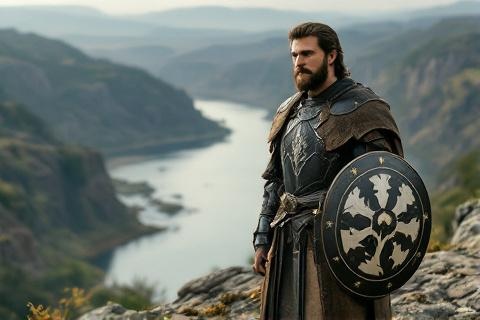
Boromir: The Bravery and Fall of Gondor’s Captain
Duty, Temptation, and Redemption in the Fellowship
Introduction: Who Was Boromir?
Boromir enters The Lord of the Rings as the proud and
valiant Captain of Gondor, the elder son of Denethor II, Steward of Minas
Tirith, and heir to a long line of rulers who hold the
realm in trust. From his first appearance at the Council of
Elrond, he is shown as confident and bold, a man
used to command and to bearing heavy responsibility. He comes not as a wandering
adventurer, but as a representative of a great city under siege, carrying the
weight of Gondor’s needs on his shoulders. Tolkien presents him as a figure of
strength and nobility, but also as someone who feels the pressure of expectation
from his father, his people, and his own sense of honor.
Within the Fellowship, Boromir stands out as one
of the most human figures, both in his virtues and in his weaknesses, with
courage and loyalty that are deeply rooted in love for his city and its people.
He is quick to place himself between danger and the weaker members of the
company, especially the hobbits, and he never forgets that
Gondor stands as the last major defense against Mordor. His
thoughts often return to Minas Tirith, its walls, and its long battle against
the Shadow, which shapes almost every choice he makes. This
strong devotion gives great strength to the Fellowship, yet it also limits his
vision, since he often weighs decisions by how they may help or harm Gondor
first of all.
This article follows Boromir’s story from his noble origins in Gondor through
the shaping forces of his heritage and duty, into the crucial moment when he
falls to the Ring’s temptation, and finally to his act of redemption and his
death. It looks at how Tolkien builds a character who is neither simply villain
nor perfect hero, but a man whose love and fear lead him onto a perilous path.
By tracing his journey, one can see how personal motives, national need, and
supernatural evil all meet in Boromir’s heart. His fall at Amon
Hen and his brave last stand show both the danger of misplaced
desire and the hope that even after grave failure, a person can turn again to
courage and truth.
Origins and Lineage: Númenórean Blood of Gondor

Boromir stands within the ruling house of Gondor, as the elder son of Denethor
II, the last Ruling Steward of Minas Tirith, and thus he is set from birth to
inherit the stewardship of a kingdom without a king. The Stewards hold power in
trust until the rightful king returns, but after many generations they have
become rulers in all but name, and this long burden lies heavily on Denethor and
his sons. As the firstborn, Boromir is his father’s pride and hope, expected to
guard the White City and carry on its hard traditions. This family position
shapes his character, filling him with a sense of duty that is both inspiring
and crushing.
The house of the Stewards descends from the Númenóreans,
those Men of Westernesse who survived the Downfall and brought their high
culture and long lives to Middle-earth, and Boromir’s
stature, strength, and bearing reflect this heritage, even if the blood has
grown thinner over the ages. Tolkien describes the Men of
Gondor as tall and stern, with a memory of their high ancestors
still present in their customs and pride. From childhood, Boromir would have
been taught that his line had once ruled mighty lands and that it must still
stand firm against the Dark Lord. This tradition of service, sacrifice, and
unyielding watchfulness forms the background for all his choices.
For Boromir, Gondor’s unending struggle against Mordor is not abstract history
but the living condition of his life, because he grows up under the shadow of
war and constant alarms from the East. He knows of lost lands like Ithilien and
Osgiliath, of ruined towers, and of black banners seen
across the Anduin, and he hears always of the need for
soldiers, captains, and strong walls. Such a life breeds urgency in him, so that
he sees delay as dangerous and compromise as a potential path to ruin. In this
atmosphere, the idea that Gondor must have every possible advantage, even a
terrible one like the Ring, becomes easier for him to
accept, since to him the cost of failure is the fall of his people.
Appearance and Abilities
In Tolkien’s description, Boromir appears as tall, broad-shouldered, and
powerfully built, with a fair face and proud carriage that show his Númenórean
heritage and mark him as a leader among men. At the Council of
Elrond, he is seen wearing rich yet practical clothing,
with a fur-lined cloak and a great shield, like a man ready for battle even amid
diplomacy. His physical presence is impressive not only for his size but also
for the air of command that surrounds him. This strong body, fit for war and
hardship, reflects the martial life he has led in Gondor’s defense.
Boromir is not only imposing in form, but also one of the most skilled warriors
of his time, trained from youth in the arts of sword and shield, as well as the
craft of leading men in battle. He has seen real war on the borders of Gondor,
unlike some in the Fellowship whose experience is smaller in scale, and he
understands formations, retreats, and raids in a professional way. When the
Fellowship faces danger, he often takes a front position, ready to cut a path
through foes with his great sword and to guard the weaker members. This
practical battle knowledge gives him authority in council, and he naturally
argues for tactics that use direct strength and disciplined force.
Among Boromir’s most important possessions is the famous Horn of
Gondor, a great horn bound with silver and said to
have come from the wild oxen of the north, which has been carried by the eldest
sons of the Steward’s house for generations. He brings it to
Rivendell and declares that he will blow it at need, so that
Gondor may hear, if any of the ancient faith remains and the sound travels far.
The horn is both a symbol of his rank and a living link with his people, since
it has always been a call to rally and to stand firm in battle. When he later
blows it in his last fight, its echo marks not only his need, but also his
unbroken tie to the city he loves.
Boromir’s proud and noble bearing, the way he carries himself as a captain and
heir, draws respect and sometimes fear from others, and it shapes how he relates
to the Fellowship. He is used to command and to having his advice taken
seriously, so he can be impatient when plans do not fit his own ideas of what is
wise or necessary. While his pride is not empty boasting, but rooted in real
service and ability, it still makes him slow to yield and quick to argue,
especially on matters that touch Gondor’s safety. This same noble spirit also
gives him dignity in failure, since when he realizes his error, he admits it
without excuse and turns again to the path of courage.
Duty and Role in Gondor

As Captain of Gondor, Boromir has long led men in defense of the realm’s
borders, holding the fords, ruined cities, and lonely outposts that stand
between Minas Tirith and the power of Mordor. He is described as having won
great victories in the field, and his people look to him as a champion who can
drive back the enemies pressing on all sides. In this role he is more than a
soldier, because he bears the hopes of those who still believe Gondor can
survive and perhaps even regain some of its lost strength. Every order he gives
in battle, every stand he makes, is part of a larger struggle that has lasted
for centuries.
Because his life has been one of siege and warfare, Boromir’s first instinct is
often to think in terms of strength, fortifications, and direct blows against
the enemy, which leads him to seek practical and military answers before
considering other paths. He trusts in walls, blades, and brave hearts, and he is
wary of plans that seem too uncertain or slow. When he hears of the Ring, he
naturally wonders how such a powerful thing might be turned into a weapon that
could break Sauron’s assaults and give Gondor breathing space. This habit of
mind does not come from greed alone, but from years of facing harsh choices
where only force seemed to hold back ruin.
His deep sense of duty to shield Gondor makes it hard for Boromir to accept that
the Ring, which appears to offer immense power, must be destroyed instead of
used, and so he sees it at first as a potential weapon rather than solely as a
deadly snare. At the Council of Elrond, he openly questions the wisdom of
sending it into Mordor without trying to wield it for good, and he thinks of
what it could do if brought to Minas Tirith and placed in the hands of a strong
leader. To him, the risk of leaving such a tool unused seems greater than the
spiritual danger that Elrond and Gandalf warn him about.
This conflict between practical defense and moral peril sets the stage for his
later struggle at Amon Hen.
Joining the Fellowship: Purpose and Tension
Boromir travels to Rivendell not by chance, but because of a strange dream or
vision that came first to his brother Faramir and then to him, which spoke of
seeking the Sword that was broken and Imladris, where
counsel could be found. He rides long and hard, through many perils, to see if
there is help for Gondor, and when he reaches Elrond’s house he brings news of
the battles on the eastern borders and of the growing strength of the Enemy. At
the Council, he listens to the tales of the Ring and the history of Sauron, and
though some of this is new to him, he never forgets why he came, which is to
find aid for Minas Tirith. When he is chosen to join the Fellowship, it is
another burden he willingly accepts for his city’s sake.
Throughout his time in the Fellowship, Boromir consistently argues for using
strength to save his city, and his words are often earnest and plain, showing
how deeply he cares for Minas Tirith and its people. He tries to teach the
hobbits the use of sword and shield, and he advises that they should go first to
Gondor, which he sees as a sensible and safe stronghold. His thoughts return
often to Denethor, to the White Tower, and to the long watch kept on the Black
Land, which makes him eager to reach home with whatever knowledge or advantage
he can bring. Even when others doubt his ideas, it is clear that he speaks from
real love and not simple ambition.
From the beginning, Boromir feels both a growing respect for
Aragorn and a tension over how the war against
Sauron should be fought, since Aragorn is the hidden heir of Isildur and the
rightful king of Gondor, while Boromir is the Steward’s heir. They travel
together through danger, and Boromir comes to recognize Aragorn’s courage and
wisdom, yet still he hesitates to accept him fully, especially when Aragorn
supports the plan to destroy the Ring instead of using it. This mixture of
loyalty and disagreement adds depth to their relationship, because Boromir is
torn between Gondor’s proud independence under the Stewards and the old prophecy
of the king’s return. Their differing views on the Ring and on the road to take
frame some of the most important debates within the company.
Temptation at Amon Hen: The Turning Point

At Amon Hen, the Seat of Seeing above the falls of Rauros, the burden of the
Ring presses heavily on the Fellowship, and its silent call grows stronger,
testing each member in private ways, while Boromir in particular begins to
struggle with a rising inner conflict that he can no longer hide. He grows
restless and uneasy, pacing and speaking more openly about his doubts regarding
the path into Mordor. Tolkien shows his thoughts turning again and again to
Gondor and to the vision of the Ring raised against Sauron’s forces, which makes
his resistance weaker. The lonely and tense setting of the hill, with the
company uncertain and divided, becomes the stage for the Ring’s power to break
through his defenses.
Boromir has come to believe, partly through his own reasoning and partly through
the Ring’s whispering, that this small golden object could be the means to save
Gondor from ruin, and this belief drives him toward the terrible idea of taking
it from Frodo. He tells himself that strong men must
sometimes seize hard choices and that those who refuse to use such a weapon may
be cowards or fools, and in this way he justifies thoughts that once would have
horrified him. As he talks with Frodo, his words become more heated and
desperate, and his longing for the Ring’s supposed power grows into a near
frenzy. In the end, that belief overcomes his honor and pushes him to reach for
it by force.
The scene at Amon Hen marks a turning point in the story, because in Boromir’s
attempt to take the Ring, readers see clearly how even noble intentions can be
twisted by the will of Sauron that is bound up with it, and how love of one’s
people can be turned into a path toward darkness. His honor as a captain and his
love for Gondor do not vanish, but they are overlaid by fear of defeat and by
pride in human strength. Tolkien uses this moment to show that the Ring attacks
each person at their strongest point, offering them what they most desire, and
then urging them to grasp it wrongly. Boromir’s collapse reveals the danger that
faces everyone who comes near the Ring, even the bravest.
When Boromir finally lunges for Frodo and tries to seize the Ring, his act is
sudden and violent, yet Tolkien presents it not as the move of a cold villain,
but as the tragic outbreak of a human heart under too much strain, filled with
fear, hope, and despair. He weeps and rages, speaking wildly of Gondor’s need
and accusing Frodo of selfishness, which shows how far the Ring’s influence has
twisted his thoughts in that brief time. When Frodo vanishes by putting on the
Ring, Boromir is left alone, shocked by what he has done, and almost at once he
begins to come back to his true self. His attempt, while terrible, is rooted in
his love for his city and in his belief that he must do anything to save it,
which makes his fall both understandable and deeply sorrowful.
Redemption and Final Stand

The moment Boromir realizes the shame of trying to take the Ring from Frodo, he
is filled with remorse, and his very next actions show his desire to atone,
because he turns all his strength to finding and defending the hobbits Merry and
Pippin when the orcs attack. Instead of chasing the Ring, he
throws himself between the enemy and the smallest members of the Fellowship,
using his great horn and his sword to draw fire away from them. In this way, he
chooses to act again as the captain and guardian he was meant to be, making his
body a shield for those who cannot protect themselves. His courage in this
moment is not driven by hope of victory, but by a clear wish to make good the
wrong he has done.
Boromir’s last battle is fought on the slopes near Amon Hen, where he stands
almost alone against a host of orcs, including the great Uruk-hai sent from
Isengard, and there he shows the full measure of his warrior
skill and spirit. Tolkien tells that he is filled with arrows but keeps
fighting, slaying many enemies and refusing to flee so long as Merry and Pippin
are still in danger. The sound of the Horn of Gondor rings out through the
woods, a sign that he is resisting to the end and still calling for aid, even if
none can reach him in time. His death is not quick or easy, but the result of a
long stand in which he spends his life entirely for the sake of others.
When Aragorn reaches him, Boromir lies dying among the slain orcs, and in his
final moments he confesses his attempt to take the Ring and begs Aragorn’s
forgiveness, which shows that his true self has returned fully. He calls himself
a fool, admits that the Ring bewitched him, and then speaks words that restore
his loyalty to Aragorn, naming him his captain and king and promising to follow
him if he could. This confession is simple and without excuse, and it is joined
to the fact that he has just given his life in defense of the hobbits. In these
last words and deeds, he regains his honor and dies as a son of Gondor, not as a
servant of the Ring.
Legacy: How Gondor and Middle-earth Remember Him
Boromir’s death deeply shapes the path of the Fellowship and the feelings of its
members, especially Aragorn, who must choose new duties, and far away Denethor
and Faramir, who will later learn of his fall. Aragorn feels the weight of
losing a strong ally and a friend whom he had begun to understand, and Boromir’s
final trust spurs him to take up more fully the role of king that he had long
hesitated to claim. The breaking of the company at Amon Hen, which follows
Boromir’s fall and death, sets the story on three separate roads, yet his memory
travels with them all. For his family in Gondor, the news of his end becomes
another sorrow that feeds both Denethor’s grief and Faramir’s quiet resolve.
Among those who survive, Boromir is remembered as a man both brave and flawed,
someone whose great love for his people opened a door for temptation, rather
than as a simple traitor. Aragorn, Legolas, and Gimli
honor him with a funeral boat on the River Anduin, laying his broken horn and
his weapons by his side, which is a mark of high respect. They speak of his
valor and of the many enemies he slew, and they do not forget that he died
defending the weak. Such memories keep his image complex and human, not reduced
to the single moment of his failure with the Ring.
In the tales that later spread in Gondor, Boromir’s last stand to protect the
halflings becomes a shining example of sacrifice, showing that even in defeat a
captain of the White Tower can win a kind of victory through loyalty and
courage. The vision of his body passing down the Great River in a fair boat,
discovered by Faramir in Ithilien, adds to the sense of honor around his death,
almost like a legend from an older age. For younger soldiers and for his own
brother, his story offers a model of how to face overwhelming odds without
surrender. His choices at the end raise him again to the standard that his
lineage and office demanded.
The story of Boromir warns that even the greatest of Men, strong in arms and
noble in purpose, can be corrupted when desire for power or safety outweighs
trust in higher wisdom, yet it also declares that repentance and self-sacrifice
can still bring about some healing. Tolkien does not hide the ugliness of his
attempt to take the Ring, but he places beside it the picture of Boromir dying
with arrows in his body and the names of the hobbits on his lips. The contrast
teaches readers that a fall need not be a final word. His life shows that the
struggle between pride and humility, fear and faith, runs through every heart,
and that turning back toward the good, even at the last, still matters.
Understanding Boromir Today: Lessons and Interpretations
Readers often view Boromir as a tragic hero, because the very qualities that
make him admirable, such as his courage, fierce love of Gondor, and strong sense
of duty, are closely tied to the flaws that lead to his downfall. He is not
ruined by laziness or cruelty, but by an intense passion for his city’s
survival, which becomes a weakness when the Ring offers him a false solution. In
him, bravery blends with impatience, and loyalty with pride, so that he comes to
trust his own judgment more than the warnings of Elrond and Gandalf. This mix of
greatness and error makes his story moving, since his fall feels both inevitable
and desperately sad.
Boromir’s struggle raises serious questions about ends and means, inviting
readers to ask whether it is ever right to use a dark weapon if it seems to
offer a path to safety or victory, and what one loses in the process. He
believes for a time that if the Ring can save Gondor, then its use may be
justified, even if the risk is high. Yet Tolkien shows through other voices, and
through Boromir’s own collapse, that such a tool would twist and destroy whoever
tried to wield it, turning good plans into tyranny or ruin. The story suggests
that trying to fight absolute evil with its own methods only spreads the
darkness further.
In Boromir, Tolkien develops a clear example of his larger theme that pride and
desire for control can bring about the ruin of even the noblest, yet that honest
confession and willing sacrifice can restore some measure of good in the world.
Boromir’s pride lies in his trust that strong Men like himself can master any
weapon and shape it to their will, which echoes the ancient mistakes of
Númenor. When he admits his failure to Aragorn and gives his
life in defense of the hobbits, he turns away from that path and accepts his own
limits. This change does not undo the harm done, but it does transform his end
from shameful defeat into a meaningful offering.
For modern readers, Boromir often feels especially close and relatable, because
his faults are not strange fantasies, but the kinds of mistakes born from love,
fear, and pressure that many can understand, and his search for forgiveness
mirrors real human experience. He wants to protect his home, to live up to his
father’s expectations, and to be strong enough to stop disaster, which are all
common desires. When he fails, he does not sink into despair or denial, but
chooses to act bravely again and to speak the truth about what he has done. His
story suggests that people can be both broken and brave at once, and that the
path to redemption usually runs through honest recognition of one’s wrongs and a
renewed gift of oneself for others.