
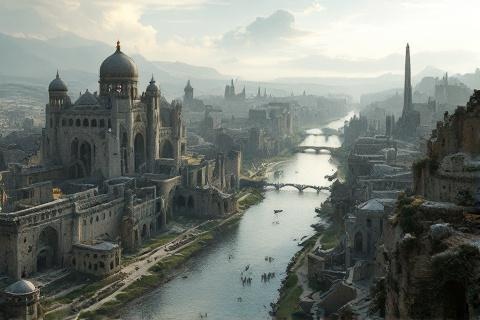
Osgiliath: The Rise and Ruin of Gondor's Star-Citadel
Before Minas Tirith, a great city straddled the Anduin. Explore the glorious history and tragic fall of Gondor's original capital, the Dome of Stars.
At the Heart of the Anduin: Osgiliath's Place in Middle-earth

Osgiliath stood upon both banks of the Anduin, which was the
greatest river of the western lands, and the city’s two halves looked at one
another across the broad, flowing water, so that the river itself became part of
its streets and life rather than a boundary at its edge. In Tolkien’s
descriptions the Anduin at this point is already wide and strong, so the city
did not simply sit beside a ford or narrow crossing, but actually embraced the
stream with quays and bridges. Stonework, piers, and landing places reached out
into the current, and the whole plan of the settlement assumed that the river
would be crossed and used every day. People, goods, and soldiers had to move
constantly between the eastern and western shores, so Osgiliath grew as a twin
city bound together by stone spans and boats drawn across the water. From the
first, its identity depended on this shared life over the Anduin’s shining
surface, with houses and towers mirrored on either side.
Tolkien presents Osgiliath as the first chief city and capital of the realm in
the south that later became known simply as Gondor, and its
setting on the Anduin made it a natural meeting point for many roads and routes.
The river ran from the north down toward the sea, and at Osgiliath a main way
crossed from the lands of Ithilien in the east to the plains and hills that led
toward Minas Anor in the west. Traffic from the coasts
could follow the river upstream, and messengers or merchants from the inland
vales could find boats and barges at its quays. Because of this, Osgiliath grew
into a place where news and power from every corner of the kingdom might gather.
The early kings ruled from a city that was not hidden or remote, but firmly
fixed in the middle of their activity and travel. Its bridges and gates stood
across what was really the main east–west road of the southern lands, and so it
naturally became the seat of rule before later events shifted that honor
westward to Minas Anor.
The position of Osgiliath along the Anduin tied together harbors on the Bay of
Belfalas and the longer inland reaches of the river, and this allowed the city
to act as a hinge between sea and land for the Númenórean-descended people.
Ships could sail up from Pelargir or the southern coasts carrying grain, timber,
or troops, and then unload at Osgiliath’s quays where the goods would move
inland by road. Likewise, produce and ore from the White Mountains or from far
northern vales could be brought downriver and gathered there. This made the city
not only useful but also powerful in symbol, because it showed that the Dúnedain
had mastered both sea and river, and had stitched together distant regions under
one rule. When the realm was young and still close to its
Númenórean beginnings, such a central node on the Anduin would
speak clearly of unity and strength, and of a people who understood how to place
their capital where the paths of many lands met.
The riverside setting shaped nearly every part of Osgiliath’s character, for the
quays, bridges, and streets all ran toward the water as if the Anduin were the
spine of the city. Instead of building away from the river and treating it as a
hazard, the people of Gondor lined it with paved embankments and constructed
broad ways that led directly to landing places and gates in the river walls. The
main bridgeheads became natural centers of traffic, so markets and halls
clustered nearby, and the sound of oars and the creak of ropes would have been
as familiar there as the noise of carts and hoofs. Even in later ages, when much
of the place lay silent, the remains of these river-facing structures showed how
strongly the water had once shaped its daily life. The citizens lived in a city
that always looked to the Anduin, watching its level, its floods, its mists, and
its glittering surface under the stars and sun.
Name and Foundation: The City of Stars

The name Osgiliath comes from Sindarin, one of the Elven tongues
that the Númenórean lords admired and often used for their
cities, and Tolkien explains that it means something like “Citadel of the Stars”
or “Starry Citadel.” This suggests that from its beginning the city was meant to
be more than a simple stronghold or trading town. The “-giliath” part recalls
the word for a host of stars, hinting that its builders thought of it as a place
under the bright sky, perhaps with open courts and domes where the heavens could
be seen. As with many Sindarin names in Gondor, the choice of such a title
reflects the high learning and old traditions of the Dúnedain, who remembered
Númenor and its friendship with the Eldar. Osgiliath therefore carried in its
very name a memory of light above dark waters, and of a proud people who wished
to honor the stars that had guided their forefathers.
Tolkien places the founding of Osgiliath early in the history of the Exiled
Númenóreans, when Isildur and Anárion, sons of Elendil, established the southern
realm that would be known as Gondor along the lower Anduin. While Minas Anor
guarded the west and Minas Ithil watched the eastern
mountains, Osgiliath rose between them as the main city, seat of the kings and
home of the chief council and records. In the early Third Age,
before war and decay had weakened the realm, this was where the king’s house
dwelt and where the stone of Isildur, the chief palantír
of the south, was kept. The city thus began as part of a deliberate plan to
anchor the power of the Dúnedain in a strong central position on the Anduin,
while the two flanking towers protected it on either side. For many generations,
before the coming of the Great Plague and further wars, Osgiliath was the clear
heart of Gondor’s rule and dignity.
Because the city’s name evoked stars and its first role was as royal capital,
its early builders likely designed it with conscious pride as a model of
Gondorian order and beauty. Tolkien’s scattered references suggest that it was
the place where the kings wanted to show their highest craft in stone and
planning, much as the Númenóreans had once shaped harbors and cities on their
lost island. The presence there of the master-stone of the palantíri indicates
that Osgiliath was not just a practical stronghold, but also a center of lore
and vision, where the rulers could survey far lands. The whole arrangement of
domes, halls, and avenues on both banks of the river would therefore have been
calculated to express unity and majesty. People in later ages remembered it as
once great and fair, and this memory itself reflects how deliberate and shining
its first design must have been.
Osgiliath’s place as the first capital meant that it gathered many of the
monuments and halls that mark a chief city in Tolkien’s vision of Gondor, such
as great courts, archives, and meeting chambers. The chief council of the realm
once sat there, and the laws and records of the early kings would have been
stored in its strong stone vaults. Noble families built houses in its districts,
and temples or memorials to victories and lineages likely rose around its
plazas, as in Minas Tirith later on. Statues and fountains, which Tolkien
mentions elsewhere as common in Gondor, would have stood in courtyards, and wide
streets gave processional routes for royal guards and embassies. Over time this
concentration of civic life made Osgiliath a symbol not just of rule but also of
Gondorian learning, crafts, and customs, so that its decline in later centuries
was felt as a deep loss of heritage.
Geography and Setting: Straddling the Great River

The Anduin did not sit at the edge of Osgiliath as a border; instead, it cut
through the middle of the city, so that houses, halls, and walls rose on both
the eastern and western banks. Tolkien notes that this was a true river-city,
with its two sides linked by strong bridges and united in a single name and
purpose. In contrast to settlements that merely face the water, Osgiliath
treated the river as a central street, even though it was broad and powerful.
The people who lived there crossed and re-crossed daily, and the city’s guards
had to watch not only landward approaches but also the long curves of the quays
and gate-towers by the water. In its prime, those who approached from north or
south along the Anduin would have seen buildings on both sides, and the city
would have seemed to stretch across the whole valley, bound together by lofty
arches above the flowing stream.
The wide quays and river-gates that Tolkien mentions were like open arms toward
the current, making Osgiliath an active port as well as a capital. Ships and
barges traveling between Pelargir and the northern lands could come alongside
strong stone embankments where cranes, ramps, and stairways allowed for swift
unloading. At intervals, tall river-gates opened in the walls along the quays,
giving access from the docks into the city’s inner streets, which likely ran
straight inward from the landing places. These gates would have controlled who
entered from the river and at what times, and soldiers of the realm would stand
watch there. The landing-stages and jetties tied the river’s traffic directly to
the urban life beyond the walls, so that every cargo, traveler, or messenger
passed quickly from ship-deck to street-paving. In this way, the Anduin did not
isolate the city but fed it constantly with movement and trade.
The breadth of the Anduin at Osgiliath, together with its strong yet not wild
flow, forced the city’s engineers to build large multi-span bridges and deep
foundations for piers, which in turn shaped the skyline. Instead of one small
arch, there were long rows of stone rising above the current, with cutwaters
facing the stream and towers or gatehouses at the points where the spans met the
shore. Seasonal mists rising from the river would have partly veiled these forms
at dawn and dusk, so that the domes and towers of the city often appeared and
disappeared like islands in a grey sea. The scale of the bridges matched the
width of the water, and this size gave Osgiliath an air of weight and permanence
long after its streets had fallen silent. Even in ruin, the great piers and
half-broken arches remained as massive shapes in the flow, reminders of the
skill and ambition that had once bridged such a mighty river.
Around Osgiliath the land was mostly low and level, a broad valley close to the
river, and this allowed the main approaches to run in on even ground toward the
city’s gates rather than climbing steep hills. This setting made the place quite
different in feel from Minas Tirith, which stood on a great out-thrust of rock.
Approaching Osgiliath, travelers would come along roads that widened into
straight, paved streets leading between walls or gardens directly toward the
waterfront. The lack of high cliffs or terraces meant that the city could spread
sideways along both banks instead of stacking itself in layers. On clear days,
people walking the outer ways might have seen long views over the river meadows
and, beyond them, the darker line of distant hills. The flat terrain also made
it easier for armies to march and for wagons to come and go, which was useful in
times of peace but dangerous in war, when enemies could approach without the
barrier of steep slopes.
Layout and Districts: Quays, Palaces, and Gates
Within Osgiliath, a network of streets ran from the quays inward, linking the
busy waterfront to the quieter civic and residential quarters deeper in the
city. The riverfront would have been loud with shouting sailors, creaking
tackle, and the splash of water, but as one walked away from the Anduin the
noise would fade and give way to the voices of markets, the sounds of craftsmen,
and finally the calmer air of inner courts. Tolkien’s brief hints show that the
riverside and the heart of the city were not separate worlds but connected
zones, with roads broad enough for carts and processions. In this way, Osgiliath
integrated its life around the river without being entirely dominated by it. The
ordering of such a city, with paths from the water to halls and houses,
reflected the Gondorian love of clear layouts and planned spaces.
The official and palatial buildings of Osgiliath stood near the river, making
them visible to those arriving by boat and giving the rulers quick access to the
main route of travel. Halls for councils, the king’s residence in earlier days,
and other chief structures likely faced formal quays or river-squares, so that
they could be approached with ceremony from both land and water. In Tolkien’s
world, nobles and captains often move by ship as well as by horse, and at
Osgiliath this double approach would be natural. Behind and beside these grand
facades, stores and workshops pressed close to the embankments, since merchants
needed to be near the unloaded goods. The lower riverfront therefore contained a
dense mix of power and business, with rich stone fronts above and more modest,
busy structures clinging to the same line of quays, all dependent on the flow of
the Anduin.
Strong walls and gates surrounded Osgiliath’s key approaches from land and
controlled entry from the river, and tall towers rose at important points,
giving the city a line of watching eyes on its horizon. In earlier centuries,
while the realm was powerful, these defenses were kept in repair, and companies
of guards manned the gatehouses and battlements. The towers at bridgeheads were
especially vital, since they protected the spans that bound the two halves of
the city together. From their heights, watchers could see sails on the river,
dust from distant marching feet, or the smoke of campfires in Ithilien or on the
western plain. The very skyline of Osgiliath, marked by these towers and
gate-structures, showed that it was both a place of trade and a fortress that
understood the dangers of enemy crossings.
Open spaces and plazas broke the pattern of streets and houses, giving the city
air and views while also forming natural gathering places for markets, speeches,
or ceremonies. Some of these squares likely lay close to the river, allowing
long sightlines toward the glimmering water and up to distant towers, which in
turn would catch the light of the sun or moon. Others were probably set deeper
within the city where great buildings rose around them, so that domes and
colonnades framed the open sky. Tolkien often imagines Gondorian cities with
such courts and gardens, where trees and fountains stand among the stone, and it
is reasonable to see Osgiliath in the same way. These spaces broke any possible
dullness of repeated house-fronts and gave the people places to gather, to watch
processions, or simply to look out along the Anduin and remember that their city
once stood at the heart of a mighty realm.
Architecture and Light: Stone, Domes, and the 'Stars' Motif

In describing Gondorian cities, Tolkien often mentions pale, finely cut stone
and dignified, simple lines of architecture, and Osgiliath clearly shared this
same language of design, even if the details are less often explained. Its
buildings were likely built of light-colored limestone or similar rock, well
carved and fitted, so that courts and streets would gleam in strong sun and take
on subtle color in dawn and dusk. The Númenórean-descended masons favored clear
shapes and firm edges, and they built for endurance as well as beauty. In
Osgiliath, this would have been seen in clean cornices, straight courses of
masonry, and carefully arched openings. Even after centuries of war and weather,
the ruins that Frodo and
Sam hear of, and that Faramir describes, still
suggest the strength of the original work. The same pale stone that makes Minas
Tirith appear fair and noble would have given Osgiliath a similar sense of
purity and age.
Domes, low towers, and lines of columns formed important parts of Osgiliath’s
appearance, and Tolkien hints that these shapes caught the changing light over
the river in beautiful ways. Domes rising above halls would have shone at
sunrise as the first rays struck them from the east, and at evening the last red
or golden light would glow along their curves from the west. Long colonnades,
perhaps facing courts or quays, cast repeating bands of shadow that shifted with
the day. Low towers, less sheer than Minas Tirith’s citadel but still
commanding, rose at corners and gatehouses, anchoring the skyline. Reflections
of these features would tremble in the slow current below, especially at calm
hours, so that the city appeared doubled in stone and in water. This combination
of rounded and vertical forms gave Osgiliath a graceful but solid character that
matched its name as a starry stronghold.
Because Osgiliath’s very name included a word for a host of stars, it is likely
that many of its decorations and carved emblems took up this theme, and
Tolkien’s comments about its “Dome of Stars” support such an image. On
door-lintels, in pavements, and on the faces of domes, craftsmen probably set
patterns of many-pointed stars, either cut in relief or picked out in darker
stone. The chief dome, which held a painted or inlaid sky of stars within, made
the connection most clear: those who stood under it would feel as though they
looked up into the night above Númenor or over
Middle-earth. Even after ruin, fragments of such carvings
and traces of star-motifs might be seen among the fallen blocks, reminding later
generations of the city’s old purpose and pride. These symbols tied the realm of
Gondor to the wider heavens and to the memory of the Eldar, for whom the stars
were always of deep importance.
Social Life and Economy: Traders on the Quays
The active quays of Osgiliath in its height point to a city busy with trade,
where ships and riverboats constantly arrived and departed, linking it with both
sea-ports and inland river towns. Grain from the rich fields of Lebennin, wine
from southern slopes, timber from upriver forests, and metals from the mountains
would all pass through its docks. Captains and crews brought news and rumors as
well as goods, so that the city became a place where people heard of distant
wars and alliances long before they reached other settlements. The regular
movement of supplies for the armies guarding the frontiers also added to the
traffic, since Osgiliath stood between Minas Anor and Minas Ithil and could
serve both as a storehouse and a staging point. In peaceful times the riverfront
would have seemed almost cheerful, with barges jostling for space and merchants
calling out as they arranged their cargoes.
Close to the water, long lines of warehouses and workshops grew up, set there so
that goods could be shifted quickly between ship and storage, or between storage
and the craft that worked on them. Some buildings might be simple and box-like,
filled with bales and barrels, while others housed smithies, ropewalks, or
carpenters who repaired vessels and wagons alike. A little further inland, where
the noise and smell of loading and labor eased, stood counting-houses, offices
of merchants, and homes of those who dealt in trade but did not work with their
hands all day. Streets joined these layers together, so that an item unloaded
from a boat could be carried through the city’s commercial heart and then on
toward markets or out through landward gates. This arrangement reflects the
practical sense of the Dúnedain, who understood that commerce needed both sturdy
storage at the water’s edge and safer, more comfortable quarters for
record-keeping and household life a little apart from the docks.
The overall plan of Osgiliath shows a balance between noble display and useful
mercantile space, which fits Tolkien’s pattern for a capital that lies on a
great river and must serve both as a symbol and as a working port. Grand stone
fronts and plazas near the quays gave visiting envoys and captains an impression
of splendor, while behind them the more humble, necessary structures of trade
ensured that the city remained supplied and wealthy. Halls of council and
justice might stand only a short walk from bustling markets, so that the rulers
would be aware of the daily life that supported their power. This blend of civic
grandeur and commercial practicality made Osgiliath not a show-city built only
for ceremony, but a living center whose towers rose above real labor and
exchange. In this it resembled other Gondorian towns, but with greater scale and
dignity, since for many years it was the first city of the realm.
Signs of Decline: Ruins, Barren Quays, and Empty Gates

By the later Third Age, Tolkien describes Osgiliath as largely broken and
half-abandoned, with many of its streets empty and its once-proud quays falling
into quiet disuse, which marks a sharp contrast with its early glory. Wars with
Sauron, plague, and internal strife had driven much of the
population away, and repeated assaults had damaged walls and buildings. Great
arches that had once carried bridges or roofed halls now stood open to the sky,
their ribs of stone bare where tiles and carvings had fallen. Breaches in the
defenses let the wild creep in, and only a few garrisons or scattered folk
remained to use the surviving structures. The wide quays, once thronged with
boats, became echoing places where the sound of the river was louder than human
voices. To travelers in this period, the city would appear as a place forsaken
by time, haunted more by memories than by living citizens.
Many of the great public buildings that had once housed councils, records, and
courts in Osgiliath now lay roofless, with their finely worked stones cracked
and worn by rain and wind. Courtyards that might once have held fountains and
trimmed trees filled instead with long grass, thorn-bushes, and even saplings
that took root in broken paving. Columns remained standing without lintels, and
stairways led nowhere as the upper floors they had once reached were gone.
Tolkien’s evocations of Gondorian ruins elsewhere help the reader picture these
scenes: noble work slowly eaten away by weather and the neglect that follows
war. The carved details which had once shown stars, leaves, or heraldic devices
became blurred and shallow, so that a passerby could barely make out their
forms. Nature did not wholly destroy the city, but it softened its edges and
claimed its empty spaces, turning halls of judgment into overgrown courts under
the open sky.
Instead of one proud line of domes and towers rising above the two halves of the
river-city, the skyline of Osgiliath in its ruin became a jagged row of stumps
and broken peaks. Some towers had lost only their crowns, but others were
shattered halfway up, leaving odd, tooth-like shapes against the daylight or
stars. Domes that had once held the image of the heavens within were cracked or
half-collapsed, so that parts of their curves remained like shells. The result
was not an ordered city outline but a scattered, uneven pattern that told of
centuries of siege and neglect. To anyone who knew the tales of its former
greatness, this broken silhouette would be particularly painful, since it kept
enough of the old forms to remind viewers of what had been, yet showed clearly
how much had been taken away.
Light and shadow played very differently across the ruined Osgiliath than they
had across the living city, and in Tolkien’s handling this contrast underlines
the sense of loss. Where once torchlight, lanterns, and windows had shone in
arches and colonnades, now the evening darkness flowed unbroken into empty
chambers and out again through shattered walls. Sunlight that might have flashed
on banners and polished stone now crawled over crumbling edges and into roofless
rooms choked with plants. The hollowness made echoing steps sound louder, and
every open space seemed to wait for a company or a ceremony that would never
return. This mood of absence turns the ruins into a kind of monument to Gondor’s
fading strength, so that even without meeting any soldiers or citizens, a
visitor would feel the weight of all the years that had stripped the city bare.
The Great Bridge and Riverworks: Engineering on the Anduin

Tolkien records that Osgiliath once had great stone bridges over the Anduin,
structures of several spans supported by massive piers, which were necessary to
cross such a wide and deep river. These bridges were not simple footways, but
broad enough for companies of soldiers, wagons, and horsemen to pass, which made
them vital military routes as well as civil links between the two halves of the
city. During the many wars with Mordor, they were fought over
fiercely and in the end were partly destroyed to prevent enemy passage, showing
how central they were to the defense of western Gondor. The scale of these
constructions reflects the advanced engineering traditions the Dúnedain brought
from Númenor, where they had mastered the building of harbors and sea-works.
Even in decay, the half-fallen arches and the stubs of spans jutting over the
water spoke of a time when the kings of men could bend great rivers to their
needs.
The heavy bridge piers and the foundations of river-gates remained as strong
shapes in the stream long after other parts of Osgiliath had fallen, and Tolkien
hints at how these hulks became the most visible remains of the city’s might.
These piers, driven deep into the riverbed and faced with hard stone, resisted
not only the current but also fire and assault, so that even broken at the top
they still stood like small islands. On them, weeds and small trees might grow,
yet the underlying work of the masons endured. The river-gates, built where
quays and walls met the Anduin, likewise retained their basic forms, often
showing how the city had once controlled all passage between land and water.
Together, these remnants served almost as teeth of a drowned giant, projecting
from the flow and reminding Gondor’s people of the time when Osgiliath had
commanded the great crossing.
The docks, embankments, and other riverworks of Osgiliath show how much labor
and skill the city had invested in taming and using the Anduin, rather than
simply building beside it. Paved quays allowed for firm footing in all weathers,
and stone steps led down to different water levels so that boats could be loaded
whether the river was high or low. Sluices and drains, some likely running under
the walls, kept the lower streets from flooding and channeled excess water away
during heavy rains or spring melt. By shaping the edges of the river in this
way, the city could rely on stable landing places and prevent the banks from
shifting. Such works required constant upkeep, but they also gave Osgiliath a
confidence in dealing with the great waterway. This attitude, that the river was
a partner to be guided rather than an enemy to be feared, set the tone for the
city’s whole relationship with the Anduin.
The presence of all these stone constructions in and along the Anduin—bridges,
piers, quays, and stairs—changed the look of the river itself for many miles at
Osgiliath, turning a simple natural channel into a partly built space. From
upstream or downstream, a traveler would see long regular lines of masonry
cutting into the water, with reflections of arches and walls trembling on the
surface. The river near the banks would run in shallower, calmer channels
because the quays and piers directed its flow, while the main current took the
deeper middle way between them. Even in ruin, the pattern of these structures
shaped how waves and eddies formed, and they broke the natural curve of the
river into a more complex scene of stone and moving water. The Anduin at
Osgiliath therefore became a kind of living mirror of the city’s history,
bearing the marks of both its building and its breaking.
Memory and Legacy: How Osgiliath Lived On in Gondor's Mind
Though it lay mostly in ruin by the time of the War of the Ring, Osgiliath still
held a powerful place in Gondor’s memory as the first capital and the seat of
its early kings. Characters like Faramir speak of it with a mixture of sorrow
and respect, knowing that their forefathers had ruled there in strength before
plague and war forced the line of kings to retreat to Minas Tirith. The very
name of the city carried weight in song and story, for it recalled ages when
Gondor’s armies marched east in victory and its ships ruled the coasts. Even as
a battlefield and a half-abandoned shell, Osgiliath stood on the Anduin as a
witness to the long struggle between the West and Sauron. To the people of
Gondor, defending or losing it was not only a matter of tactics but also of
holding on to a piece of their own beginnings.
The influence of Osgiliath did not vanish with its decline, because elements of
its style and planning lived on in other Gondorian centers, especially along
rivers and harbors. Later builders in Minas Tirith, Pelargir, and smaller towns
would have remembered the patterns used there: the alignment of major streets
with water-gates, the use of tall riverfront walls, and the favored motifs in
stonework. Star-emblems, smooth pale masonry, and the balance between domes and
towers all appear in Tolkien’s descriptions of various Gondorian sites, and
these likely echo the old capital. In this way, the lost city served as a kind
of first model that set the taste and standard for the southern realm. Even if
later generations could not fully match its breadth and twin-bank arrangement,
they still imitated what they could, so that traces of Osgiliath’s character
remained visible across the land.
In Tolkien’s writings, Osgiliath is remembered not only for the battles fought
around it but also as a particular physical place shaped by river, stone, and
the echoes of its own past, which gives it a quiet, haunting presence in the
legendarium. He does not spend many pages describing its wars in detail, yet the
few notes he gives on its domes, bridges, and ruins are enough to fix the image
of a once-great river-city slowly sinking into decay. The setting itself carries
meaning: the wide Anduin, the broken spans, the empty courts tell the story of
Gondor’s fading even when no characters speak. When readers or characters think
of Osgiliath, they recall a city that tried to bring together sea and land, east
and west, Númenórean pride and the hard reality of Middle-earth. What remains in
the Third Age is less an active capital and more a long, stony memory, held in
the minds of its people and in the enduring shapes that still rise from the
flowing river.