
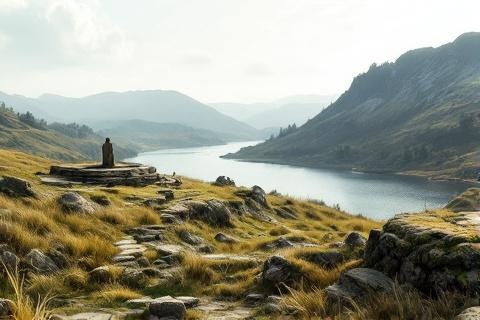
Amon Hen: The Hill of Sight Where the Fellowship Broke
Explore the lore behind the ancient watchtower where Frodo faced his greatest trial and the Fellowship of the Ring was shattered forever.
Quick overview: what Amon Hen is

Amon Hen, whose name means Hill of Sight in the tongue of the
North-kingdoms, is remembered in the histories of
Gondor as one of the marked high places beside the Great
River, a place where the power of perception seemed sharpened
and ordered toward watchfulness rather than wonder. The name itself appears in
The Lord of the Rings when the
Fellowship approaches the Falls of Rauros, and
it signals at once that this is not just a random hill but a named and storied
height known to the Dúnedain of old. In the traditions of Arnor and Gondor, such
hills often received titles that spoke of their purpose, and here sight and
vigilance are bound together in a single word. This meaning helps readers
understand why the seat upon its summit was set there long before Frodo’s time,
tying the landscape to the long work of guarding
Middle-earth against gathering shadows. Through that
name, Tolkien invites the reader to see Amon Hen not as a mere scenic overlook,
but as a deliberate instrument of watch and ward in the days when the kings
still cared for the borders of their realm.
The Hill of Sight rises alone on the western bank of the Great River Anduin at
the western end of the long, still pool of Nen Hithoel, creating a striking
landmark where the river’s hurried northern waters slow and gather before
plunging over the Falls of Rauros. Tolkien describes the place as lonely and
quiet, part of a wild region where the great kingdoms no longer held strong
garrisons, yet the old geography of their vigilance still shaped the land. From
the river below, Amon Hen would have appeared as a single, pronounced height in
a line of lower ground, its summit just high enough to command the approaches
both upstream and down. Its position at the end of Nen Hithoel makes it a
natural turning point in the journey of the Fellowship, marking the last pause
before the river becomes dangerous and signaling a change from shared travel to
scattered paths. In the long story of the Third Age, this
solitary hill stands as one of those quiet edges where the memory of past
strength lingers even as the world moves on.
Upon the summit of Amon Hen stood an ancient stone seat and the remains of a
watch-place, relics of a time when men of Gondor or their forebears kept a more
careful eye upon the middle reaches of Anduin. The Seat of Seeing, as it is
later called in the text, was set so that a watcher could turn and look out
toward every quarter of the compass, and from that vantage the lands of
Rohan, Emyn Muil, and even distant
Mordor lay within the sweep of the eye on a clear day. Around
the seat Tolkien hints at broken works of stone, traces of walls or platforms
that show it was once arranged as a purposeful station rather than an accidental
pile of rock. These remains preserve not only the memory of older political
borders, but also the idea that important places gain shape through human labor
and enduring need. When Frodo climbs there, he is
moving through the traces of forgotten guards who once sat in that same place
and peered out upon the world, searching for threats that in his time have
returned in greater force than they could have imagined.
Amon Hen stands opposite Amon Lhaw, the Hill of Hearing, which rises on the
eastern bank of the Anduin so that the two together frame the narrow pool of Nen
Hithoel like paired sentinels on either side of a gate. This deliberate symmetry
in the landscape gives the impression that the river itself is passing between
two watchful presences, one associated with sight and the other with sound.
Tolkien seldom explains the full history of these places in the main narrative,
yet from their balanced names and facing positions it is clear that they were
part of a system of vigilance set up in the great days of the realm. The
Fellowship passes between them almost unknowingly, yet the reader understands
that this is a threshold, for just beyond lie the roaring falls and the breaking
of the company. By setting these paired hills opposite each other, Tolkien
underscores both the former strength of the Dúnedain and the sense that the
physical world of Middle-earth still remembers the watch that Men
once kept upon the river.
Name and meaning
The name Amon Hen comes from Sindarin, one of the Elvish tongues
that many of the Dúnedain adopted for their place-names, with Amon meaning hill
and Hen meaning sight or eye, a direct indication of the hill’s designed
purpose. In The Lord of the Rings, Tolkien uses these Elvish elements
consistently so that a reader who knows their meanings can often guess the
character of a place before it is described in detail. Here, Hen evokes not only
the physical act of looking, but also the idea of vision sharpened and directed
toward distant things. The choice of Sindarin for such a practical and strategic
feature shows how deeply Elvish culture and language shaped the heritage of the
Men of the West, especially in Gondor where many prominent
features still bore Elvish names. As a result, the name itself serves as a
thread connecting the hill to the larger linguistic and historical tapestry of
Middle-earth, reminding the reader that even bare stones and lonely heights
belong to a long story of peoples and tongues.
Tolkien’s choice of this name also ties Amon Hen to ancient practices of watch
and vision in the North-kingdoms and in Gondor, suggesting that the hill was
used in systematic observation of the river and the lands beyond. The Dúnedain
were seafarers and explorers, yet they also valued high places from which they
could measure distances, study weather, and look for movements of friends and
foes. By calling the place Hill of Sight, Tolkien signals that it is not merely
scenic or poetic, but part of the work of kings and stewards who tried to
understand and control the wide regions in their care. Later, when Frodo sits on
the Seat of Seeing and experiences a heightened and almost painful breadth of
vision, the name gains a deeper layer of meaning, for the hill becomes not
simply a watchtower of stone, but a focus of insight in a world clouded by the
growing will of Sauron. Thus the linguistic choice supports
both the practical history of the place and the spiritual drama played out upon
it.
The deliberate pairing of Amon Hen, the Hill of Sight, and Amon Lhaw, the Hill
of Hearing, shows how the ancient builders and namers of Gondor or their
predecessors envisioned the riverbanks as a coordinated line of observation and
defense. One side of the river was marked by the power of the eye, the other by
the alertness of the ear, as if those who guarded the Great River knew that
danger could be detected both in what is seen and what is heard across the
water. Tolkien’s gift for suggestive names lets the reader feel that these were
not isolated works, but parts of a structured system, perhaps once manned by
wardens who watched the traffic of boats and listened for the approach of
enemies. While the details of their garrisons are left in shadow, the symmetry
of the names and their matching positions beside Nen Hithoel implies an older
age when Gondor still held a tighter grip on its long borders. In this way the
two hills act as more than landmarks; they become symbols of a vigilant order
that time and waning power have almost erased.
Where to find it: geography and setting

Geographically, Amon Hen stands firmly on the west bank of the Great River
Anduin, at the western end of the still, dark pool called Nen Hithoel, just
before the river plunges southward over the great Falls of Rauros. Tolkien
positions it as the last notable height before the harsh maze of the Emyn Muil
and the roaring waters beyond, which makes it a natural stopping point for river
travelers seeking to decide their next move. By setting the seat of an ancient
watcher here, he acknowledges what any mariner or scout would understand: that a
calm reach of water backed by a solid hill is a perfect place to halt, look, and
listen. The Fellowship’s halt near Parth Galen at the foot
of Amon Hen follows this logic, although they no longer have any guides from
Gondor to tell them the full story of the place. In the wider map of
Middle-earth, Amon Hen therefore marks a hinge between the safer northern
journeys from Lothlórien and the perilous descent toward Mordor.
The hill itself is not a towering mountain but a modest height that becomes
important because it rises from an otherwise fairly low and gentle river plain,
so that even its limited elevation gives a commanding prospect. Tolkien’s
descriptions suggest a hill that lifts boldly above surrounding ground without
competing with the great ranges far away, such as the Misty Mountains or the
Ephel Dúath. This modest scale suits its function, since a seat of watch need
only rise high enough to see over local obstacles and along the course of the
water. Its prominence comes not from sheer altitude but from contrast: a single,
solid rise where much of the land along Nen Hithoel lies lower and nearer to the
water. To the travelers of the Third Age, worn with long roads and encumbered
with heavy choices, such a hill would feel both accessible and significant,
close enough to climb in an hour yet high enough to crown the day with a wide
and searching view.
Across the water, the opposite bank is marked by Amon Lhaw so that the two hills
form a quiet but insistent pair, framing the pool between them like pillars at a
river gate. This arrangement gives the entire landscape a sense of deliberate
structure, as if the river flows through a doorway shaped by human intention and
ancient strategy. Any boat or raft passing through Nen Hithoel could be watched
from both sides, and the twin hills together would make it difficult for an
enemy to approach unseen in former days. Tolkien’s map and narrative both
emphasize this pairing, showing the reader that the Fellowship’s stopping place
is not only convenient, but ensnared in the residues of a long-ago defense line.
The company’s divided choices on the western shore are thus set against an
eastern mirror, silently recording the passage of a world that no longer has the
strength to man both banks.
Around these facing hills spreads a countryside that Tolkien sketches as part
river meadow, part scattered woodland, with rougher broken ground lying at a
distance where the smooth levels give way to more difficult country. The
immediate shores of Nen Hithoel are gentle enough for landing boats and for
short camps, which explains why Parth Galen serves well as a landing place for
the Fellowship’s elven boats. Yet beyond the soft grass and isolated trees, the
land begins to twist and rise into the complicated ridges of the Emyn Muil, and
to the south the land falls sharply away toward the cliffs above Rauros. This
mix of open meadow, isolated trees, and far-off ruggedness gives the area its
distinctive mood of quiet before danger, a feeling that aligns closely with the
turning point in the story. Thus the physical arrangement of river, hill, and
broken ground supports the narrative sense that the travelers have come to the
end of relatively easy paths.
The Seat of Seeing and summit architecture

At the very top of Amon Hen stood a carved stone seat, sometimes called the Seat
of Seeing, which Tolkien describes as broad, weathered, and simple in form, a
practical chair for a watcher rather than a throne meant for display. When Frodo
reaches it, he finds an object already old in the Third Age, its edges worn
smooth by time and perhaps by the many sentries who once sat there in long
watches. The seat faces outward rather than inward, inviting its occupant to
turn and look over the lands rather than gaze toward any hall or city. This
emphasizes that Amon Hen was never a royal court, but a place of duty where the
value lay in outward vision. In that moment when Frodo sits down, the ancient
practical seat becomes a focus for something far greater, as his sight expands
beyond natural limits and he sees many parts of Middle-earth at once, trapped
between the searching Eye of Sauron and his own desperate need for choice.
The Seat of Seeing rests upon a low platform of hewn stone, with evidence of
steps and broken walls that hint at more complete structures in earlier days,
perhaps a ring of protection or a small encircling court. Tolkien mentions these
remains in passing, yet they are enough to show that the summit was once
carefully shaped by builders who made a level place and marked it with ordered
masonry. The ruined steps suggest a formal approach to the seat, which may once
have been reached by guards and messengers who ascended with reports from the
river below. As stones cracked and toppled over the centuries, the watch-place
would have taken on a more deserted air, but its plan could still be traced by
anyone with an eye for old works. Thus when Frodo climbs the worn stair, he
walks not only on rock but on the fading outline of human intention, feeling the
echo of long-forgotten vigilance beneath each step.
The masonry on Amon Hen is plain and functional rather than adorned, and Tolkien
notes the signs of great age in the growth of lichen on the stones, the
crumbling mortar, and the edges worn soft by countless seasons of wind and rain.
These details show that the ancient realm which built the watch-place valued
sturdiness and purpose over decoration in such a remote position. The neglect of
later ages has left the stones stained and softened, yet they still hold their
form well enough to speak of a disciplined hand that first shaped them. Lichen
and moss soften the masonry and root it into the surrounding hill, blurring the
line between human craft and natural rock. Readers are reminded that the men who
raised these structures have passed away, leaving their silent works to be
slowly taken back by the land, even as the power that once gave them meaning
returns in the form of spreading darkness from Mordor.
In the time of the War of the Ring there was no high tower
on Amon Hen; instead it functioned as a watch-stead, a single prepared height
rather than a fortress bristling with defenses. Tolkien never describes walls,
gates, or dwellings atop the hill, only the seat and its low surrounding works,
which indicates that the hill had always been a place of observation and
signaling rather than a stronghold capable of withstanding siege. This matches
its strategic role within Gondor’s history, since the great defences of the
realm were concentrated nearer to Osgiliath, Minas
Tirith, and the fortresses along the Anduin further south.
Amon Hen was one eye in a long chain of vigilance, and its usefulness depended
more on clear sight and communication than on military strength. When the
Fellowship arrives, they encounter only the ghost of that earlier system, a
lonely seat that still serves its ancient function for one last crucial watch.
Terrain, soil, and natural features
The slopes of Amon Hen are described as a mixture of shallow soil, exposed rock,
and loose scree, which together create a hill that is easy enough to climb but
rough enough to feel wild and ungoverned. Paths may once have been cut by the
wardens of Gondor, yet by the end of the Third Age any such roads would have
decayed into faint tracks hidden among broken stones. These thin soils cling to
the harder rock beneath and provide only limited anchorage for plants, which
leads to a patchwork of stony outcrops and pockets of vegetation. The feel of
the ascent that Frodo and Aragorn make is
therefore steep and labored, but not technically difficult, with the earth
slipping under foot and stones occasionally skittering downslope. This rugged
mixture suits the mood of a place where old human effort meets the patient
wearing-down of time.
Near the summit, short grasses and tough little herbs hold what soil there is,
while richer earth and larger trees gather closer to the river where water and
silt have settled more generously, forming a natural division of plant life
along the height. The top of the hill is open and largely bare, which allows for
the wide views that gave Amon Hen its purpose, yet even there small, wind-bent
plants cling to cracks and ledges. Further down, as the slope eases and the
ground deepens, shrubs and young trees find a better hold, until at the base of
the hill the land blends into the greener meadows and scattered woodland of
Parth Galen. This pattern of vegetation, from sparse summit to leafy foot,
emphasizes the transition from the clear, exposed realm of watchers and
decision-makers to the more sheltered places where camps can safely be made. It
also mirrors the journey of the Fellowship, who move from the cover of the
lakeside trees to the exposed height where their fates are decided.
The river plain near Nen Hithoel includes marshy edges where slow water and silt
create wet ground, fringed by reeds and water-loving plants, while slightly
higher banks provide firmer earth where men can walk, camp, and draw their boats
ashore. Tolkien hints at these differing textures of ground when he describes
how the Fellowship lands at Parth Galen and moves between grass, trees, and the
first rising slopes. The marshy edges belong to the river’s own world and mark
the limit of easy footing, a boundary that both men and animals must consider
when choosing routes. Above them, the firmer banks and low shelves of land
invite fires, tents, and the drawing-up of boats, making Amon Hen’s base a
natural staging ground. Thus the pattern of wet and dry land shapes not only the
local ecology, but also the movement of armies and travelers who pass this way.
Wind and river mist work together over long ages to leave stones streaked with
lichen and soil stained by repeated flood seasons, so that the whole hill bears
marks of weather and water. Morning vapors rise from Nen Hithoel to wrap the
lower slopes, beading on rock and grass before the sun burns them off, while
stronger winds later in the day scour the summit and drive thin clouds across
the sky. The result is a landscape that looks washed and faded in places, bright
and newly rinsed in others, depending on the light. These subtle signs of
climate and water remind the reader that Middle-earth is not a static painting
but a living world where seasons and years leave their traces. When Frodo climbs
Amon Hen, he is not only walking into a place of legend and decision, but also
into a real environment shaped by weather, erosion, and the long memory of the
Great River.
What one can see from the top (the view, not the story)

From the summit of Amon Hen, the view stretches far along the course of the
Great River Anduin and out across the surrounding lands, giving any watcher a
commanding sense of the region’s geography and its possible roads. Tolkien
describes how Frodo, sitting in the Seat of Seeing, is able to perceive the
river both above and below Nen Hithoel, as well as distant lands such as the
plains of Rohan, the dark peaks of Mordor, and even the glimmer of Minas Tirith.
Though much of what he sees is heightened by the power of the Ring and the
struggle with the Eye of Sauron, the basic width of the viewpoint reflects the
natural advantage of the hill. In practical terms, such a vantage point would
allow wardens of Gondor to watch for the movement of boats, the smoke of distant
fires, and any mustering of armies along the river corridor. Thus the summit of
Amon Hen binds the small scale of local watch with the immense scale of the
wider War of the Ring.
Across the water, the opposite hillside of Amon Lhaw rises in close answer,
forming a natural pair with Amon Hen and giving the feeling that the watch from
the summit is part of a dialogue between the two banks. Even if in Frodo’s time
no one sits in any seat on Amon Lhaw, its presence is still felt as the other
eye of a long-forgotten face that once studied the river. From Amon Hen, a
watcher could easily see signaling fires or flags on the eastern hill, and the
two together would have allowed fast exchange of information across the river.
Tolkien uses this facing arrangement to give the reader a strong mental image of
the Fellowship resting in a kind of enclosed arena, bounded not by walls but by
natural forms that were once integrated into human plans. The quiet
companionship of the two hills heightens the sense of loss, because one can
almost imagine them alive with wardens that no longer come.
On clear days, distant low hills, the sweep of river meadows, and far lines of
trees are all visible from the height, while light plays strongly on both water
and stone, flickering and flashing as clouds move overhead. Tolkien often draws
attention to changes of light on landscapes, and Amon Hen is no exception, for
the sun’s path across the sky marks out the river in bright strokes and then
throws the far country into shadow, emphasizing its depth and secrets. For a
watcher with patient eyes, these shifts would reveal the passage of time and
perhaps the approach of storms or dust raised by marching companies many miles
away. To Frodo, the brightness and sharpness of what he sees become almost
overwhelming, as if the whole world had been shown to him at once in its beauty
and its peril. The strong contrasts of light and shade on that day underline how
close the company stands to the division between hope and despair.
The horizon from Amon Hen feels unusually open, and anyone who stands on the
summit has a sense of being suspended between river and sky, with the stone seat
acting as a small fixed point in a vast moving world. The lands fall away in
many directions, letting the eye travel outward to great distances without being
blocked by nearby peaks, which increases the feeling of exposure and
possibility. In the story, this wide horizon mirrors Frodo’s inner state as he
tries to see what road he should take, caught between the wishes of his friends
and the dangerous pull of the Ring. The emptiness of the sky above and the long
ribbon of the river below seem to offer many paths, yet in truth only a few can
lead to the destruction of the Ring. Thus the physical sensation of standing
between earth and heaven becomes part of the moral and spiritual weight of the
scene, binding landscape and choice tightly together.
Relation to nearby features: Nen Hithoel, Anduin, and Amon Lhaw

Amon Hen forms the western side of the long, narrow pool called Nen Hithoel,
while Amon Lhaw rises on the eastern bank so that together they cradle the water
between their slopes in a calm reach before the river rushes south. This pool is
an important landmark on the Anduin, for it marks the place where the tumult of
northern waters slows and collects in a dark mirror before breaking again into
foam at Rauros. Tolkien’s map places the two hills like bookends at the western
end of the pool, suggesting that they form a natural end point for journeys
upstream and a last place of order before the more dangerous stretch downstream.
In this arrangement, Amon Hen is never just an isolated hill but one half of a
gateway, and the events that take place there feel fittingly like a threshold in
the story, where the Fellowship’s shared road comes to a close.
In this region the Great River Anduin broadens and slows, creating reflective
stretches of water whose surface can seem still and deep even as currents
continue their steady work underneath. The characters note how their boats move
more easily and quietly through Nen Hithoel, with the noise of rapids replaced
by a heavy hush that carries sound a long way. This broadening turns the river
into a kind of quiet stage upon which the two hills look down, watching the
mirrored sky and the small craft that cross its face. The sense of pause that
Nen Hithoel gives reflects the story’s own pause in movement as the company must
consider where next to go. The stillness also heightens the shock when violence
comes to the shore, for it breaks a silence that had seemed almost sacred.
The two hills act as natural lookout points that mark a distinct place on the
long southward course of the Anduin, announcing to any skilled navigator or
warden that they have reached a significant station. From their slopes and
summits, watchers could observe travel both up and down river, see smoke or
movement on the opposite bank, and look out toward the plains and broken hills
that stretch away from the water. In the stronger years of Gondor these heights
might have been staffed by small companies of men who kept records of who
passed, warned of approaching enemies, and perhaps even controlled certain river
tolls or permissions. Never fully explained, this system is only hinted at by
Tolkien, but the placement of the hills and their old seats of watchfulness tell
an eloquent story. Even in ruin and abandonment, they still mark a boundary in
the landscape and in the narrative, a place where purposes are decided and paths
diverge.
Because the hills stand at a crossing of natural routes, the area around Nen
Hithoel serves as a stepping point between river travel and inland paths that
lead away from the Anduin toward Rohan, Gondor, or the wild Emyn Muil. Boats
that cannot or will not attempt the plunge over Rauros must be halted or
portaged here, which means that men and goods move from water to land on these
shores. Aragorn understands this, and that is why he considers leaving the river
at Parth Galen to strike east or west on foot, even though the choice will tear
the company apart. In earlier times, roads or trails may have climbed away from
the landing-places toward watch-stations and further settlements, making this a
junction between many different journeys. In this way Amon Hen stands at a
meeting of elements and directions, where river road, land road, and the high
road of watchfulness all intersect.
Flora, fauna, and climate at the hill
The vegetation of Amon Hen is varied, with short, wind-toughened grasses and
herbs clinging to the summit, while taller trees and denser undergrowth gather
closer to the river where soils are deeper and more often renewed by floods.
Tolkien’s references to the green sward of Parth Galen and the scattered trees
near the landing place suggest a kind of park-like lower slope that contrasts
with the barer, more exposed crest. The tough summit plants must withstand
constant wind and thinner soil, bending low and growing close to the rocks to
survive. Below, trees such as beeches, oaks, or other hardy species common in
Tolkien’s northern landscapes would spread their roots in richer earth and offer
shade to travelers. This vertical pattern of plant life creates a natural
gradient from sheltered rest at the foot to bare decision at the top, matching
the emotional climb of those who ascend.
Lichen and moss cling to exposed rock and old masonry on Amon Hen, softening the
hard lines of stone and bearing quiet witness to the long years since the
watch-place was last regularly used, while seasonal grasses around the hill turn
gold by late summer. These humble plants give texture and color to the ruins,
dressing the seat and walls in a slow-growing garment that hints at neglect but
also at resilience. Each patch of moss speaks of many damp mornings and shaded
hours, each stain of lichen of countless days of sun and rain. The golden
grasses suggest the turning of the year, for their color marks the difference
between fresh spring journeys and the weary end of summer campaigns. In the time
of the Fellowship’s passage, which occurs in the late winter and early spring,
many of these plants would still be waking from cold, adding a sharpness and
clarity to the air that matches the urgency of their choices.
The banks and nearby trees of Nen Hithoel would attract birdlife typical of
riverine country, such as ducks, herons, and smaller songbirds, while the marshy
edges support reeds, rushes, and other wetland plants that shelter insects and
amphibians. Tolkien does not list species in this area, but his general pattern
elsewhere suggests that living creatures fill these quiet reaches even when men
are rarely seen. The cries and movements of birds might have served as subtle
alarms to old wardens, hinting at the approach of boats or the stirring of
something out of place. Frodo and his companions travel mostly in silence, yet
the land around them is far from dead, and the presence of unseen animals
contributes to the sense that Middle-earth is full of life that will go on
regardless of the fate of the Ring. This unseen teeming world along the
riverbank emphasizes what is at stake, for if Sauron prevails, even these remote
waters and their flocks would fall under shadow.
The climate around Amon Hen is temperate, shaped by the broad flow of the
Anduin, with river mists in the morning that drift and thin as the sun rises,
breezy afternoons that clear the view from the hill, and cool nights that slow
plant growth and deepen the silence. Tolkien often marks time in this part of
the story by changes in weather and light, noting the mists that soften outlines
and the breezes that later sharpen them again. The mildness of the climate
stands in contrast to the harsher conditions the company recently left in the
snows of Caradhras and the gloom of Moria, granting them a short respite in
gentler air. Yet the coolness at night and the steady movement of wind remind
them that they are exposed and that spring is still young and uncertain. These
climatic rhythms shape the pattern of plant and animal life and also provide the
atmospheric setting for some of the most important decisions in the tale.
Antiquity and cultural resonance
Amon Hen preserves in its lonely summit and ruined works the layout of an older
watch-place, echoing not only the practical needs of the North-kingdoms and
Gondor, but also perhaps the habits of even earlier peoples who valued high
ground and clear sight. The seat, the platform, and the deliberate choice of a
hill that commands Nen Hithoel all point to a tradition of strategic thinking
that stretches back over centuries. Tolkien rarely spells out each stage of that
history, yet he lets readers feel the weight of time in the worn stones and
faint paths. As Frodo climbs, he is taking part in the same repeated act that
past wardens performed: to go up above the camp and look out over the land. This
continuity of use binds the Third Age to the distant past and shows how certain
places remain important long after the names of their builders are forgotten.
The simple stonework and unadorned seat at the top of Amon Hen reflect a
practical site for observation rather than a grand fortress or ceremonial
monument, which tells much about the priorities of those who first raised it.
Here there are no carvings of kings, no inscriptions in proud letters, only
smooth blocks shaped for endurance and a chair fitted for a human frame. This
restraint suggests a culture that understood the difference between glory and
duty, reserving elaborate beauty for cities and tombs while giving outposts only
what they needed to function well. The ruinous state of the masonry in Frodo’s
day is therefore not a sign that the place was unimportant, but rather that its
importance lay in constant use rather than in proud display. In the War of the
Ring, the seat’s final great use in Frodo’s vision gives a last confirmation
that utility, not monumentality, was the heart of its design.
Because of its position on the river and the events that occur there, Amon Hen
carries strong symbolic weight as a place of seeing and watchfulness, where
hidden truths and future paths are briefly brought into sharp focus against a
background of uncertainty. When Frodo sits in the Seat of Seeing, his experience
of far vision is not merely a convenient plot device but a fulfillment of the
hill’s purpose, as if the land itself were helping him to understand what must
be done. At the same time, the pressure of Sauron’s searching Eye makes the act
of seeing dangerous, turning clear knowledge into a battlefield of wills. Thus
the hill becomes a symbol of the perilous gift of insight, where knowing too
much or looking too far can expose one to terrible power. In Middle-earth,
places often hold such layered meanings, and Amon Hen stands among them as the
spot where outward watchfulness and inner discernment collide.
The pairing of Amon Hen with Amon Lhaw shows an ancient pattern of opposing
lookout sites that once guarded the river corridor together, reflecting a
balanced concern for both sight and hearing in the defense of the realm. On one
side, watchers scanned the horizon; on the other, they listened for distant
sounds carried over water and through mist. Even though by the time of the War
of the Ring these systems of guard had long fallen into decay, their physical
framework still shapes the story world and the travels of its characters. The
Fellowship’s passage between the two hills and the breaking of their company
beside one of them echo the earlier purpose of these sites as places where
decisions about danger and movement were made. In this way, the ruins of an old
strategy continue to influence new struggles, and the hills remain faithful to
their ancient role as guardians of a critical stretch of the Great River.