
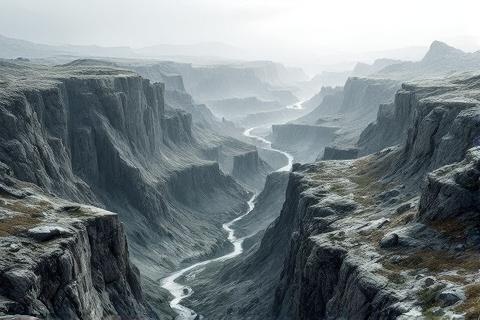
Lost in Emyn Muil: Frodo & Sam's Desperate Gamble
Before they met Gollum, two Hobbits faced a labyrinth of razor-sharp rocks, treacherous cliffs, and utter despair. This is the untold story of their harrowing journey through the barren hills of Emyn Muil.
A Wasteland of Stone
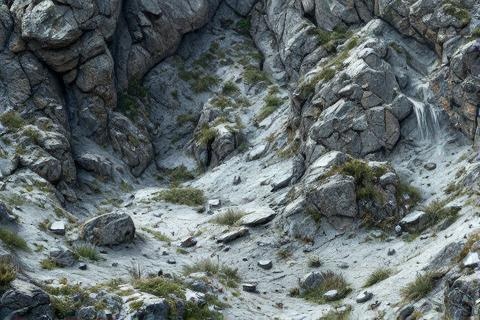
Emyn Muil is presented in The Lord of the Rings as
one of the harshest stretches of country that Frodo
and Sam ever cross, a confusing wilderness of
broken hills and stony ridges that seems almost hostile to living things, so
that when they first look upon it after the Breaking of the
Fellowship, they see no clear way forward,
only a tangle of jagged outlines and crumbling heights that promise toil and
danger rather than passage or rest.
Under their feet the ground is described as a chaos of grey stones, loose scree,
and sharp-edged ledges, with only the thinnest dusting of soil in places, so
that every step feels uncertain and tiring, and the hobbits
often find themselves slipping on sliding gravel or scrambling over broken rock,
more like climbers in a quarry than travelers on any recognizable road of
Middle-earth.
Vegetation appears as little more than an afterthought in this landscape, where
only thin, colourless grasses, pale lichens, and scraggly, thorny scrub manage
to root in narrow cracks, and Frodo and Sam see nothing like the soft turf of
the Shire or even the rough heather of the wild lands, only
these poor, tenacious plants clinging to life on the face of bare stone.
Because of this starkness, Emyn Muil gives the strong impression of a land
shaped over long ages by rupture and erosion rather than by growth or gentle
weathering, so the hills seem not to roll but to have been shattered and left in
broken heaps, as if some forgotten convulsion of the earth had splintered the
rocks and then left wind and rain to carve them into still harsher, more
forbidding forms.
The Broken Ridges and Labyrinthine Paths
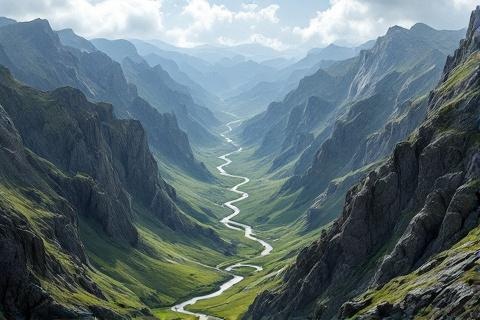
The hills of Emyn Muil are arranged in two great, broken ridges of craggy stone
that run roughly north and south, but within these lines the rocks rise and fall
in such disorder that they form a bewildering maze of gullies, knife-edged
spurs, and cramped passages, so that Frodo and Sam, once down among them, feel
as though they have entered a stone labyrinth with walls too high to climb and
no clear way out.
Such ways as they find are not real paths but narrow ledges that creep along
steep rock faces or thread the bases of cliffs, often no wider than a hobbit’s
foot, and they are easily lost when a ledge blends into another band of similar
stone or vanishes behind a fallen mass, leaving the travelers to backtrack or
risk a scramble up or down some new, untested route.
The nature of the terrain forces the hobbits into constant labours of climbing,
descending, and sidling along crumbling edges, with no level stretch where they
can simply walk, so that progress becomes a painful series of short gains and
hard-won turns, every yard earned by hauling themselves over boulders or sliding
down screes that threaten to carry them into unseen hollows below.
Cliffs, Canyons, and Sudden Drops
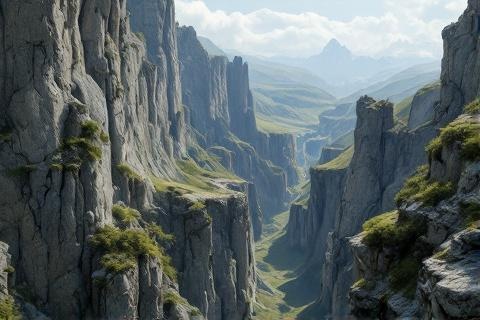
Everywhere in Emyn Muil the hills are bitten into by steep cliffs and deep
chasms that cut the ridges into separate hummocks and isolated rock-towers, so
that what might from a distance look like a single slope becomes up close a
bewildering assembly of sheer sides and sharp angles between which only the
narrowest slots permit passage, if they permit it at all.
The rock has fractured into sudden vertical faces, and the hobbits often come
without warning to the brink of drops that fall away for many fathoms, hidden
until the last steps by twists in the paths or folds of stone, making each
approach to an edge a moment of wary testing rather than a simple look ahead.
Even when they find what seems to be a usable ledge, it may end in a blank wall
or break off at an abrupt void, so that they must turn back or attempt risky
descents, and Frodo and Sam learn that in Emyn Muil the existence of a ledge
does not mean that it leads anywhere, for the land seems almost contrived to
mislead or trap them in blind corners.
In some places the long work of rain and frost has gnawed deep clefts in the
ridges, forming narrow rock corridors so tight and high that they swallow light
and sound, where a voice falls flat and footsteps seem muffled, and one can feel
as cut off from the outer world as if already in the tunnels under the
mountains.
Thin Soil and Scarce Plant Life
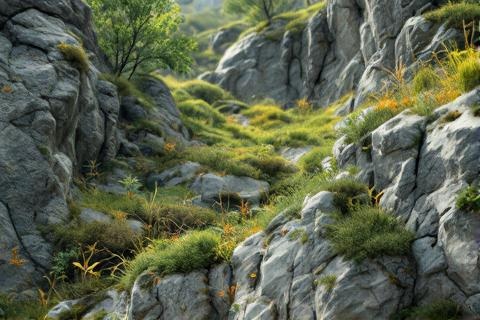
What little soil exists in Emyn Muil lies only in shallow, scattered patches,
most of it gathered as a thin crust in rock fissures or at the foot of crags
where dust has settled over the years, so that the ground seldom feels like
earth and almost always like stone with only a skin of darker grit that does
nothing to soften the hardness beneath.
In these mean holdings only the toughest plants manage to survive, such as
threadlike grasses, crusted mosses, and stunted, grey-green shrubs that crouch
close to the rock in sheltered cracks, and even these look starved of light and
nourishment, serving more to emphasize the barrenness than to relieve it, like
the hair on a skull rather than the growth on a living field.
On the higher slopes, trees are almost entirely absent, for roots cannot find
anchorage in the fractured stone, and the wind scours away what little soil
tries to collect, leaving the ridges naked and exposed to rain and frost, so
that no friendly trunk or leafy bough breaks the harsh lines of the cliffs and
ledges.
Because there is so little cover, whether of tree, bush, or even tall grass, the
hills of Emyn Muil feel far barer and more exposed than the neighbouring wooded
lands or the reed-beds of the marshes, and a traveler there soon becomes aware
of having nowhere to hide and no shelter from the eyes of any watcher who may
stand upon the higher crests.
Light, Shadow, and the Weather
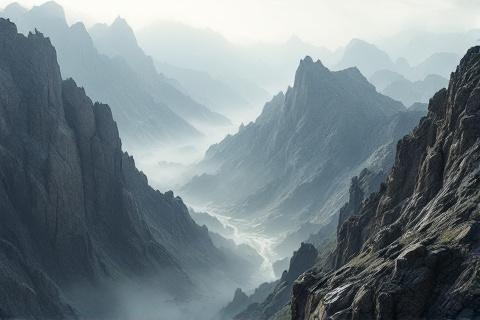
The light that falls upon Emyn Muil, whether under sun or cloud, often seems
pale or cold when it touches the grey stone, so that the whole country appears
washed of colour and sharply outlined, with little of the softening glow that
warms the Shire or Ithilien, and when Frodo and Sam look about them they see not
the greens and golds of living lands, but a severe landscape of stone that
reflects back a hard, cheerless gleam.
Because the hills are cut by deep clefts and sudden falls, the shadows they cast
are black and abrupt, lying in long, jagged shapes across the slopes or pooling
like ink in the bottoms of ravines, so that a traveler can walk from glaring
light into near-darkness in only a few steps, and distances become hard to judge
when cliffs and hollows stand half-hidden in these violent contrasts.
The wind that runs through Emyn Muil makes itself known as it whistles and moans
along the narrow gullies, funneled between the rock-walls until it seems to
speak in strange, thin voices, and at times it brings with it fine rain or
drifting mist that clings to the stone and turns the already treacherous ledges
slick, while cold droplets gather in every crack.
Weather in this broken country changes quickly, for clouds build and break on
the jagged heights, and when rain falls it turns bare rock into slippery plates
and sends loose scree sliding at the lightest tread, while in drier moments the
same gravel rolls treacherously underfoot, so the hobbits must be cautious in
both wet and dry, never sure that a foothold will hold.
Sound and Silence Among the Rocks
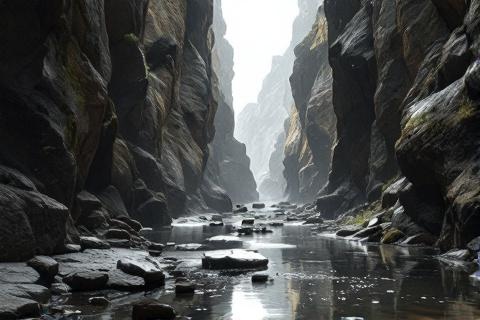
The shapes of Emyn Muil, with their angles and hollows and close-set walls,
treat sound in strange ways, swallowing some noises while throwing others back
in sudden echoes, so that a voice may seem to die only a few paces away while
the clatter of a stone rings out as if struck inside a drum, making it hard to
guess who might hear and from how far.
When Frodo or Sam dislodge loose rocks in a narrow gully, the fall of stone can
sound startlingly loud and far-reaching as it bounces from face to face,
producing sharp reports and sliding rattles that race ahead of them, and they
often pause to listen anxiously, fearing that such sounds may carry to
unfriendly ears hidden somewhere among the ridges.
Apart from these abrupt noises, the land is strangely quiet, and most of the
time the only regular sounds are the sighing or keening of the wind and the
distant murmur of unseen water, perhaps from the Anduin far
below or from streams in hidden clefts, all of it filtered and altered by the
broken country until it reaches the traveler as wandering, uncertain whispers
rather than clear, comforting voices of nature.
Wayfinding: Misleading Ledges and Dead-Ends
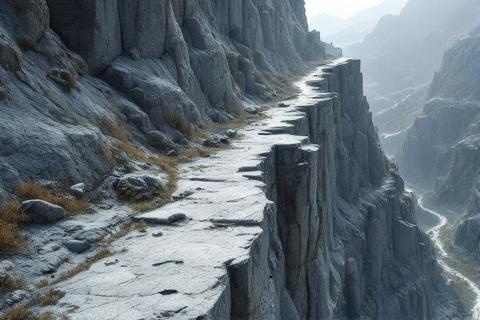
The supposed tracks and ways in Emyn Muil often reveal themselves as more
illusion than route, for a line of ledge or a beaten strip between stones will
appear to promise continuing passage, only to lead straight into a sheer face or
an impassable chimney, so that what first looked like a path proves to be no
more than a trick of perspective, and Frodo and Sam must turn aside again to
search for a new outlet.
Because so much of the landscape is made of the same grey, fissured stone, with
repeating patterns of cracks, buttresses, and small pinnacles, it is dreadfully
easy to lose all sense of direction, and the hobbits frequently find that one
hollow looks much like another and one ridge repeats the last, so they can
hardly tell whether they are gaining or only wandering in circles, climbing only
to descend again into yet another look-alike valley.
Sometimes they notice small piles of stones or arrangements that might be
mistaken for cairns, perhaps made by earlier wanderers or simply by natural
falls, yet in such a crumbling place any marker is soon toppled or buried under
later slides, so nothing can be relied upon as a sign, and what may once have
guided a traveler now lies scattered and useless among the general rubble.
Even when they manage to reach a high point and gain what should be a commanding
view, the ridges of Emyn Muil often block the line of sight to any distant
landmark, hemming them round with yet more ranks of broken hills, so that only a
glimpse of far-off haze, or later the faint glimmer of the Dead Marshes, hints
at what lies beyond the maze.
The Borders: Emyn Muil and the Wider Land
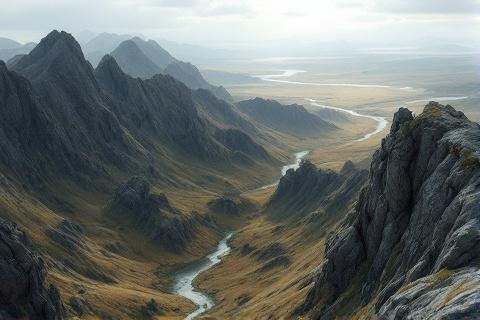
In the wider map of Middle-earth, Emyn Muil lies as a bleak belt of stone
between the more fruitful lands of the west and the darker, more sinister
lowlands that lead toward Mordor, standing like a stony girdle
along the eastern side of the Great River, so that travelers who would pass from
the green vales and woods must reckon with these broken hills or seek some long
way around.
From certain notches or summits along its ridges, one can just catch sight of
broader features that mark the world beyond the labyrinth: the silver line of
Anduin flowing southward in its deep cloven bed, or, to the east and south, the
low-lying fens of the Dead Marshes and the shadowed plains that trend toward the
Mountains of Shadow, all seen as distant, hazy shapes beyond the immediate chaos
of rock.
The stark difference between Emyn Muil and its neighbours is striking, for
beyond its flanks lie the brown, waterlogged wastes of the marshes or, further
off, the green lands that still hold grass and tree, and these contrasts only
underscore how bare, fractured, and lifeless the hills themselves appear, as if
they belong less to the living world and more to some ancient ruin of the
earth’s making.
Because of its position thrust across the way between the River and the plains
beyond, Emyn Muil stands as a visible but stubborn barrier in the region,
difficult to cross and easy to become lost in, and this is why Frodo and Sam,
forced to approach Mordor from the east after the Fellowship’s breaking, find
themselves entangled in its cliffs and ravines, until the coming of
Gollum and his hidden knowledge of paths gives them at last
a doubtful road out of that stony trap.