
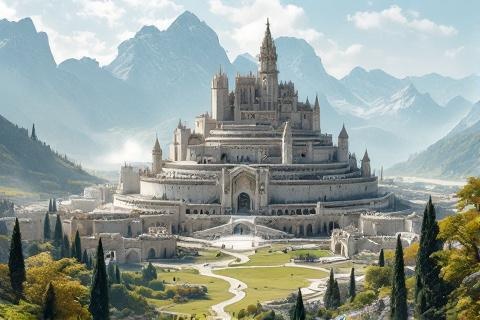
Minas Tirith: The Seven-Tiered Citadel of J.R.R. Tolkien's Legendarium
Unveiling the Secrets of Gondor's White City, from its Origins as Minas Anor to the Epic Siege of the Pelennor Fields and its Restoration under King Elessar.
Origins and Names: From Minas Anor to Minas Tirith
Minas Tirith began its existence in the Second Age as Minas
Anor, the Tower of the Sun, raised by Anárion, the younger son of Elendil, as a
companion to his brother Isildur’s eastern fortress of Minas
Ithil, and Tolkien notes in “The Lord of the Rings” and in
the appendices that this city on the western flank of Mindolluin formed part of
the early strength of the realm of Gondor, with Anárion ruling
there while Isildur held Osgiliath and his own city to the
east, so that Minas Anor stood from the beginning as both a royal residence and
a guard-post against threats that might creep in from the South or rise again in
the shadow of Mordor after the fall of
Sauron in the War of the Last Alliance.
From the start Minas Anor and Minas Ithil were conceived as twin watch-towers
that faced different dangers, with Osgiliath between them as the chief city on
the Anduin, and the books describe how the two mountain-cities
balanced one another across the Great River, one guarding the approaches from
the West and South, the other watching the Ephel Dúath and the borders of
Mordor, so that together they formed a great defensive triangle around Osgiliath
and the heartlands of Gondor in the early days of the kingdom when the Dúnedain
still held wide lands and their power had not yet waned.
The name Minas Tirith, meaning Tower of Guard in Sindarin, came into use only
after Minas Ithil fell to the Nazgûl late in the Third
Age, and the chronicles in the appendices explain that when the
Ringwraiths captured Minas Ithil and it became Minas
Morgul, the Tower of Sorcery, Minas Anor was renamed to
mark its new primary burden as the chief guard against Mordor, so that its very
title announced its function as the last vigilant stronghold that still faced
east in defiance of the returning Shadow.
As the centuries of the Third Age passed, the identity of the city shifted with
the fortunes of Gondor, so that its history mirrors the line of kings and
stewards who held it, for in the time of glory it shone as a royal city with
kings dwelling in the high house, yet in the long years of decline and plague
and war it became a stern fortress of the Stewards, its splendor fading even as
its walls remained strong, until by the War of the Ring the Guarded City carried
in its stones the memory of lost kingship and the stubborn endurance of a people
that refused to abandon their watch against Sauron.
The Seven Levels and Concentric Walls

Minas Tirith is described as a city of seven concentric levels or circles, each
one built higher up the rocky shoulder of Mindolluin than the last, so that the
structure climbs the mountain like a great stair, and Tolkien’s narrative
emphasizes how the walls and ramps rise tier upon tier, giving the whole place a
sense of layered strength and height that reflects the ancient
Númenórean skill in stonework and the patient labor of
generations who extended and strengthened the city over many centuries.
Each of these seven tiers forms a walled ward with its own gate, streets, and
inner life, and the text makes clear that the road does not climb straight but
passes through each level in turn, so that every circle can be closed and
defended separately, which means that an enemy who breaks the Great Gate still
must fight again and again up through new walls and narrow ways toward the
Citadel that crowns the summit, turning the entire plan of the city into a
series of defensive platforms that narrow as they rise.
From a distance the city appears, as Pippin first sees it, like a vast cone of
white stone cut into steps, with each level set back a little from the one
below, and this form, rising sheer from the plain of the
Pelennor, makes Minas Tirith visible for many miles in
clear weather, gleaming by day and standing pale in the moonlight by night, so
that it becomes a landmark and a sign of Gondor’s endurance to all who travel
the great roads that cross the lands near the Anduin.
The lowest and broadest ring opens outward toward the Pelennor Fields and the
Great Gate, taking in the traffic of wagons, farmers, and soldiers who pass
between city and plain, while each higher circle grows tighter, steeper, and
more restricted, so that the upper wards contain fewer and more important
houses, and by the time one reaches the seventh level the city has become a
compact stronghold of stone dominated by the Citadel and the high tower from
which the rulers of Gondor look east toward the shadow of Mordor.
The Citadel, the White Tree, and the Court of the Fountain

At the very top of the seventh level stands the Citadel, a strong but relatively
small fortress built of pale stone, centered on the high Tower of Ecthelion that
rises above all, and within this compact space lie the great hall of the rulers,
the guard-houses, and the inner court, so that the summit of Minas Tirith
combines both a military redoubt and the chief seat of government from which the
Steward, and later King Elessar, can look down
on every tier of the city and out across the Pelennor and the Anduin to the dim
eastern lands.
In the Court of the Fountain behind the Citadel, Tolkien places the White Tree
of Gondor, which in the time of Denethor stands
dead and leafless as a sign of the long absence of the rightful king, and this
tree, descended from the Nimloth of Númenor and ultimately
from the Eldarin trees of Aman, marks the true kingship of Gondor, so that its
withering foretells decline and its renewal under Aragorn in the Fourth
Age becomes a visible pledge that the ancient line and the
favor of the West have been restored.
The pale walls of the Citadel and the lone figure of the White Tree together
form the most symbolic point of the city, since the stone expresses the lasting
strength of the Dúnedain while the tree embodies their living hope and
connection to the Elder Days, and Tolkien’s descriptions dwell
on how this contrast of hard stone and frail branches, death and rebirth, makes
the court behind the tower not only the highest physical place in Minas Tirith
but also the spiritual heart of the realm.
Around the Citadel cluster various halls, guard-rooms, and houses for the chief
servants and captains of the Steward, all drawn close to the crown of the
mountain, and from this crowded yet ordered summit the rulers of Gondor can
survey all seven levels below them as well as the sweep of the Pelennor and the
bends of the Anduin, which reinforces the sense that the Citadel is both the
head of the city’s body and the watchful eye that oversees its defense and its
governance.
Materials, Color, and Architectural Character
The city bears the name the White City in many passages because its walls and
many of its buildings are made of pale dressed stone that catches light readily
so that, as the narrator and characters note, it glows in the morning and gleams
in moonshine, and this whiteness, though weathered by age and smoke of battle,
sets Minas Tirith apart from the darker fortresses of Mordor, presenting it as a
beacon and a memory of the high craft of Númenor.
Within those walls the buildings rise in tight ranks, often terraced or stepped
in order to cling to the curve of each ring and the natural slope of the
mountain, and Tolkien hints that the houses of the higher levels are more noble
and spacious while those of the lower tiers are humbler and more crowded, yet
everywhere the stonework follows the lines of the circles so that the domestic
life of the people is literally shaped by the great arcs and climbing ways of
the city’s design.
Towers, bastions, and battlements stand at intervals along the walls and at key
corners, giving the skyline its distinctive forest of sharp shapes, and the
combined effect, as seen by characters like Gandalf and
Pippin, is one of majesty and severity, for Minas Tirith appears less as a place
of colorful decoration than as a stern, ordered, and ancient stronghold whose
beauty lies in its proportion, endurance, and the disciplined pattern of its
towers and courts rather than in rich ornament.
Gates, Roads, and the Winding Approach

A single principal road threads through the heart of Minas Tirith, beginning at
the Great Gate and winding upward by sharp turns, passing each successive gate
and ward, so that anyone who wishes to reach the Citadel must follow this
ascending path, which is described as long and steep and gives a clear sense of
climbing through layers of the city’s life from the busy outer circles up to the
quieter and more solemn spaces near the top.
The Great Gate itself faces eastward onto the Pelennor plain and is heavily
defended with iron and stone, guarded by the walls and by the silent figure of
the stone sentinel, and during the War of the Ring it becomes the crucial point
of attack where Grond, the great battering ram from Mordor, is brought to bear,
showing how this entrance controls the main approach to the city and how the
outer wall is the first but most dramatic test of Gondor’s resolve.
Inside the walls, the steep streets that climb from gate to gate are often cut
close against the rock and broken by many stairways and narrow passages between
terraces of houses, as Pippin’s journey with Gandalf reveals, and this internal
arrangement not only suits the mountain’s shape but also makes the city feel
like a knot of stone paths where people move more by foot up and down steps than
by straight roads, creating a vertical life that differs from the flatter towns
of Rohan or the Shire.
The rising way to the Citadel moves in exposed bends that any watcher on the
walls can observe, and this means that an enemy who tried to storm upward would
be visible and vulnerable at many points, which turns the very layout of the
city into a weapon, forcing an assaulting force to advance slowly and in narrow
files under the eyes and arrows of defenders who can see every turn and gate
long before it is reached.
The Surrounding Landscape: Mindolluin, the Pelennor, and the Anduin

Minas Tirith is set upon the western shoulder of Mount Mindolluin, the last and
westernmost of the White Mountains, and the city seems almost to grow out of the
living rock of the spur that thrusts eastward, so that its foundations are
rooted deep in the mountain and the high rear of the city is backed by sheer
cliffs, which strengthens its defenses and links it closely to the great range
that runs like a backbone behind the lands of Gondor.
Below the eastern face of the city lies the wide, encircling Pelennor Fields,
which are fenced by the Rammas Echor and stretch down toward the Great River
Anduin, and beyond that the river bends southward past Osgiliath, so that Minas
Tirith stands as a kind of balcony above its farmlands and the main waterway of
the realm, depending on the Pelennor for food and open ground while watching the
traffic that passes on the Anduin to the sea.
From the upper circles and especially from the Citadel, the view eastward takes
in the full breadth of the Pelennor, the line of the river, and the hazy forms
of far mountains, and in the story this perspective is crucial, for it allows
the watchers of Gondor and their allies to see fires and marching hosts long
before they reach the walls, and it also impresses visiting characters with a
sense of standing on the last great western outpost that looks across wide lands
toward the dark frontier of Mordor.
Defenses, Lookouts, and Strategic Siting
The combination of concentric rings and the hard climb from level to level makes
Minas Tirith a naturally defensive city, because any enemy must fight uphill
through a series of narrow gates and walled enclosures, and Tolkien often
stresses how the sheer stone, the narrow ways, and the great height all work
together with the Númenórean engineering to turn the city’s plan and terrain
into a layered fortress that can continue to resist even if one or more circles
fall.
Along each ring rise towers, battlements, and projecting bastions from which
soldiers can look out over the Pelennor and the roads that lead toward Osgiliath
and the river-crossings, and this arrangement creates overlapping fields of view
and fire so that watchmen and archers on different levels can support one
another, making it difficult for an enemy to approach unseen or to concentrate
their assault on a single stretch of wall without drawing missile fire from
several directions at once.
By its very placement Minas Tirith serves as a watch-post over the eastern plain
and the broad Anduin, for it commands the approaches from the east and northeast
and serves as a final shield before the heartlands of western Gondor, and
throughout the narrative it is clear that the Stewards and their captains
understand the city as the last great guard-station of Men against
Mordor, from which they can send out scouts, signal allies, and hold the line
while keeping constant watch for any stirrings in the Black Land.
Life Within the Rings: Districts, Public Spaces, and the Court

Within the seven circles the tiers are not all alike, since each contains its
own mixture of workshops, dwellings, storehouses, and small courts that are
fitted to the rising ground, and though Tolkien does not give a full map of
these inner quarters he implies that the lower levels are busier with crafts,
trade, and the movement of common folk, while the higher circles hold more noble
houses, armories, and administrative quarters, so that the social and practical
life of Gondor is arranged physically along the upward path of the city.
At the summit, the Court of the Fountain with the White Tree and the surrounding
halls of the Citadel form the ceremonial and administrative heart of Minas
Tirith, for here the Steward or King holds council, receives envoys, and renders
judgment, and the formal spaces described in “The Lord of the Rings” give a
sense of ancient ritual and dignity, with guards in livery, the long dark hall
with its pillars and great chair, and the bright open court outside where the
fate of the kingdom is silently symbolized in the state of the Tree.
Between the walls and houses, many terraces, gardens, and waterworks are hinted
at, with cisterns and channels bringing water down from higher springs so that
even in wartime the city can sustain its people, and these features, along with
the many narrow streets and side alleys, shape daily life so that citizens live
in a close yet ordered environment where stone and cultivated greenery are
interwoven, especially in the higher circles where the great houses maintain
courts and tended plots.
Public squares and open places within Minas Tirith tend to be modest in size and
framed tightly by the strong, regular lines of the city’s architecture, and this
gives communal gatherings, markets, and ceremonies an intimate yet formal
character, since the people come together in spaces that are always overlooked
by walls, towers, and official buildings, reinforcing the sense that life in the
Guarded City takes place under the shelter of a strong but somewhat stern civic
order.
Symbols, Names, and Heraldry of the White City
The White Tree stands in Tolkien’s work as the chief emblem of Gondor’s unbroken
line and the special role of Minas Tirith as the seat of the kingdom, because it
is bound by descent to the ancient Trees of the Eldar and to the royal lineage,
and its presence or absence in the Court of the Fountain directly reflects
whether a rightful king of the house of Elendil rules in the land, so that the
dead tree in Denethor’s time expresses a long interregnum and the new sapling in
Aragorn’s day proclaims the renewal of true kingship.
The names Minas Anor and Minas Tirith carry layered meanings drawn from Sindarin
and older tongues preserved by the Dúnedain, for Minas Anor, Tower of the Sun,
recalls the bright westernward aspect of the city in the days of earlier kings,
while Minas Tirith, Tower of Guard, emphasizes its later destiny as a military
bulwark, and in the appendices Tolkien links such names to Númenórean habits of
honoring celestial lights and watchful guardianship, showing how language
records shifts in history and purpose.
The whiteness of the city’s stone, together with the high Citadel and the White
Tree, makes Minas Tirith into a focused emblem of Gondor’s authority and
identity, since from far away its pale walls and tower signal the presence of a
great realm of Men still standing against the Shadow, and within, the
combination of royal court, sacred tree, and ancient halls marks it not merely
as a military fortress but as the rightful center of law, memory, and governance
for the surviving Dúnedain of the South.
Minas Tirith Restored: The City after the Reign of Elessar

After the downfall of Sauron and the crowning of Aragorn as King Elessar, the
chronicles indicate that Minas Tirith’s walls, gates, and buildings were
repaired and renewed, healing the damage of the siege and long years of neglect,
and these labors, carried out in a time of peace with aid from many peoples,
restored the strength and beauty of the Guarded City so that it could once again
serve not just as a bastion against enemies but as the capital of a reunited
kingdom that stretched from Arnor in the north to Gondor in the
south.
In the early years of the Fourth Age a new sapling of the White Tree was found
on the slopes of Mindolluin and planted in the Court of the Fountain, and this
young tree, which soon put forth leaves and flowers, became the central sign of
the city’s renewal, since its living growth under the rule of King Elessar and
Queen Arwen showed that the grace of the West still
touched Middle-earth and that the broken line of
kingship, long preserved only in memory and prophecy, had truly been
reestablished.
The restorations under the new king emphasized not radical change but the
cleansing and repairing of what already existed, with the pale masonry cleaned
of smoke and blood and the terraces, walls, and houses put into good order
again, and Tolkien’s brief notes suggest that the ancient Númenórean character
of the city was honored rather than replaced, so that Minas Tirith in the Fourth
Age shone more clearly as it had been meant to look when first founded in the
elder days.
Even after its renewal Minas Tirith kept its seven-tiered form with the Citadel
still crowning the highest level, and in this continuity of shape and function
the city carried forward the memory of Elendil, Anárion, and the Stewards into
the Age of Men, standing once more as the Tower of Guard but now in a time when
its vigilance supported not desperate defense against an overwhelming foe but
the ordered peace of a king who had finally fulfilled the long watch of Gondor.