

Legolas Greenleaf: Prince of the Woodland Realm
The Elven Archer Who Became a Legend
An Elf Prince from Mirkwood

Legolas was a Sindarin Elf, a line of Elves also known as the
Grey Elves, who never completed the journey to the Undying
Lands in the West. He came from the Woodland
Realm, located in the northern part of a great forest
called Mirkwood. This forest was once known as Greenwood the
Great, but it became a dark and dangerous place under the shadow of the evil
sorcerer Sauron. The Elves of the Woodland Realm lived deep
within the forest, protecting their home from giant spiders and other foul
creatures that lurked there.
As the son of the Elvenking Thranduil, Legolas was a
prince among his people. King Thranduil was a powerful and ancient Elf who had
ruled the Woodland Realm for a very long time. He was known for being proud and
wary of outsiders, especially after centuries of fighting the darkness that
surrounded his kingdom. Growing up as the son of such a king, Legolas was a
skilled warrior and a noble leader, fiercely loyal to his father and his people.
The name Legolas Greenleaf is deeply connected to his woodland home and
heritage. In Sindarin, the language of the Grey Elves, his name is a combination
of 'laeg', which means 'green', and 'golas', which means 'a collection of
leaves' or 'foliage'. The name Greenleaf is simply a translation of his Elven
name into the Common Speech of Middle-earth. This fitting
name reflected his identity as a Wood-elf, at one with the trees and forests of
his realm.
Like all Elves, Legolas possessed a timeless quality that made him appear
ageless and youthful to mortal eyes. However, he was ancient by human standards,
having lived through many centuries in Middle-earth before the events of the War
of the Ring. While his exact age is not mentioned in the stories, it is clear
that he had seen the world change over vast stretches of time, giving him a
wisdom and perspective that his mortal companions could not match.
The Eyes and Ears of the Fellowship
Legolas traveled to Rivendell as a messenger from his father,
to bring the news that the creature Gollum had escaped from
their watch in Mirkwood. He arrived just in time to take part in the great
Council of Elrond, where the fate of the One
Ring was decided. When the Fellowship of the
Ring was formed, Legolas was chosen to be the
representative for the Elves. His inclusion ensured that the wisdom, skill, and
ancient strength of the Elven-kind would aid the quest to destroy the Ring.
Within the Fellowship, Legolas's primary duties were to serve as a scout and an
archer. His role was vital for the survival of the small group as they traveled
through dangerous lands. With his sharp eyes, he could see threats from far
away, and with his bow, he could defend his companions from a distance. He was
the eyes of the company, always watchful and ready to react to danger with
incredible speed.
The physical abilities of Elves were far beyond those of mortals, and Legolas
was a prime example of this. He had incredibly sharp senses, particularly his
eyesight. His vision was so keen that it seemed like magic to his friends. He
could see with perfect clarity over vast distances, allowing him to spot things
that were completely invisible to Men, Dwarves, or
Hobbits. This skill proved useful time and time again, giving
the Fellowship an early warning of approaching enemies.
There were many times when his amazing eyesight gave his companions a great
advantage. While chasing the Uruk-hai across the plains of
Rohan, Legolas could see for miles, describing the enemy riders
and their gear in detail while his companions
Aragorn and Gimli could see nothing but tiny
specks on the horizon. He was able to count the number of riders from over
fifteen miles away, a feat that showed the huge difference between the senses of
Elves and other races.
Master of the Bow and Blade

Legolas was a master archer, and his skill with the bow was legendary. He moved
with a natural grace and his aim was almost perfect, allowing him to make shots
that would be impossible for any human archer. Early in the Fellowship's
journey, as they traveled down the river Anduin at night, he
shot down a giant flying creature of a Nazgûl with a single
arrow in the dark. This incredible shot filled his companions with hope and
showed them the true extent of his abilities.
When he left Mirkwood, Legolas carried a short bow made by his own people. It
served him well, but when the Fellowship reached the Elven realm of
Lothlórien, he received a special gift from the Lady
Galadriel. She gave him a new bow, longer and stronger
than his old one, strung with a strand of Elven hair. This powerful weapon
allowed him to shoot farther and with greater force, making him an even more
formidable warrior in the battles to come.
Although he was most famous for his archery, Legolas was also deadly in close
combat. He was incredibly fast and agile, able to move through a fight like a
blur. For close-quarters fighting, he carried a long, white knife. He wielded
this weapon with amazing speed and precision, capable of defending himself
against multiple enemies at once. Whether at a distance or up close, Legolas was
a graceful and dangerous opponent to any who served the enemy.
Light-Footed and Tireless
One of the most remarkable abilities Legolas possessed was the Elven trait of
being incredibly light on his feet. This was more than just being nimble; it was
a fundamental difference in how Elves interacted with the world. They could move
with a grace that left little trace of their passing, allowing them to travel
silently and swiftly through any terrain, which made him an excellent scout for
the Fellowship.
This special ability was clearly demonstrated when the Fellowship tried to cross
the snowy mountain pass of Caradhras. While the others were forced to struggle
through deep snow that exhausted them, Legolas could walk lightly on top of the
snow's crust. He left almost no footprints, as if he were floating over the
ground. This allowed him to move ahead of the group to look for a clear path
without sinking into the deep drifts.
Elves also had a different way of resting than mortals. They did not require
long hours of sleep to recover their strength. Instead, Legolas could enter a
state where his mind rested and found peace while his body remained awake and
alert. This meant he could recover from weariness while still being able to
watch for danger, making him a perfect guard for the company during their
perilous journey.
His Elven endurance was nearly limitless, which allowed him to perform amazing
feats of travel. The best example of this was when he, Aragorn, and Gimli
pursued the Uruk-hai who had captured Merry and Pippin. For three days, they ran
across the plains of Rohan without stopping to rest. While Aragorn and Gimli
were pushed to the very edge of their strength, Legolas ran lightly and without
tiring, never losing hope.
An Unlikely Friendship
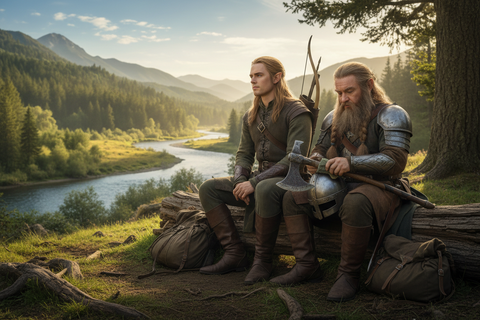
For thousands of years, there had been a deep-seated distrust between Elves and
Dwarves. This ancient conflict stemmed from betrayal and war in ages past, and
the bitterness had been passed down through generations. Legolas, whose father
had once imprisoned Thorin Oakenshield and
his company of Dwarves, naturally shared this prejudice. When he first met the
Dwarf Gimli, son of Glóin, they were cold and suspicious toward one another.
However, their journey as members of the Fellowship of the Ring forced them to
rely on each other for survival. As they faced dangers together in the mines of
Moria, defended each other in battle, and shared the hardships of the road,
their initial hostility began to melt away. A grudging respect grew between
them, which slowly blossomed into a true and powerful friendship based on
loyalty and shared experience.
The friendship that grew between Legolas the Elf and Gimli the Dwarf became a
famous story in its own right. In a world divided by old hatreds, their bond was
a symbol of hope and reconciliation. It showed that even the most ancient
prejudices could be overcome through understanding and companionship. Their
friendship became a testament to the idea that unity could be found even between
the most different of peoples.
A key moment that cemented their bond occurred after they left the golden wood
of Lothlórien. When they met Éomer of Rohan, the Man spoke disrespectfully of
the Lady Galadriel. Gimli's fierce defense of her honor nearly started a fight,
but Legolas immediately stepped forward to support his friend. He drew his bow
and warned Éomer that he would not allow anyone to speak ill of the Lady or harm
his friend, proving that his loyalty to Gimli was absolute.
The Call of the Sea
As a Wood-elf, Legolas had a profound and deep-rooted love for the natural
world, particularly for forests and trees. His entire life had been spent under
the canopy of Mirkwood, and he felt a kinship with all growing things. He
grieved to see forests harmed, as he did when he saw the destruction caused by
the wizard Saruman around Isengard. For
Legolas, the health of the trees was connected to the health of the world
itself.
This deep connection to the woods was unexpectedly challenged late in the War of
the Ring. As he and his companions neared the sea at Pelargir in
Gondor, Legolas heard the crying of seagulls for the first time
in his long life. The sound awakened something ancient and powerful within him:
a deep and unstoppable longing for the Sea. From that moment on, he would never
be completely at peace again in the forests of Middle-earth.
This 'sea-longing' is a powerful calling that affects many Elves. It is a
spiritual pull toward the Undying Lands of Valinor, which lie
across the Great Sea to the West. This was the original home of the Elves, and
the sea-longing was a deep yearning to return there and leave the fading lands
of Middle-earth behind. Once awakened, this feeling could never be ignored.
Despite this newly awakened desire, Legolas was a loyal friend. He had made
promises to his companions, especially to Aragorn and Gimli, and he would not
abandon them. He vowed to remain in Middle-earth for as long as his friends
lived, helping to heal the world after Sauron's defeat. However, the call of the
waves and the cry of the gulls would now forever be in his thoughts, a constant
reminder of his final journey.
After the War of the Ring

After the final victory and the crowning of Aragorn as King Elessar, Legolas did
not immediately return to his home in Mirkwood. He first had to keep a promise
he had made to his friend Gimli. During the battle at Helm's Deep, the two had
agreed to visit the wonders of each other's worlds. True to his word, Legolas
traveled with Gimli to the Glittering Caves of Aglarond, located behind the
Hornburg, and was amazed by their stunning, jewel-like beauty.
Following his travels with Gimli, Legolas received permission from King Elessar
to lead a group of Elves from his homeland to settle in Ithilien. This beautiful
region in Gondor had been badly damaged during the long wars with Sauron, and
its forests were in need of healing. Legolas and his people came south to live
there, eager to use their Elven skills to restore the land to its former glory
and make it a green and peaceful place once more.
For many years during the Fourth Age, Legolas lived as the
lord of the Elves in Ithilien. Under his care, the land flourished and became
one of the fairest domains in all of the Westlands. The Elves of his company
replanted its gardens and forests, and their songs could once again be heard in
the woods. His work helped to symbolize the great healing of Middle-earth that
began with the start of King Elessar's reign.
The final chapter of Legolas's story in Middle-earth came long after the War of
the Ring, when his friend King Aragorn passed away after a long and peaceful
rule. With his friend gone, Legolas finally felt ready to answer the call of the
Sea. He built a grey ship in Ithilien and sailed down the Anduin River and out
into the Great Sea. In a final act of their legendary friendship, he took Gimli
the Dwarf with him, an honor never before granted to any Dwarf, allowing his
dear friend to see the Undying Lands.