

The Ride of the Rohirrim
Galloping to Glory at the Battle of the Pelennor Fields
Opening Image: The Thunder of Hooves

The Ride of the Rohirrim bursts into Tolkien’s story as a single, thunderous
moment when history seems to turn in the space of a few heartbeats, for with one
great charge the horse-lords of Rohan crash into Sauron’s armies and change the
fate of beleaguered Gondor. Outnumbered and almost too late,
they arrive like a storm on the plain, their coming long prepared by oaths,
friendship and duty. In that fierce rush of hooves, horns and battle-cries, the
scattered hopes of the West suddenly gather themselves, and the darkness that
has closed over Minas Tirith shudders and begins to
break.
The Pelennor Fields stretch wide and
grey before the walls of Minas Tirith, a great crescent of land that lies
between the White City and the dark river Anduin, and it is here that the drama
of the Rohirrim’s ride unfolds. Above the plain rise the seven levels of the
city, white-walled and tiered against the stone shoulder of Mount Mindolluin,
its banners once bright but now dimmed by smoke and shadow. Around those walls,
Sauron’s hosts have spread like a stain, with siege-towers, engines, and cruel
fires, so that the green fields are trampled and scarred, and the ground itself
seems to groan under the weight of war.
From the first glimpse of the Rohirrim’s host on the darkened ridges to their
final, desperate charge, their ride is marked by a strange blend of swiftness,
fierce courage and an awareness of looming doom that hangs over king and riders
alike. Tolkien describes their movement as like a grey tide rolling in from the
North, yet woven into that image is the knowledge that many will not ride back
again. The Ride of the Rohirrim is therefore not only a moment of rescue and
glory, but also a ride into peril accepted with clear eyes, where honor and love
for their allies drive them to face near-certain death with raised spears and
unshaken hearts.
The Call from Gondor: Why Rohan Rode
Gondor’s need became desperate when the great armies of Mordor
crossed the river and ringed Minas Tirith about, so that the walls were battered
by rams and fire while black sails moved upon the Anduin, and in that hour the
Steward Denethor at last sent out the Red Arrow as a plea for aid to Rohan. As
the beacons on the mountain-tops leapt into flame one after another, they
carried the silent cry that Gondor was besieged and near to ruin. The message
that reached Rohan was not only a formal summons, but a sign that the last
stronghold of the West was about to fall unless its ancient ally answered
swiftly.
The call for help crossed leagues of wild country and came in person to King
Théoden at Edoras, brought by Hirgon bearing the Red Arrow, and
the Rohirrim answered because long ago the Men of the Westfold had
sworn oaths of friendship and mutual defense with the lords of Gondor. Théoden
remembered how Gondor had aided Rohan in past need, and he would not let that
bond wither in the face of Sauron’s might. Even though Rohan had just staggered
from war in its own lands, with scars from the battles of the Hornburg and the
Fords of Isen still fresh, the king chose to ride rather than turn away from an
ally’s ruin.
Rohan’s swift answer shows that in the Third Age the alliance
between the two realms was not an empty tradition but a living duty that shaped
the great events of the War of the Ring. Tolkien’s narrative makes clear that
without Rohan’s response, Gondor might well have fallen before
Aragorn could bring reinforcements by the
river. The Ride of the Rohirrim becomes proof that in
Middle-earth, ancient oaths and mutual loyalty between
kingdoms can still stand firm against the overwhelming power of Mordor, and that
such bonds hold back the darkness when all other defenses seem to fail.
Gathering at Edoras: The Mustering of Horse and Man

When the Red Arrow and the tidings of Gondor’s siege reached Meduseld, Théoden
did not delay but summoned his people at once, sending riders through the
Riddermark so that men left plough and hearth behind and gathered at Edoras.
Farmers who had only recently driven off the foes at Helm’s Deep now put aside
the tools of peace and took up spears once more, while household riders and
marshals reported to their king in the golden hall. The decision to ride was not
made lightly, yet the response was broad and swift, for the people of Rohan
understood that if Gondor fell, Rohan’s own doom would soon follow.
The Rohirrim moved with the efficiency and speed of a folk bred to the saddle,
and in Tolkien’s account their preparations for war feel like a single, flowing
motion as horses are brought from the fields, hooves shod, harness tightened,
and weapons gathered. Spears were chosen and balanced, shields unhooked from
walls and huts, and packs made ready for a hard journey with little sleep. Horns
sounded across the uplands as messengers called the muster, and the long, low
notes answered each other among the hills, until the land itself seemed to stir
and awaken to war.
As they armed for the march, the mood among the riders mixed pride in their king
with quiet fear and a grim resolve, for many had already buried kin after the
battles with Saruman and knew what awaited them beyond
their borders. Men put on mail that had seen their fathers’ wars, tightened worn
belts around hauberks patched and mended, and braided the manes and tails of
their horses with simple tokens and small charms of home. They spoke in low
voices, some sharing jests, others silent, yet beneath it all ran the sense that
they rode now not just for Rohan, but for the fate of all the Free Peoples, and
that this might be the last ride for many among them.
The Long Road: March to Minas Tirith
When at last Théoden led his host from Dunharrow, the Rohirrim rode hard over
the uplands and vales of their own land, covering long miles each day as they
made for the forgotten road through the Stonewain Valley and so toward Gondor.
Tolkien hints at the strain of this journey by showing how the muster stretches
out over the hills like a river of riders, each company keeping pace despite
weariness. Yet the need of Gondor drove them on, and the king’s presence at the
head of the host held their spirits together as they crossed their fields for
what might be the final time.
The march did not pause with the setting sun, for they traveled by night as well
as by day, threading their way through dim dales, chill uplands, and damp
lowlands where mist clung about the horses’ legs. In the Stonewain Valley they
rode under the guidance of Ghân-buri-Ghân and the Wild Men, hurrying unseen
through the wooded hills while the great road below lay watched by the enemy.
The riders endured little sleep and rough food, yet they urged their mounts
forward, whispering to them and trusting in the strength and loyalty of the
horses that shared their fate.
Through this relentless pace and strict order, the gathered companies of
herdsmen, household knights, and border-riders became a single, disciplined host
that moved like one living creature. Tolkien makes clear that these were not
knights drilling on a field, but free men of a horse-people whose long habit of
riding together now hardened into an army fit for sudden war. Lines were kept,
scouts sent out, and messages flown along the column, so that by the time they
reached the outer lands of Gondor, the Rohirrim were no longer scattered riders
of the Mark, but the full strength of Rohan forged into a swift spear aimed at
the heart of Sauron’s assault.
Horses, Gear and the Culture of Riders

In Rohan, horses are not simply useful beasts but lie at the very heart of the
people’s identity, so that their land is called the Mark of the Riders and their
greatest pride is in their strong, swift, and sure-footed mounts with flowing
manes. Tolkien gives the Rohirrim names like the Mearas for the noblest horses,
such as Shadowfax, and shows how deep the bond runs between horse and rider.
These animals endure long journeys and terrible noise without breaking, and they
respond to the voice and touch of their masters as if sharing one mind, which
makes the charge on the Pelennor not just a feat of men, but of horses who share
in the courage and cost.
The gear of the riders matches their way of war, for Tolkien describes them
wearing mail-shirts of linked rings, bearing round shields, and carrying long
spears or lances that can be couched for a charge or wielded in close fighting.
Their helms are simple but sturdy, often with horse-tail crests or small
decorations that speak more of function than of courtly display. Swords hang at
their sides for battle once a charge breaks apart, and many carry small daggers
as well, so that from head to foot their arms are shaped to serve a people who
must fight from the saddle in wind, rain, or sudden ambush on the grasslands.
They ride beneath banners marked with the emblem of the white horse on a green
field, the sign of the House of Eorl and of Rohan itself, and these flags stream
out proudly over the host as they move toward Minas Tirith. Horns and trumpets
are also central to their command, for on the wide plains signals must carry
far, and the great horns that sound the charge or call a rally can be heard
above the thunder of hooves. On the Pelennor, these horns cry out over the din
of battle, giving shape and order to the chaos as captains guide their éoreds by
sight of banner and sound of note.
The Rohirrim fight as cavalry before all else, and Tolkien shows them relying on
speed, the weight of horse and rider, and the perfect timing of their formations
to smash into enemy ranks like a hammer-blow. Unlike heavy foot-soldiers, they
do not dig in behind shields but move and strike, wheeling and reforming to
attack weak points again. Their strength lies in striking at the right place and
moment, with many lances leveled as one, and in the close coordination between
king, marshals, and riders that lets their army surge forward like a single,
overwhelming wave.
Arrival at the Pelennor Fields: Sight and Sound

When at last the long ride ended and the Rohirrim looked out from the heights
above the Pelennor, they saw the wide plain spread like a darkened sea beneath
them, crowded with the tents, engines, and banners of both Gondor and the enemy,
though Gondor’s signs were nearly swallowed in the press of Mordor’s armies.
Great siege-towers and monstrous rams clustered near the city’s gates, while far
lines of Orcs, Haradrim, and other servants of
Sauron ringed the walls in layer upon layer of steel and
malice. The Rohirrim understood at once that they faced not a raid or border
war, but the main strength of the Dark Lord brought up against the last
stronghold of Men in the West.
The air above the plain was already alive with sound even before the charge
began, filled with the distant calls of horns and trumpets, the beat of
war-drums, and the creak and crash of siege-engines hurling stones and fire
against Minas Tirith. As the riders moved into formation and the hooves of
thousands of horses shifted and stamped, a deep rumble joined that storm of
noise, like thunder rolling far off before a storm. Mail and weapons clanked as
men adjusted gear and checked straps, and when the horns of Rohan finally rang
out in answer to Gondor’s call, the overlapping sounds became a single,
overwhelming rush that seemed to shake both earth and air.
Before them the white walls of Minas Tirith rose proud yet beleaguered, now
stained with smoke and ringed by flames, and the sheer scale of the enemy host
around it filled many hearts with a sharp spike of fear even as it hardened
their will. Tolkien shows the riders catching sight of the city they had come to
save at the very edge of ruin, with the main gate under the assault of the great
ram Grond and fires burning in the lower circles. That vision of a noble city
hard-pressed and nearly overborne stiffened the resolve of king and riders
alike, for they knew that they had arrived not in time for an easy rescue, but
just moments before final disaster.
The Charge: How the Rohirrim Broke the Lines
Once the signal was given and the morning light touched the plain, the Rohirrim
reformed their lines in swift order and thundered down from the higher ground,
driving straight at the masses of Orcs, Southrons, and other foes who clustered
about the siege-engines and archers. Tolkien describes how the front of their
charge curled slightly, like a great wave with Théoden at its crest, so that
they could strike many points at once and keep momentum. The sudden fury of
their coming fell first upon those lightly defended ranks that had grown
careless in their apparent victory, and the horse-lords trampled bowmen,
shattered the crews of engines, and tore deep into unprepared lines.
The shock of the Rohirrim’s impact at chosen points along the great host of
Mordor scattered some troops outright and shook the rest, and in that confusion
the defenders of Gondor found heart to sally forth from the gates and fight
beside their rescuers. Tolkien notes that Orcs and Men of the East began to look
behind them in fear as the riders broke through, cutting off groups and forcing
others back from the walls. Though the enemy was still vast, the sudden breach
in their tight ring around Minas Tirith upset their plans, and the sight of
Rohan’s banners heartened the Men of the city so that they no longer fought as a
cornered remnant, but as an army newly joined by strong allies.
The success of the charge rested on careful timing, the choice of an open plain
where horses could move freely, and the long habit of the Rohirrim of riding as
one ordered host rather than as scattered warriors. Guided unseen through the
hills to the right moment, they emerged just as Sauron’s forces focused on
breaking the gate, and Théoden’s captains kept their éoreds together even at
full gallop so that they struck like a single living wave against the enemy
shore. Without this discipline, the riders might have been swallowed piecemeal,
but because they kept formation and struck with unity, their first assault tore
great rents in the enemy lines and bought precious hours for the fortunes of the
West.
Théoden’s Last Stand and the Witch-king
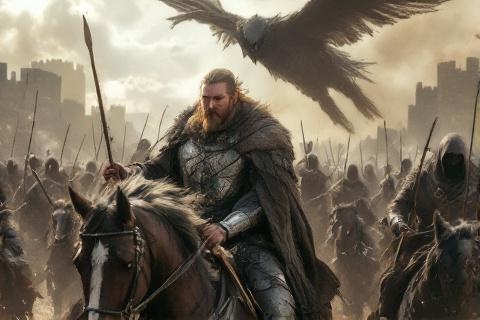
At the very front of the charge rode King Théoden himself, old yet now renewed
in strength, golden shield gleaming and white hair streaming, crowned with his
helm as he called his people to battle with a clear, ringing voice. Tolkien
paints a vivid picture of the king riding on Snowmane, raising his sword and
crying his war-cry of “Forth Eorlingas!” so that riders behind him took up the
shout until it rolled over the plain. His fearless advance into the thickest
press of foes stirred hope among Gondor’s defenders, who saw at last that Rohan
had come, and sent a chill of fear through many enemies who had never before
faced the full fury of the horse-lords led by their king in person.
Above the field meanwhile loomed the dread figure of the Lord of the Nazgûl, the
Witch-king of Angmar, riding not upon a horse but upon a vast fell beast with
leathery wings, whose screech brought terror to Men and beasts alike. Tolkien
shows the Witch-king as commander of Sauron’s army, moving from point to point
with cruel purpose, and he personally turned his mount toward Théoden when he
perceived the king’s presence and the effect of his leadership. Their
confrontation was not a formal duel but a collision of wills on the battlefield,
as the Black Captain sought to break the courage of Rohan by striking down its
lord before the eyes of his people.
The story also reminds readers that this fateful meeting took place against the
shadow of treachery long past, for Gríma
Wormtongue had once weakened Théoden in mind and
body through deceitful counsel, leaving him unready for war until Gandalf cast
off that spell in Edoras. Though Gríma was far away by the time of the Pelennor
and plays no physical part in the clash, the grievous wound that Théoden
receives when Snowmane is struck and falls upon him can be seen as the final
cost of those earlier betrayals that left Rohan unprepared. Théoden’s
death-wound thus comes not only from the crushing weight of his fallen horse and
the terror of the Nazgûl, but also from the long chain of treachery that delayed
his strength and shortened the years left to fight.
By challenging the king in that moment, the Witch-king unknowingly sets the
stage for the act that will undo him, for Théoden’s fall draws
Éowyn and Merry into the very heart of the battle. Tolkien
hints at a pattern of fate beyond the plans of Sauron and his servant, because
out of the ruin of the king’s body comes the chance for a young woman and a
small hobbit to face the Black Captain where great warriors might have
despaired. The confrontation on the Pelennor thus becomes more than a clash of
two leaders; it becomes the turning point of an ancient prophecy that no living
man could slay the Witch-king.
Éowyn and Merry: A Hidden Pair of Heroes
Éowyn, having secretly ridden from Rohan in the guise of a young male rider
under the name Dernhelm, refuses to abandon her king when the Witch-king’s
attack brings Snowmane down and shatters Théoden’s shield. She stands alone
before the fell beast, small and slight against its huge, clawed form, yet she
raises her shield and sword with steady hands. When the Black Captain commands
her to stand aside, she reveals herself as a woman, declaring that she is no man
and will protect her fallen lord, a bold defiance that Tolkien presents as both
deeply personal and woven with the threads of fate.
Beside her in that terrible moment is Meriadoc Brandybuck, the hobbit Merry, who
had ridden hidden behind her saddle all the way from Dunharrow despite fear,
small stature, and the pain of leaving his friend Pippin behind. Though
terrified by the Nazgûl’s presence and nearly frozen by its supernatural dread,
Merry remembers his love for Théoden, who had treated him kindly in Rohan, and
his sense of duty as a esquire of the king. Gathering his courage, he draws the
barrow-blade given to him in the Barrow-downs and creeps behind the Witch-king,
seeking some way to strike in aid of Éowyn’s stand.
In perfect accord of desperate courage, Éowyn and Merry act together to break
the legend that no living man could kill the Witch-king, for while she faces him
and withstands his blows, Merry strikes from behind at the sinews of his unseen
knee with the ancient blade forged against the powers of Angmar. That stroke,
though delivered by a hobbit of the Shire, pierces the dark sorcery that
sustains the Witch-king’s spirit and opens him to Éowyn’s final blow. She then
drives her sword into the void where his helm had been, and with a great cry the
Black Captain is unbodied and destroyed, his legend shattered by the courage of
a woman and a hobbit working in unplanned, fateful unity.
Aftermath: Costs, Burial and the King’s Passing

Though the Rohirrim’s charge on the Pelennor helped turn the tide and played a
large part in winning the field that day, the victory was dearly bought in the
blood of both Men and horses. Tolkien does not gloss over the cost, describing
many riders and their mounts slain or maimed amid the hacked bodies of Orcs,
Southrons, and Easterlings. The green fields that had once been fair grazing
land became a place of trampled grass, broken gear, and the still forms of noble
horses that had carried their masters bravely to the end, so that even in
triumph the survivors walked among scenes of sorrow and loss.
For Théoden, the wounds he received beneath his fallen steed proved fatal, and
though Éomer and others drove back the nearby enemies, they could not save their
king’s life. In his final moments on the battlefield, he speaks with Éowyn
before she is borne away, and then with Merry, naming him a knight of the Mark
and giving him his blessing. Later Théoden is honored with kingly rites upon the
field and afterward returned to Rohan for burial among the mounds of his
fathers, where riders sing laments that remember him as the last king of the
line of Eorl to die in battle, faithful to his oaths to Gondor.
Among the Rohirrim there is both mourning and a kind of fierce, quiet pride as
they look upon the cost of their stand, for they know that their courage helped
to save Minas Tirith even as it shattered many families and herds at home. They
grieve for their comrades and for their king, yet they also share in the joy of
Gondor’s deliverance and the brief peace that falls after the terrible press of
battle. The Pelennor Fields thus become a place where the bravery of Rohan is
forever written into the land, but also a reminder that in Tolkien’s world, even
the most glorious deeds carry a heavy price that cannot be forgotten.
Origins and Importance: Why the Ride Matters
Tolkien drew heavily on Anglo-Saxon and other Northern traditions when shaping
the culture of the Rohirrim, and this influence shows clearly in the Ride of the
Rohirrim, from their names to their speeches and songs. The very sound of words
like Éomer, Théoden, and Meduseld echoes Old English, and their society of
horse-lords with mead-halls and loyal hearth-companions recalls early medieval
Germanic warriors. On the Pelennor, their charge and their king’s war-cry have
the tone of heroic lays out of ancient Northern poetry, where warriors ride to
battle with full knowledge that fame and death often walk side by side.
Within the larger story of The Lord of the Rings, the
Ride of the Rohirrim marks a crucial turning point, because it restores hope at
a moment when Minas Tirith stands on the brink of destruction and Sauron’s
victory seems almost assured. The sudden arrival of Rohan splits and weakens the
Dark Lord’s forces, buying time for Aragorn and the southern reinforcements to
enter the war in strength. From that point on, the battle for Gondor shifts from
a desperate defense to a struggle that the West might yet win, and the momentum
of the entire war begins to bend away from Sauron’s apparent triumph.
This episode also gathers together several of Tolkien’s major themes, including
courage in the face of overwhelming odds, the necessity of sacrifice, the
workings of fate, and the unexpected power of small and overlooked people like
Merry to shape great events. By placing a hobbit and a shieldmaiden at the
center of the Witch-king’s fall, the narrative shows that prophecy and destiny
can hinge on those whom the great might ignore. At the same time, the loyalty of
Rohan to Gondor, and of individuals to their oaths and friends, demonstrates how
steadfast hearts can resist the dominating will of Sauron, making the Ride both
a heroic spectacle and a moral lesson woven into the fabric of Middle-earth.
In the broader history of the Third Age, the Ride of the Rohirrim confirms
Rohan’s role as a key pillar of resistance against the Shadow, and it
strengthens the bond between the Mark and Gondor in a way that will shape their
futures after the War of the Ring. Théoden’s willingness to ride to Gondor’s aid
even after grievous losses, and Éomer’s later friendship with Aragorn, grow out
of what was won and lost on that field. The charge on the Pelennor thus sets the
stage for the later mustering of all the West under Aragorn’s banner and for the
final campaigns that bring about the downfall of Sauron and the beginning of the
Fourth Age.
Legacy: Art, Film and the Echo of Hooves

The power of the Ride of the Rohirrim has reached far beyond the pages of
Tolkien’s text, inspiring painters, illustrators, and filmmakers to capture its
sense of motion and scale, with lines of riders pouring down onto a crowded
battlefield. Artists often focus on the moment Théoden raises his sword or when
the host crests the hill and horns sound, seeking to show both the fear and the
exultation of that instant. In many visual retellings, the sweep of the charge
and the sight of white horse banners flaring against dark skies have become some
of the most recognizable images associated with The Lord of the Rings.
Writers of later fantasy works and designers of games have also drawn on the
Rohirrim as a model for the archetypal horse-lords, shaping cultures of riders
who live on wide plains, value loyalty and song, and ride into battle with
spears and banners. The idea of a sudden, decisive cavalry charge that arrives
at the last moment to turn a hopeless battle has become a familiar pattern,
often echoing the Pelennor in how it is described. In role-playing games, war
games, and novels, echoes of the Riddermark can be seen wherever mounted
warriors fight with a blend of rustic simplicity, deep honor, and fierce skill.
The scene endures in memory and in adaptations because it unites sheer spectacle
with intense emotional stakes, offering not just the sight of thousands of
riders in motion, but also the grief of loss and the relief of deliverance.
Tolkien does not treat the Ride as a simple victory, but as a moment in which
joy and sorrow are bound tightly together, and that complexity gives depth to
every later retelling. Readers and viewers are moved not only by the thunder of
hooves and the crash of battle, but also by Théoden’s fall, Éowyn and Merry’s
courage, and the sense that history itself shivers and changes course in those
few desperate hours.
Conclusion: The Ride as a Moment of Late Hope
In the full arc of The Lord of the Rings, the Ride of the Rohirrim stands out as
one of the most dramatic and decisive bursts of courage, when a single
determined host rides straight into a sea of enemies and for a time seems to
push back the darkness by sheer will and skill. It is a moment that readers
often recall first when they think of the battles of the War of the Ring,
because the image of Rohan’s riders rushing from shadow into light carries a
strong sense of release after long chapters of fear and waiting. The thunder of
their coming on the Pelennor marks the point when the West stops merely enduring
blows and begins to strike back.
At the heart of this charge lies the idea that loyalties, sworn oaths, and the
readiness to act even in desperate conditions can change the flow of events that
might otherwise seem fixed. Rohan could have stayed behind its own borders, worn
down from its struggles with Saruman, yet Théoden chose to fulfill his promise
to Gondor, and his people followed. Tolkien suggests that history in
Middle-earth is not only shaped by great powers and ancient prophecies, but also
by such choices of honor made by flawed and mortal men and women who decide that
some bonds must not be broken.
Readers remember the Ride partly for its grand, thunderous image of horses
rushing over the plain, but just as strongly for its human cost and for the way
small and hidden acts shape the larger fate of Middle-earth. Merry’s decision to
ride with Éowyn, Éowyn’s refusal to remain behind, Théoden’s resolve to answer
Gondor’s call, and even the unseen toil of the Wild Men who guide the host all
combine to make the charge possible. In this way the Ride of the Rohirrim
becomes more than a stirring cavalry scene; it becomes a vivid example of how
courage, loyalty, and the deeds of the seemingly small can join together to turn
back a rising darkness and open the road toward a freer age.