
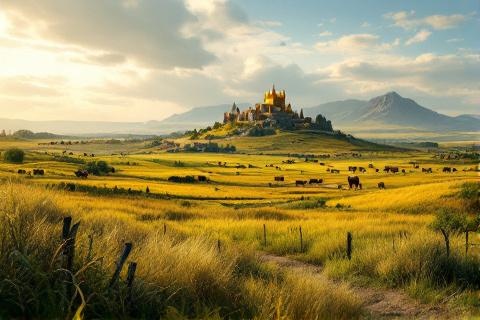
Forth Eorlingas! The Horse-Lords of Rohan Explained
From the plains of Calenardhon to the Hornburg's blast, uncover the history, culture, and heroes of the Riddermark, Tolkien's legendary kingdom of horsemen.
Rohan at a Glance
Rohan, also called the Riddermark or the Mark, is a wide realm of grasslands in
the northwestern part of Middle-earth’s central lands, lying between the great
river Anduin and the White Mountains where the lands begin to
rise toward Gondor. It is the country of the Horse-lords, a
people who came from the North and made their home in the broad plains that once
belonged to Gondor under the name Calenardhon, the Green Province. In The Lord
of the Rings the reader first sees Rohan as a land of
wind and open sky, dotted with hill-forts and small settlements, with the royal
seat of Edoras shining like a jewel at the feet of the
mountains. Though it may seem remote compared to mighty Gondor, the Riddermark
stands at a crossroads of roads and rivers, guarding the vales that lead south
and east, and so its story is bound tightly to the fate of the West in the
Third Age. Rohan’s identity as a kingdom of riders, its proud
independence, and its loyalty to its allies make it one of the most vivid realms
in Tolkien’s world.
The Rohirrim are known above all for their love of horses and their skill in
riding, so much so that other peoples call them Horse-lords and regard them with
a mixture of respect and awe. From childhood, free men and women of Rohan learn
to ride, and in battle they fight most often as mounted warriors, charging with
spears and long swords while singing harsh and stirring songs. Their way of life
is shaped by the wide plains and rolling downs, where a rider can see far and
move quickly, and where great herds can be pastured in every season except the
hardest winter. Tolkien shows them as brave, straightforward, and faithful, with
a courage that springs not from craft or lore but from strong hearts, clear
voices, and the trust they place in each other and in their steeds. Their music,
speech, and customs echo old northern cultures from our own world, yet they
remain unique to Middle-earth as a people whose whole
culture has been shaped by open land and swift mounts.
Politically, Rohan is bound to Gondor by an ancient oath of mutual aid, and this
alliance becomes one of the pillars of resistance against
Sauron in the later Third Age. The Rohirrim hold the passes
and river-crossings that shield Gondor’s northern flank, especially the Fords of
Isen and the Gap of Rohan, while Gondor in turn recognizes their kings and
grants them the land as a free realm. During the War of the Ring this
relationship is tested and proven when Théoden King rides with his host to the
relief of Minas Tirith, even as Gondor had once ridden to
the aid of Rohan in older days. Beyond the war itself, Rohan’s presence shapes
the history of the age by checking the power of Saruman in
the west and by keeping open the lands between Fangorn and the White Mountains
so that free peoples can still pass and trade. Without the horsemen of the Mark,
Gondor would stand more exposed to its enemies, and the story of the Ring would
unfold in a far darker way.
Plains of Calenardhon: The Open Country of the Riddermark

Before it bore the name Rohan, the land was called Calenardhon, meaning Green
Province in the tongue of Gondor, and it was known for its broad, fair plains
covered in grass and low hills. Tolkien describes it as rolling turf, dotted
with scattered trees and small streams, a country where the wind flows almost
without hindrance over the land and clouds throw moving shadows across the
ground. This was not a wild forest or a harsh wasteland but a place that seemed
made for herds, with long reaches of pasture reaching to the horizon and soft
slopes that allowed swift travel by horse and wagon. When the Northmen under
Eorl settled there, the land welcomed their flocks and horses, and its open
character allowed them to shape it without great works of stone or earth.
Calenardhon’s beauty lies in its simplicity and breadth, a kind of ordered
wildness that fits the character of the Rohirrim themselves.
The landscape of Rohan shapes almost every part of Rohirric life, since a people
who dwell on wide plains must be ready to move quickly and see danger from far
away. Their settlements are mostly small and lightly built, with timber halls
and thatched roofs rather than great stone cities, because the land invites
mobility rather than walls and towers. Great herds of horses, as well as cattle
and sheep, range over the grasslands, and the riders must know the
grazing-grounds, the streams, and the seasons of the wind as well as other folk
know city streets. The open horizons make watchfulness a habit and allow
messengers to ride at speed from one end of the Mark to the other, so news and
calls to muster can spread swiftly whenever the king commands. This life in the
saddle and in the wind breeds people who value freedom, personal courage, and
readiness to answer a horn from afar, which is exactly how the Rohirrim appear
during the War of the Ring.
Rohan’s borders are marked by strong natural features and by its neighbors,
which both protect and threaten it. To the west runs the River Isen, flowing
down from the southern slopes of the Misty Mountains and forming a crucial
frontier and battleground, especially in the wars against Saruman who strikes
across the Fords of Isen. To the south rise the White Mountains, with
snow-capped peaks and secret valleys, on whose northern feet lie places like
Edoras and the refuge of Dunharrow, while beyond those mountains, farther south
and east, lies Gondor, Rohan’s chief ally and older lord. To the north stretch
the eaves of Fangorn Forest and the courses of the Entwash and other rivers
leading toward the great Anduin, where the wild lands of the Wold and the Vales
of Anduin begin. These boundaries place Rohan between older powers and hidden
threats, so that its riders must always watch the passes, rivers, and gaps that
connect their grassy home with the rest of Middle-earth.
Edoras and Meduseld: The Golden Hall on the Hill

Edoras, the capital of Rohan, stands on a green hill or grassy mound at the feet
of the White Mountains, where the mountain-wall breaks into smaller ridges and
dales, and it can be seen from far across the surrounding plain. A dike and a
wooden palisade guard the rising slopes, and houses of timber with
straw-thatched roofs climb the hill in terraces, giving the town a close yet
simple beauty. Above them all, on the highest point of the mound, stands the
great hall of the king, Meduseld, shining in the sun so that travelers can spot
the golden glimmer of its roof from a long distance away. A stream runs through
Edoras from the springs in the mountain behind, and there is a green
barrow-field before the gate where the kings of Rohan are buried under
grass-covered mounds ringed with white simbelmynë. The setting of Edoras makes
it both a stronghold and a symbol, a beacon of the Rohirrim’s life in which the
plain below and the mountains above seem to meet.
Meduseld, the hall of the king, is the heart of Edoras and one of the most
striking buildings described in The Lord of the Rings, with its roof covered in
golden thatch that glows in the light, so that it appears like a throne of gold
set above the Mark. The hall is built of great timbers and richly carved, and
inside its long interior is warmed by a central hearth, with smoke rising to the
darkened beams overhead. The walls are hung with tapestries that show the
history and legends of the Rohirrim, including battles, horses, and ancient
kings, so that one who sits there finds the past looking down from every side.
The floor is of wood, the benches are long, and at the far end stands the dais
with the king’s high seat and the carved pillars near which the guests take
their place. Firelight and torchlight make the gold, the tapestries, and the
polished oak glow warmly, and songs, speeches, and oaths fill the echoing space,
so that Meduseld is not only beautiful but alive with sound and memory.
As both home and court, Meduseld serves a symbolic role that goes far beyond
being a large house, since it is the place where kingship is seen, heard, and
renewed through daily life. Here the king meets his counsellors, hears
petitions, settles quarrels, and gives judgment, so law in Rohan is closely tied
to the spoken word within this hall. Feasts and celebrations also happen in
Meduseld, where guests drink mead, listen to minstrels, and hear the recitation
of old lays that connect them to their ancestors and to the land they rule. When
Théoden casts off the shadow of Wormtongue and
takes up his sword again, it happens in this very hall, and his change restores
the honor of the house as well as his own spirit. In this way Meduseld stands
for the health of the realm, because if the king’s hall is darkened or
corrupted, the Mark itself falls into danger, but when it is bright and filled
with loyal voices, Rohan is strong.
The Hornburg and the Deeping-coomb: Stone and Shelter
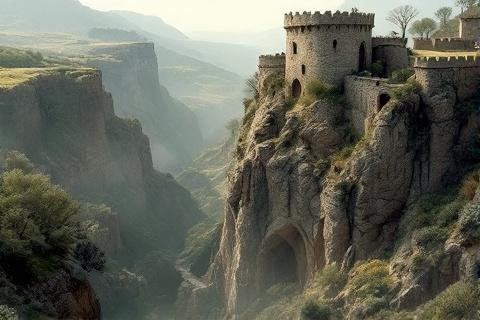
The Hornburg is a grim and sturdy fortress that stands at the entrance to a
narrow valley called the Deeping-coomb, which runs back into the northern side
of the White Mountains like a cleft in the rock. It is built of stone upon steep
natural rock, with sheer sides that rise above the approach, and it commands the
Deeping-stream that flows through the gorge. To reach the stronghold, an army
must come up a confined valley where its numbers are less useful, which makes
the place ideal for defense in times of war. Tolkien shows it first in the night
and storm, when the Rohirrim retreat there before Saruman’s forces, and the
Hornburg appears as a last refuge of the West against the gathering dark. The
mingling of human craft with the shapes of the mountain gives it a harsh,
enduring presence, as if it has stood against many storms of both weather and
war.
The Hornburg includes a central stone keep, the tower proper, and an outer wall
known as the Deeping-wall, which runs across the mouth of the coomb and turns
the valley behind it into a protected space. Behind the wall lies Helm’s Deep, a
sheltered area with caves and hollows where the people of the Westfold can take
refuge, bringing their families, herds, and stores to safety when enemies
overrun the open country. The Deeping-stream flows out beneath the wall through
a culvert, and within the fortress are stairways, gates, and courts that allow
the defenders to move quickly between positions. Below and behind the walls, the
deeper caverns can also be used for shelter or last retreat, and in the story
they hold a host of refugees during the great battle. In times of peace, the
valley serves for grazing and as a secure place to gather supplies, so that the
stronghold is woven into the daily life of the surrounding people, not just used
in war.
The geography of the Hornburg gives it great natural strength, since steep walls
of rock enclose the Deeping-coomb on three sides and the only broad approach is
narrowed by the out-thrust of the fortress itself. Attacking forces must advance
in a tight space under the defenders’ arrows and stones, and even a large army
can find itself trapped against the Deeping-wall with little room to maneuver.
The height of the keep and the curves of the valley also allow signals and horns
to carry far, which adds to the fortress’s reputation as a place where alarms
are sounded and last stands are made. In The Two Towers this
is exactly what happens when the Rohirrim and their allies endure a long night
of assault that hurls waves of orcs and wild men against the steep walls until
dawn comes and relief arrives. Because of its setting, the Hornburg looms in the
memory of the Mark as a brooding guardian of the Westfold, trusted in peace and
feared by its enemies in war.
Origins and Foundations: Eorl the Young and the Oath of Eorl
The people of Rohan trace their origin back to the Northmen who lived in the
upper vales of Anduin and in the lands north of Gondor, a hardy folk of riders
and farmers who long had dealings with the South-kingdom. In the days of Steward
Cirion of Gondor, the northwestern province of Calenardhon lay underpopulated
and threatened, and Gondor was pressed in many places at once. When a great
invasion from the East swept down upon Gondor, Eorl the Young, lord of the
Éothéod, led his riders south in answer to Cirion’s call and helped win a
crucial victory on the Field of Celebrant. As a reward and in recognition of
their valor, Cirion granted Eorl and his people the land of Calenardhon to dwell
in forever, and Eorl led a migration of his folk from the north into their new
home. From that time the land took on the name of the Rohirrim’s own choosing,
and the Horse-lords became a distinct people rooted in the green fields that had
once been empty borderland.
The founding of Rohan rests on a solemn compact between Cirion and Eorl, which
they confirmed with oaths on the hill of Halifirien in the border-woods of
Gondor. Cirion swore that Calenardhon would be given to Eorl and his descendants
in free and perpetual gift, to be held as a kingdom of their own, and Eorl swore
that he and his heirs would come to the aid of Gondor whenever they were called
and able. This bond, sometimes called the Oath of Eorl, set the political shape
of Rohan for centuries, since it defined them as both independent kings and
sworn allies of the South-kingdom. The Riders guarded the northern approaches
and the Gap of Rohan, and in return they expected Gondor to stand by them in
their own times of peril, creating a friendship that lasted through many
generations. Even in the War of the Ring, when the Steward of Gondor doubts and
delays, Théoden still honors that ancient promise when he rides to the Pelennor
Fields, showing how deep the old oath lies in the heart of his people.
Before they ever came to Calenardhon, the ancestors of the Rohirrim had been
shaped by long migrations, kinship ties, and warfare with both allies and
enemies along the northern frontiers. They shared blood and customs with other
Northmen who served Gondor as soldiers and settlers in earlier centuries, and
some of their forefathers fought against the Wainriders and other eastern
invaders, which built a tradition of alliance and conflict that lingered in
their songs. Living in the cooler north before their move, they learned to trust
swift horses, close family bonds, and the leadership of chosen war-chiefs,
habits that they brought south into their new kingdom. Their speech kept older
forms related to the tongues of Men in the West, which Tolkien
represents through Old English, and their sense of honor was bound up with
memory of battles fought to protect their homes. All these strands came together
in Rohan, so that by the time of The Lord of the Rings they are both a new
people of the Mark and also the heirs of long struggles along the edges of
Gondor.
Kings, Houses, and the Eorlingas
From the time Eorl the Young became the first king in the Mark, the royal house
of Rohan was known as the Eorlingas, and its line runs through many generations
listed in the appendices to The Lord of the Rings. The early kings, such as
Brego and Aldor the Old, strengthened the realm, built halls like Edoras, and
expanded the settlements across the plains, while later kings faced invasions
from Dunlendings and from the East. The line of Eorl is marked by both glory and
hardship, including periods when a king dies in battle or leaves a young heir to
rule in troubled times, yet the descent continues through father to son or near
kin. By the days of Théoden son of Thengel, the Eorlingas’ claim is old and
deeply rooted, so that the people look to the king as the living memory of all
their past. This continuous royal line gives Rohan a strong sense of identity,
for to follow the king in war is also to carry forward the inheritance of Eorl
and his first ride.
Succession in Rohan generally follows the direct male line, but when needed it
can pass to the nearest male relative within the royal house, and this is
accepted because personal loyalty to the Eorlingas matters as much as strict
blood. Leading thanes and marshals of the Mark stand close to the king, advising
him, commanding parts of the army, and holding important regions like the
East-mark and West-mark, so that government is spread among trusted captains
rather than through distant bureaucracy. In return, these nobles and captains
owe the king oaths of fealty and the duty to bring riders to war when he calls,
creating a web of personal bonds that holds the kingdom together. Honor is shown
by readiness to ride at need, to speak openly in council, and to keep faith even
in dark times, as Éomer and others do when Wormtongue seeks to weaken the realm.
Through these customs, rulership in Rohan remains close to the land and its
riders, instead of being lost in ceremony far from everyday life.
Among the many rulers of Rohan, Théoden stands out in the story as a king who
passes from weariness and shadow back into courage and clear sight, and his life
shows how kingship in the Mark is tied to land, law, and ritual. When
Gandalf frees him from the influence of Saruman’s agent,
he takes up his sword Herugrim, calls his household to arms, and restores the
practice of open counsel and swift decision. The burial mounds before Edoras,
with their white flowers and singing, show the ritual side of kingship, where
the dead rulers are honored and remembered so that their deeds guide the living.
Théoden’s choice to ride to war in person, leading the Rohirrim first to Helm’s
Deep and then to the Pelennor Fields, reflects the ideal that a king should
share the risk of his warriors, not stay hidden. His death on the field and the
mourning that follows emphasize that the king’s body is bound to the fate of the
Mark, and when Éomer succeeds him, the line and the laws continue, but with a
renewed spirit that points toward healing after war.
Horses of the Rohirrim: Mearas, Mounts, and Horsecraft

Among the horses of Rohan, the greatest and most mysterious are the Mearas, a
superior breed said to be swifter, taller, and wiser than ordinary steeds, with
long lives that almost match those of Men. Their origin is hinted to be ancient
and noble, and they are rarely tamed by any rider, for they will bear only the
lords of the Mark whom they choose. Shadowfax, called the chief of the Mearas,
is described as silver-gray that shines like starlight, fast as the flowing
wind, and he understands Gandalf’s commands without bit or bridle. Legends in
Rohan say that the Mearas were gifts long ago, and the right to ride them was
once limited to the kings, which shows how closely their prestige is tied to
royal dignity. The presence of such a breed in the Mark gives physical form to
the Rohirrim’s love of horses, as if the land itself had rewarded them with
steeds beyond the measure of ordinary beasts.
In daily life across the Mark, horses are everywhere, not only in war but in
work, travel, and trade, and every free person is expected to know how to ride
and handle them. The people breed many lines of horses, suited to different
tasks such as heavy work, riding, and battle, and they keep stables and paddocks
near their halls and farmsteads. Saddles, bridles, bits, and harness are made
with care by skilled craftsmen, and much of the wealth of Rohan lies in its
herds, which can be moved, traded, and gifted. Riders often live far from large
towns, yet the link of road and horse keeps the realm connected, since messages
and goods can be carried quickly across the plains. Because of this, the
Rohirrim see their horses as companions in ordinary labor as well as in the
great charges sung of in their songs.
The Rohirrim’s deep bond with their horses is shown not only in battle but also
in their names, their habits of grooming, and the respectful way they speak of
their mounts. Many horses receive names that carry meaning, such as Windfola,
Firefoot, and Hasufel, which reflect their color, speed, or nature, and riders
speak to their steeds as if to close friends who understand. Grooming is
important, with manes and tails combed and kept clean, and horses well fed and
sheltered, since neglect would be a sign of shame and poor character in a people
who depend on them. Songs and sayings in Rohan honor famous horses alongside
their riders, treating the pair as one whole in memory and story. This reverence
creates a sense that to harm or mistreat a horse is to go against the very
spirit of the Mark.
Several named horses in The Lord of the Rings serve as clear examples of the
honor and value placed on mounts in Rohan, and they highlight both breed and
status. Shadowfax, though claimed from the king’s herd, chooses to bear Gandalf
and becomes a symbol of unmatched speed and freedom, racing from Edoras to
Gondor and beyond without rest. Snowmane carries King Théoden and shares in his
last charge on the Pelennor Fields, where both king and steed fall in battle and
are remembered together in song. Éomer’s horse Firefoot, and the steeds Hasufel
and Arod given to Aragorn,
Legolas, and Gimli, show the trust the
Rohirrim place in their animals and their willingness to share prized mounts
with honored guests. Through these examples, Tolkien makes the horses of Rohan
almost characters in their own right, sharing in deeds and glory rather than
serving as mere tools.
Rohirrim Culture: Songs, Craft, and Daily Life
The arts of the Riddermark are rooted strongly in speech and song, especially in
oral poetry, war-songs, and the telling of tales that link lineage to law and
memory. In Meduseld and around smaller hearths, minstrels and elders recite lays
of ancient battles, of Eorl’s ride, of Helm Hammerhand, and of other heroes
whose deeds mark the history of the Mark. Many of these songs have alliterative
patterns and a strong rhythm, which Tolkien represents using a style drawn from
old northern poetry, so the Rohirrim’s verses sound both strange and familiar to
the reader. Such recitations are not only entertainment but also a way to teach
young people about their kin, their oaths, and the reasons behind their customs
and boundaries. In this way, poetry becomes a living record, and to forget the
old songs would mean losing part of what it means to be of the Eorlingas.
Rohirric crafts and domestic life grow out of the resources of their land, so
timber-building, thatch, and gilding are their main skills, rather than
stone-carving or metalwork on the scale seen in Gondor or among the
Dwarves. They construct strong wooden halls with carved beams
and pillars, decorate roof-ridges with horse-head shapes, and cover their
buildings with straw that catches the light like gold, especially in Edoras.
Skilled workers adorn important halls with gilded details and rich woven
hangings that show scenes from history or daily life, while more ordinary homes
keep to simple but sturdy design. Food in Rohan is plain yet hearty, with meat,
bread, and ale or mead, and feasts focus on abundance shared with guests rather
than on rare luxuries. Horse-trade and the making of gear for riding also
support the households of the Mark, tying craft to the animals that stand at the
center of their world.
Social customs in Rohan place high value on honor, kinship, and open-handed
hospitality, which the reader sees clearly when strangers are welcomed or
challenged at the king’s gate. Guests who come in peace are offered food and
drink, and to grant shelter in time of need is expected of all who have the
means, for the riders know that in a wide and dangerous land, tomorrow they may
be the ones in need. Stewards manage the king’s household and lands, while
marshals command the Riders of the Mark, and both roles rest on loyalty and the
trust of their lord rather than on distant or hidden power. Quarrels can be
sharp, but they are usually settled by direct speech before witnesses, with the
king or a lord giving judgment, and a person’s word, once pledged, is treated as
binding. These customs build a society where courage, truthfulness, and care for
one’s kin and companions are the highest virtues, fitting for a people whose
lives depend on each other in war and in the saddle.
Rohan in The Lord of the Rings: The Riddermark's Place and Legacy

In the geography and politics of the late Third Age, Rohan holds a strategic
position as a shield on Gondor’s northern and western approaches and as a vital
source of fast-moving cavalry and bold leaders. The Gap of Rohan, between the
southern Misty Mountains and the White Mountains, is a chief doorway into the
Westlands, and the Rohirrim stand watch over it, along with the crossings of the
River Isen. When hostile forces from Isengard or from beyond
the mountains move south, they must first break the strength of the Mark, which
is why the battles at the Fords of Isen and at Helm’s Deep are so crucial. The
Riders’ ability to muster quickly and move over great distances allows them to
strike where needed, as in the sudden arrival of the host at the Pelennor Fields
that turns the tide before Minas Tirith. By holding the wide lands that might
otherwise fall into enemy hands, Rohan ensures that Gondor is not surrounded,
and the free peoples retain room to maneuver and to hope.
The people and rulers of Rohan embody several themes that Tolkien weaves through
The Lord of the Rings, especially renewal after despair, simple yet steadfast
courage, and the deep bond between rider and horse. Théoden’s awakening from a
withered, counsel-bound king to a lord who can still ride to battle shows how
strength can return even in old age when hope and purpose are restored. The
ordinary Riders who follow him, many of whom never speak in the story, represent
the faithfulness of common folk who risk everything for home and honor without
seeking glory or reward. The close partnership of man and steed, seen in
charges, rescues, and long rides through night and storm, adds a living energy
to the narrative and reminds readers that the victory of the West depends on
more than weapons and walls. Through Rohan, Tolkien offers a picture of nobility
that grows from plain living, deep loyalties, and the will to act bravely even
when the outcome is uncertain.
After the War of the Ring, the legacy of Rohan lives on in the appendices and in
later writings as genealogies, place-names, and tales that show how strongly the
Mark remains in the memory of Middle-earth. The line of kings continues under
Éomer, friend of King Elessar of Gondor, and the alliance between the two realms
is renewed and strengthened, with borders confirmed and mutual help promised
once more. Tolkien’s notes and histories list the rulers who come after, and the
old names of places such as Edoras, the Firien Wood, and the Fords of Isen
preserve the story of battles and oaths made there. Among Elves,
Dwarves, and Men, the deeds of Théoden, Éowyn, Éomer, and the Riders at Helm’s
Deep and on the Pelennor become part of the great songs of the age. For readers,
Rohan’s lasting legacy is a vision of a people whose courage on the open plain
helps bring about the final downfall of Sauron and the dawn of a new era.