
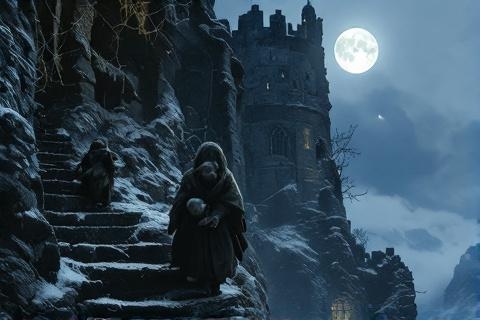
The Escape from Cirith Ungol
Peril and Rescue in Mordor’s Shadows
Why This Moment Matters
The escape from Cirith Ungol stands as a turning point in the quest to destroy
the Ring because it marks the moment when the mission
almost fails and is then saved by one hobbit’s resolve. Up to this point,
Frodo has carried the Ring and the story has
followed his inward struggle, but in the tower of Cirith Ungol he is helpless,
stripped of his clothing and gear, and left in the clutches of the Enemy’s
servants. If Sam had faltered or turned back, the
Ring would likely have been taken to Sauron, ending all
hope for Middle-earth. The rescue therefore shifts the
story from near despair to a renewed, though fragile, chance, and the road to
Mount Doom becomes possible again only because of what
happens on that dark stair and within that grim tower.
The events at Cirith Ungol show Sam’s loyalty and courage at their highest
pitch, when all visible hope seems gone. He believes at first that Frodo is
dead, yet even then he refuses to abandon his master, choosing instead to
continue the quest alone rather than turn aside or seek safety. When he learns
that Frodo still lives, his devotion takes on a fiercer energy, and he marches
straight into the enemy’s stronghold despite his terror and inexperience. Sam’s
heroism is not built on confidence or skill but on steadfast love; he goes
forward shaking and miserable, yet he goes forward all the same, and that
persistence in the face of dread is what Tolkien repeatedly marks as true
courage.
This episode also briefly shifts the burden of the quest onto Sam and reveals
important themes of humility and heroism that run through The Lord of the
Rings. For a short but crucial time, Sam carries the
Ring, makes decisions for them both, and acts as the leader, though he never
seeks that role or boasts of it. He imagines himself as the hero of a great tale
but quickly sees the foolishness of self-glory and sets the thought aside.
Through this, Tolkien shows that the greatest hero may be the one who does not
desire greatness, whose humility protects him from the Ring’s corruption. By
handing the story’s weight to the most unassuming character, the narrative
underscores that the fate of the world rests not on kings or wizards alone, but
on the hidden strength of the seemingly least important person.
The Pass and the Tower of Cirith Ungol

Cirith Ungol is described as a steep and narrow pass on the western edge of
Mordor, where cold winds sweep along knife-like ridges and
shadows cling to every rock. The way is no gentle road but a climbing cleft
carved between cruel heights, looming over the plain of Gorgoroth. Travelers
find little footing and no comfort among these slopes, which are bare of green
things and filled instead with ash and broken stone. The very shape of the pass
serves the Dark Lord, for it funnels intruders up a single perilous path,
watched and controlled, and anyone who dares approach from the west must pass
beneath its looming menace.
The Tower of Cirith Ungol rises above this grim pass like a crow perched on a
jagged spur of rock, set to watch and to snare. Tolkien describes the upper
chamber with its iron-latticed window that looks eastward toward Mordor’s plain,
a hateful eye gazing out from a dark face of stone. The tower’s lower levels are
guarded by a heavy, barred gate and lined with rooms used by Orcs
for torment and storage of prisoners. Its structure is not grand like the towers
of Gondor but harsh, cramped, and angular, built for war and
cruelty rather than beauty, and it stands as a hard outpost of Sauron’s power on
the borderlands.
The way up to the tower is marked by stone steps hewn directly into the cliff,
each one a trap for the weary or unwary. These stairs are steep and uneven,
often crumbling at the edges, and exposed to sudden drops where a misstep could
send a traveler plunging into darkness. Sam and Frodo, already spent from their
journey with Gollum and the terror of
Shelob, must climb and descend such stairs with little
strength left in them. The risk lies not only in the heights and the sharp rocks
below, but also in the fact that the steps are overlooked by the tower’s
watchers; any sound of slipping or clatter might bring down Orcs armed and eager
for blood.
The whole area carries an atmosphere of old and lingering danger, as if the very
stones remember malice. Webbed ledges and dark holes show where Shelob and
lesser spiders have hunted for years unnumbered, even before Sauron rose again.
The tunnels stink of decay and the unclean life of creatures that feed on fear
and flesh, while the traces of Orc watch are everywhere in discarded gear, rough
signs, and the clack of iron on stone. Tolkien makes it clear that Cirith Ungol
is not just a random stronghold but a place where ancient horror and newer
tyranny meet, so that the hobbits walk in a landscape shaped by long ages of
darkness that now serves the Dark Lord’s immediate purposes.
Detailed Scene-by-Scene Summary
Gollum leads Frodo and Sam toward the pass of Cirith Ungol as a guide who knows
secret ways into Mordor, but his treachery grows as they draw closer to the land
of the Enemy. Outwardly, he appears to be fulfilling his promise to take them to
a path that will bring them near the Black Gate’s back ways, away from the main
armies and watchful eyes. Inwardly, he plots with Shelob, intending that the
spider will take Frodo and allow him to reclaim the Ring from the corpse or the
web. The route he chooses is not a simple mistake or a mere shortcut; it is a
calculated betrayal hidden under fearful fawning, and it leads the hobbits into
a place where few have entered and lived.
Inside the dark tunnel of Shelob’s Lair, Frodo and Sam pass from dim twilight
into a suffocating black where every sound is swallowed. There the great spider
springs her trap, and in that chaos Frodo is attacked, wrapped in her cords, and
stung by her venomous barb. Tolkien lingers on the horror of that moment,
describing Frodo’s arm going numb and his body turning stiff as if dead, even
while Sam stands by, thinking his master lost forever. The attack is not just a
physical blow; it shocks the story into a moment of complete despair, for the
Ring-bearer falls in a place of utter darkness, beyond the sight of friends or
allies.
The Orcs of Cirith Ungol, patrolling and spying for signs of intruders, discover
Frodo’s body as Shelob abandons him, expecting to return later to her prey.
Mistaking the spider’s poison for death, they first believe him to be a dead
spy, but their leaders soon recognize that he may be of special value. Under
orders from above to seize any stranger of note, they carry him up into the
tower, stripping him of gear and clothing and arguing fiercely over the share of
loot and credit. This cruel quarrel over a helpless captive reveals the Orcs’
nature: greedy, suspicious, and ready for violence even with their own kind, and
it sets the stage for the chaos that later allows Sam to slip inside.
Sam, left alone beside what he believes is Frodo’s corpse, is crushed by grief
yet slowly realizes that the body does not look or feel truly dead. When he
learns from overheard Orc talk that Frodo still lives as a prisoner, something
hardens within him, and he takes up the task of rescuer and guardian of the
quest’s hope. He claims Sting and the phial of
Galadriel, and for a brief time he carries the
Ring itself, feeling its lure and almost putting it on but mastering the
temptation. In that dark hour he sets aside his own despair and fear and turns
all his thought to finding and freeing Frodo, accepting that the burden of
saving Middle-earth may now rest on his small shoulders.
Following the Orcs’ trail, Sam climbs toward the tower, creeping among shadows
and hiding whenever he hears harsh voices or the jangle of armor. He passes
through the outer defenses and into the tower itself, where he confronts guards,
using Sting’s light and his own sudden ferocity to drive them back or slay them.
The internal strife of the Orcs has already thinned their numbers, yet danger
remains at every turning of the stairs and every dark doorway. At last Sam
reaches Frodo’s cell, cuts his bonds, and lifts him free, then together they
slip down the long stone stair, Frodo stumbling and weak, while the first signs
of a fragile dawn touch the sky above the Mountains of Shadow.
Shelob’s Lair: Darkness, Webs, and Old Hunger

Shelob’s dwelling lies within a narrow, foul tunnel that winds deep into the
rock of the mountains, far from sun and star. The air is thick and clammy,
choked with webs that cling to face and hands, so that the travelers must cut
and burn their way through with Sting and the phial of Galadriel. The smell of
decay is strong, for there are bones and foul remnants of past meals scattered
in side passages and pits that cannot be seen but can be sensed in the darkness.
The tunnel is not just a passage but an extension of Shelob herself, a physical
expression of hunger and secrecy that presses on the minds of those who enter.
Tolkien describes Shelob as an ancient creature of great size and malice, a
shadow-dweller from before the days of Sauron, descended from the terrible
Ungoliant who once drained the light of the Two Trees of
Valinor. She is no servant bound by loyalty, but a power in her own right,
living by devouring all that she can catch, including Orcs who stray too near.
Her eyes are many and her body vast, swollen with long years of feeding in
secret, and no pity moves her. She represents a primordial darkness older than
the politics of Mordor, and her presence in the story reminds readers that evil
in Middle-earth has deep roots that stretch back into the First
Age and beyond.
Her lair forms a perfect trap, spun of silken threads placed to catch and
confuse any prey that gets past the tunnel entrance. Light fades and seems to
die the deeper one goes, absorbed by her webs, so that even the shining of the
phial becomes a rare and piercing blade against the gloom. Sounds too are
muffled, swallowed by the close, damp stone and the hanging curtains of web, so
that footsteps and cries do not travel far. This sense of isolation heightens
the danger, for help cannot easily come, and those who enter are truly alone
with the spider’s hunger.
When Shelob finally attacks, the suddenness of it fulfills the long tension
built up through the journey in the tunnel. The victim is first overwhelmed by
sticky cords that bind arms and legs, then stung by her venomous point, which
works swiftly to paralyze and mimic death. Once helpless, the prey is dragged
away among the foul silks and crawling filth, to be stored and eaten at her
leisure. Tolkien uses this pattern to show how evil often works unseen for a
time, weaving snares and clouds of fear, then striking in a single, decisive
moment when the victim has already been worn down by dread and weariness.
Sam: From Gardener to Reluctant Hero
Sam’s courage in the escape from Cirith Ungol grows directly out of his deep
devotion to Frodo, rather than from any taste for adventure or honor. When he
thinks Frodo is dead, he weeps and nearly breaks, yet he refuses to leave the
body or abandon the larger purpose they shared. Even when he decides that he
must take the Ring and go on alone, he does so not out of pride but because he
believes it is what Frodo would have wished. Once he discovers that Frodo still
lives, his loyalty becomes his driving force, and he is willing to face spider,
Orcs, and the Black Land itself rather than forsake his master.
Sam’s actions throughout this episode display a kind of heroism that is
practical and small in outward appearance, yet great in moral weight. He sneaks
and listens at doors, uses scraps of food and simple tricks, and moves quietly
along passages where mighty warriors might have died in open battle. He does not
wield great spells or command armies; instead, he tends his master, makes plain
decisions, and chooses the next right step again and again. Tolkien shows that
such small-statured heroism, grounded in attention and care, can achieve what
grand gestures cannot, for the success of the quest depends more on Sam’s
careful deeds than on any show of power.
Throughout The Lord of the Rings, Tolkien presents Sam as a kind of moral
center, and this rescue highlights that role clearly. While others struggle with
temptation or ambition, Sam’s loyalty remains a steady counterweight to the
Ring’s corrupting influence. Even when the Ring is in his hand and he imagines
himself as a great hero, he quickly recognizes the foolishness of that dream and
puts it aside, choosing instead to serve Frodo quietly. In this way, Sam
embodies the virtues that can resist evil in Tolkien’s world: faithfulness,
humility, and the willingness to suffer for another’s good.
Sam’s growth into a true hero is not a sudden burst of glory but a steady
unfolding of his stubborn love, which becomes decisive only when crisis comes.
From the beginning he is the gardener who fusses over rope and cooking, but at
Cirith Ungol those same homely qualities turn into endurance and practical
bravery. Each choice he makes, from following Frodo out of the Shire to climbing
the tower steps with Sting in his hand, builds upon the last. At the tower, all
these choices come together, and the quiet hobbit who once
listened at windows in Bag End becomes the savior of the Ring-bearer and the
hinge on which the fate of Middle-earth turns.
Sam’s Solo Trek: Stealth, Cunning, and Grit

As Sam approaches the tower, he must slip past sentries who are sharper and more
brutal than any foes he has faced before, and he relies on every scrap of
knowledge he has gained. He listens to the harsh voices of the Orcs and makes
use of their talk, catching enough words to guess their movements and quarrels.
Following the sound of marching feet and clanking armor, he trails behind
patrols and creeps up the long stair that clings to the rock. The climb taxes
his strength, yet the fear of losing Frodo drives him forward step by step, even
as he presses himself into corners whenever a patrol passes.
To avoid detection, Sam keeps his head low and moves with great care, trusting
not in boldness but in small skills learned on the road. He notices blind
corners, dark niches, and half-open doors where he can duck out of sight like a
rabbit in a hedge. He times his movements with the changes of the watch, waiting
for moments of noise or argument among the Orcs to cover his own footsteps. This
attention to detail allows him to pass where a louder or prouder hero might have
been caught, for in the narrow spaces of the tower, silence and patience are
sharper weapons than swords.
The Elven-blade Sting hangs at Sam’s side, its faint glow a warning whenever
Orcs are near, yet he must be careful not to let its light betray him. The cold
stone of the stair bites at his feet and legs, and the steepness demands all his
balance, especially when he is weary and burdened with gear. A fall here would
not only injure him but also raise an alarm that could doom Frodo, so each step
feels like a test of body and nerve. Sam grips the rail and wall, breathing
shallowly, and moves as quietly as he can, knowing that in this climb there will
be no second chances.
Throughout this ascent, Sam never once thinks of himself as a hero earning
praise or fame; instead he focuses entirely on the single aim of reaching Frodo
and drawing him out of danger. His thoughts circle around simple promises made
long ago in the Shire, that he would not leave his master and would see the
journey through. The fear of failure troubles him, but not for his own sake; he
fears more that he might let Frodo down or allow the Ring to fall into the
Enemy’s hands. This pure, self-forgetting purpose gives his courage a clear
shape and strips away hesitation, so that he becomes able to face horrors he
would once have fled.
The Rescue Inside the Tower: Tension, Deception, and Risk

Inside the shadowy rooms and passages of the tower, Sam at last discovers Frodo
alive, though barely conscious, behind iron bars. The hobbit lies naked and
bruised, emptied of strength and dim in spirit from the lingering poison of
Shelob and the cruelty of his captors. To Sam, the sight is almost more than he
can bear, yet it also confirms that his desperate climb has not been in vain.
The prison cell, with its hard floor and iron door, becomes the setting for a
reunion that mixes joy, grief, and urgency, as there is no time for comfort
while danger presses in on every side.
To free Frodo, Sam draws not only on his bravery but also on his gift for
stealth and quick thinking that has grown during the journey. He has already
taken Orc gear, including a cloak and mail, and moves among the lower levels of
the tower disguised, slipping past sleeping guards and listening at doorways.
The confusion and bloodshed left by the Orcs’ own quarrels give him chances to
move without notice, yet he must still judge when to creep and when to strike.
His ability to adapt, to pretend and hide, shows that even a hobbit who once
feared the Gaffer’s scolding can act with cunning when the need is dire.
The strife between the Orc bands of Shagrat and Gorbag becomes a strange
blessing to Sam, for their greed and mistrust turn the tower into a
battleground. Almost all the guards fall in their own quarrels over plunder and
prisoners, leaving only a few survivors who are fearful and scattered. When Sam
reaches the upper rooms, he finds dead bodies and wreckage where once a strong
garrison stood. This internal collapse gives him the opening he needs, a narrow
window of time in which the tower’s power is greatly weakened and a single small
intruder can achieve what would otherwise have been impossible.
Once Frodo is freed, he is too weak to move quickly, and Sam must support and
sometimes carry him out through the gate and onto the stair. The descent from
the tower is long and full of peril, for the way is watched and the alarm might
still rise at any moment if any Orcs remain. Sam guides Frodo along the same
narrow steps he climbed in fear, urging him on, whispering comfort, and bearing
most of the burden when Frodo stumbles. Together they pass out from the shadow
of the tower into the bleak light beyond, still far from safety yet at least
delivered from immediate capture and torment.
The Flight Down the Stair: Stones, Stars, and a Fragile Hope

The way down from the tower of Cirith Ungol is as dangerous as the way up, and
the descent proves slow and painful for the two exhausted hobbits. Every step on
the steep stair carries the risk of a slipped foot or a loose stone that might
send them tumbling into the darkness below. Frodo, still weak and shaken from
poison and captivity, leans heavily on Sam, who must balance his friend’s weight
with the need to move quietly. The fear of being seen by any surviving Orcs or
spies forces them to pause often, listening and clinging to the rough rock
whenever a sound echoes from the tower behind them.
As they inch their way downward, the first light of dawn begins to show in the
east, a thin, pale glimmer behind the clouds over Mordor. This cold light is far
from the golden mornings of the Shire, yet it brings a measure of hope to Sam,
who feels encouraged simply to see any sign that night does not rule forever.
The darkness of Shelob’s tunnel and the blackness inside the tower have pressed
on them like a weight, so even a wan dawn seems like a promise that the world
outside Sauron’s shadow still exists. Tolkien uses this small change in the sky
to mirror the fragile new chance the escape has created, a tiny brightness in a
land of gloom.
During this descent, Sam carries not only Frodo’s failing body but also the
emotional weight of their whole errand. He must watch every step for both of
them, listen for patrols, and keep track of their scant food and water, all
while wondering how they will ever cross the plain of Gorgoroth to reach Mount
Doom. His heart is heavy with fear for the Shire and for all their friends who
might even now be fighting or falling in distant battles. Yet he keeps faith
with the quest, telling himself and Frodo that they must go on a little further,
then a little further still, placing his trust in the idea that even such small
trudging may yet matter in the great design.
When they finally move out of sight of the tower and press on toward the
interior of Mordor, their escape brings no sense of triumph or victory. Instead,
it feels like a narrow survival won at great cost, leaving them more worn than
before and facing a land that seems larger and more deadly than ever. They are
almost empty of strength and half-clothed, with no allies at hand and only the
most basic tools. The wider war rages elsewhere, unseen but deeply felt, and
their role in it remains humble and hidden; yet the reader understands that this
quiet, exhausted survival marks a crucial success in the long struggle against
Sauron.
Origins: Shelob, Ungoliant, and the Wider Legendarium
In the story, Shelob is named as a last brood of Ungoliant’s line, tying her
directly into the vast mythic history that Tolkien built for Middle-earth.
Ungoliant was the monstrous spider who aided Melkor in the
First Age, helping him destroy the Two Trees and drink their light, and her
descendants carry echoes of that first great evil. By making Shelob part of this
ancient brood, Tolkien shows that she is not merely a local menace but a remnant
of primeval darkness that has long haunted the world. Her presence near Mordor
links Sauron’s present tyranny with the older rebellions and corruptions that
began in the Blessed Realm, reminding readers that the struggle of the Third
Age rests upon foundations laid in ages long forgotten by most
peoples of Middle-earth.
The geographical position of Cirith Ungol on Mordor’s western border made it a
natural place both for predators like Shelob and for the watchful strength of
Sauron. The pass is one of the few climbing ways over the Ephel Dúath, so any
enemy or spy seeking a hidden entrance would likely try there. Over time, the
Dark Lord’s servants fortified the height with a tower to control this approach,
while Shelob occupied the deeper tunnels below, hunting whatever passed near her
lair. Thus, the border becomes a layered defense of both natural horror and
organized malice, where creepy wilderness and militarized stonework join to bar
the way into the Black Land.
Tolkien drew upon very old mythic patterns when shaping this episode, especially
the idea of monstrous guardians and narrow passes that heroes must brave.
Ancient stories from many cultures speak of dragons at mountain gates, giants on
lonely paths, or serpents at river crossings, and Shelob stands in this long
line as the terror that waits in a confined way. The tunnel itself recalls the
underworld journeys in old tales, where the hero passes through darkness and
faces a being of overwhelming hunger or death. This pattern gives the scene a
familiar yet fresh power, since the hobbits, small and unarmed by legend, walk
the same kind of road once taken by legendary warriors and demigods in older
myths.
By understanding these mythic and historical roots, readers can better see how
the escape from Cirith Ungol fits into the broader sweep of Middle-earth’s
history and the high stakes of the Third Age. The confrontation with Shelob and
the struggle in the tower are not random dangers but parts of a long chain of
dark powers that began before even Elves awoke. The quest of
Frodo and Sam therefore becomes more than a local mission; it stands as the last
chance to break patterns of evil that have echoed through ages. Their survival
through this testing place hints that even ancient darkness can finally be
outlasted and undone by faithfulness in a later time.
Why It Matters: Themes and Character Importance
The episode at Cirith Ungol shows clearly that heroism in Tolkien’s world can be
humble and unlooked-for, as a gardener’s love rather than a warrior’s pride
saves the quest. Sam comes from the simple fields and lanes of the Shire, more
used to planting potatoes than drawing swords, yet it is he who rescues the
Ring-bearer when all others are far away. His skills in cooking, packing, and
caring for Frodo’s needs, which might seem lowly compared with the arts of kings
and captains, turn out to be exactly what the mission requires. Through Sam,
Tolkien declares that greatness of heart matters more than greatness of birth,
and that quiet affection can shape the fate of the world.
The escape also provides a severe test of loyalties and moral choice, and Sam’s
decision stands out as a clear rejection of power in favor of service. With
Frodo seemingly dead, Sam takes the Ring and has every chance to claim it as his
own, even imagining himself as Samwise the Strong, hero of the Age. Yet he
chooses instead to see himself as Frodo’s helper, a small figure in a larger
story, and resolves to use the Ring only as a burden to be carried to its end.
When he later gives the Ring back to Frodo without hesitation, he completes this
pattern of humble service, proving that not all hearts can be turned by the
promise of mastery.
The rescue from the tower reframes the danger of the Ring by focusing on how
small and hidden acts can tip the balance of Middle-earth’s fate more than any
great army. While Sauron musters countless troops and vast engines of war, it is
a single hobbit slipping through corridors and cutting bonds who prevents the
Ring from falling into the Dark Lord’s hands at this crucial moment. This
contrast presses home the idea that victory or ruin in Tolkien’s world often
hinges on what unnoticed people do when no one is watching. Great battles in
Gondor and Rohan matter, but the secret work of Frodo and Sam in Mordor quietly
determines whether those battles can ever bring lasting peace.
From a literary point of view, the escape provides a stark and memorable
contrast between ordinary life and devotion on one side and sprawling evil and
ambition on the other. Sam’s memories of the Shire, his talk of plain water and
strawberries, and his everyday worries about food and rest stand against the
tower’s torture chambers, the hunger of Shelob, and the schemes of Sauron. The
scene thus dramatizes Tolkien’s theme that simple, wholesome life is always
under threat from those who would dominate and despoil. By showing Sam’s homely
love at work in the heart of Mordor, the story lifts that ordinary goodness to
the level of true nobility and sets it against the large but hollow grandeur of
evil.
Legacy: Echoes in Adaptation and Reading

Readers often celebrate the escape from Cirith Ungol because it carries a strong
emotional truth that makes Sam feel like the most human hero in the story, even
though he is a hobbit. His fear, weariness, and brief moments of daydreaming
about glory all feel close to real human experience, as do his tears and his
stubborn refusal to give up. People recognize themselves in his mix of doubt and
determination, in his clumsy bravery that finds its way forward without fine
speeches or clear plans. This connection helps many readers see Sam as the heart
of The Lord of the Rings, and the tower episode as the place where that heart
shines brightest.
In visual and dramatic adaptations, such as films and stage works, artists often
focus on the intense drama of this sequence, using lighting and set design to
emphasize the narrow stairs and looming tower. The smallness of the hobbits
against high stone walls, barred doors, and giant Orcs turns the physical
difference between them into a powerful image of vulnerability. Directors play
with sharp contrasts between the suffocating dark of Shelob’s tunnel, the
flickering torches in the tower, and the faint glimmer of dawn as the hobbits
escape. These choices underline the story’s themes, showing in images how
fragile courage can still move through crushing surroundings.
Scholars who study Tolkien’s work frequently point to this scene as central to
his moral vision, because it blends rescue, loyalty, and sacrificial care in one
tightly written episode. They note how Tolkien, shaped by his own war
experiences and Catholic faith, portrays heroism not as conquest but as faithful
endurance and the willingness to suffer for another’s sake. Sam’s choices at
Cirith Ungol echo throughout the wider narrative, influencing how readers
interpret other characters’ decisions about mercy, power, and duty. The tower
thus becomes a key example when discussing Tolkien’s views on humility,
providence, and the hidden workings of grace in dark times.
The legacy of the escape from Cirith Ungol endures in the way fans and critics
alike return to it as a clear example of how small, faithful courage can change
history within the story’s world. Many remember Sam carrying Frodo down the
steps as one of the most moving images in the entire tale, a picture of
friendship stronger than despair. The episode is often quoted or retold when
people talk about quiet heroism, about standing by loved ones in hardship, or
about holding to a task when one feels unfit and afraid. In this way, Sam’s
climb and descent from the tower continue to inspire readers long after they
close the book, shaping how they think about bravery in their own lives.