
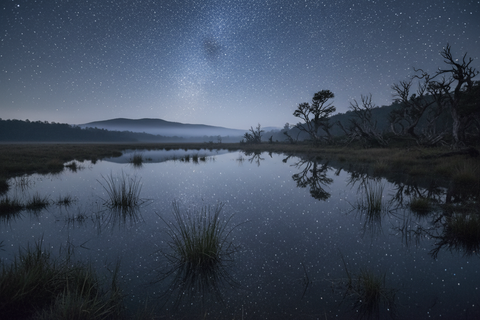
Cuiviénen: The Awakening of the Elves
Journey to the Waters of Awakening Where the Firstborn Opened Their Eyes to the Stars
Introduction: A Place at the Edge of the Map
In The Silmarillion, Cuiviénen appears as one of the
earliest named places in the history of Arda, set in the far
eastern regions of Middle-earth during the Years of the
Trees, long before the making of the Sun and Moon; it
is mentioned as the shore where the first Elves awoke beside a
dark inland sea under the starlit sky of Varda. Tolkien never draws it on a
finished, canonical map, yet the text clearly locates it beyond the familiar
western lands of Beleriand and later Eriador, in a direction
most Elf-stories seldom revisit. This placement in the distant east gives
Cuiviénen an almost mythical quality, as if it lies at the very edge of
remembered geography, and it serves as a counterpoint to
Valinor in the far West, marking the opposite end of the
Elvish journey across the world. Whenever Cuiviénen is mentioned in the
narrative, it carries a sense of deep antiquity, for it belongs to a time when
Middle-earth was still dark, unshaped by Men, and the
Valar had not yet fully turned their attention to the Firstborn
in the Outer Lands.
The name Cuiviénen itself points to the nature of the place, since it is not the
title of a city, fortress, or realm, but of a water landscape that stands apart
from the wider lands of Middle-earth; in Quenya, it is a toponym that describes
a physical feature rather than a political or cultural center. Tolkien’s use of
this name hints that the awakening of the Elves is tied to a natural setting
created in the Music of the Ainur and shaped in the early labors of the Valar,
not to any achievement of the Elves themselves. This makes Cuiviénen feel like a
cradle or basin where life begins, a quiet hollow of the world that gathered
waters and starlight long before any people came to dwell there. Readers are
meant to picture it as a marked place on the face of the earth, set aside by
intention or destiny, rather than as something that grew out of Elvish building
or craft.
From the beginning, Tolkien’s description sets the tone that Cuiviénen is best
imagined as a remote and watery landscape rather than a settlement, fortress, or
walled refuge; the Elves do not wake into a city but into untouched creation.
The texts in The Silmarillion and in Christopher Tolkien’s commentaries show
that the first dwellings, tools, and customs of the Quendi grow slowly out of
their life beside this water, instead of the place being defined by buildings
from the start. As a result, Cuiviénen itself remains more like a sacred natural
site, a memory of the earliest world that persists in song and legend even after
the Elves leave it. Later strongholds such as Tirion upon Túna,
Menegroth, or Gondolin are often described in relationship to
their founders, but Cuiviénen is remembered more as a scene or setting, the
silent backdrop against which the Firstborn opened their eyes to the stars.
Name and Meaning
In Tolkien’s own translation, Cuiviénen means “Water of Awakening,” which
directly links the place-name to the first stirring of the Quendi, the Firstborn
of Ilúvatar; this is clearly stated in The Silmarillion when the narrative
explains that there the Elves awoke by the starlit waters. The phrase does more
than mark a location, because it suggests that awakening itself is bound to
water, reflection, and the stillness of the world in the hours before dawn, when
only the stars give light. The name also carries a tone of reverence in Elvish
memory, similar to how Men in later ages might speak of a distant homeland they
have never seen but hold in song. In their tales, the Water of Awakening becomes
not only a physical shore, but the threshold between sleep and consciousness,
between silence and the first Elvish voices calling themselves Quendi, “those
who speak with voices.”
As a compound, Cuiviénen points to a body of water as the central and defining
element of the place, rather than woods, mountains, or plains; Tolkien’s wording
indicates that the early Elves dwelt “by the waters of Cuiviénen” and not simply
in a region that bore that name. This emphasis on water supports the picture of
the first Elves gathering along lakeside margins, where reflection and gentle
sound shaped their first experiences of the world. In such a setting, it is easy
to imagine how the Elves first saw the wheeling stars mirrored on the surface,
how they heard the whisper of reeds and soft movements of the shore, and how
this formed their earliest songs and words. The idea that a single water feature
can name the entire place shows how important it is in their memory, since the
shore, the nearby hills, and the meadows are all defined by their relationship
to that dark, still basin.
In Tolkien’s early mythic histories, including the accounts woven together in
The Silmarillion and the later volumes of The History of Middle-earth, the name
Cuiviénen is used consistently to mark this one particular site in the east
where the Elves first arose, and it is never casually applied to any later
dwelling. The recurring mentions underline that Cuiviénen is unique in the story
of Arda, just as there is only one Valinor in the West and one Halls of Mandos
beneath the western mountains. Even when the Elves move far from their first
home, their chronicles keep returning to this same name as a fixed point in the
timeline, a symbol of beginnings before the great sundering of their kindreds.
Because Tolkien keeps the term stable across drafts and languages, readers can
follow it through the legendarium as a firm anchor to the earliest days, despite
many changes to maps and cosmology in his evolving work.
Geographic Setting in Middle-earth

Tolkien places Cuiviénen “in the east of Middle-earth,” in a distant and
little-traveled part of the world that remains shadowy throughout most of the
legendarium; this is explicitly contrasted with the western lands that become
central later in The Silmarillion and The Lord of the
Rings. In the early days of the Quendi, there are no
great kingdoms or famous roads leading westward, and the Valar themselves have
turned their main power toward Aman across the Great Sea. By choosing the remote
east, Tolkien makes the awakening of the Elves feel far removed from the later
centers of power, as if their first memories belong to another world of quiet
and unbroken darkness under the stars of Varda. Later references to the east in
the tales of Men and of Sauron’s influence only deepen the feeling that
Cuiviénen lies in an almost unreachable past, both in time and in distance.
Cuiviénen is portrayed as an inland and remote place rather than a coastal bay
or sea-shore; Tolkien speaks of a “bay in the inland sea of Helcar,” suggesting
a smaller inlet off a much larger interior water. There is no mention of
pounding surf or the roar of an ocean, but instead of still waters enclosed by
land, which implies broad regions of wilderness stretching around it. The
surrounding lands are described in general terms as wide and sparsely peopled,
for at that time only the Elves have awakened and their numbers are few. This
emptiness of the region supports the idea that the Firstborn were truly alone at
the beginning, with no Men, Dwarves, or other speaking peoples
in sight, and with the servants of Melkor roaming mostly
in the dark far away until they seek out the new race.
The maps and notes that survive in Tolkien’s writings deliberately leave the
exact coordinates of Cuiviénen uncertain, and Christopher Tolkien often remarks
on this in his editorial commentary, noting that his father never fixed its
position on the same kind of precise map used for Beleriand or for the lands of
The Lord of the Rings. This uncertainty strengthens the feeling that Cuiviénen
belongs to a mythic, half-remembered geography, known only by direction and by
great distances, instead of by careful measurement. To later Elves living in
Lindon, Lothlórien, or
Rivendell, it would seem as far away in space as it is in
time, a place of origins that lies beyond the known charts. For modern readers,
this vagueness invites imagination, encouraging many different artistic and
cartographic visions of where the Water of Awakening might once have been before
the tumults that reshaped Middle-earth.
The Water and Shoreline
At the heart of Cuiviénen is a still body of water, spoken of as a bay of the
great inland sea of Helcar, whose surface is often imagined as calm, reflective,
and clear enough to mirror the stars that Varda set in the heavens; Tolkien’s
few brief phrases suggest quiet rather than storms. This stillness fits with the
moment of awakening, when the first Elves open their eyes in peace, not in
terror of roaring waves or clashing rocks. As they stand by this lake, they
would see the darkness above repeated below, forming a double dome of starlight
that surrounds their earliest days. In such a setting, it is natural that the
Elves come to love stars above all other lights, for the world they first know
is shaped by that gentle gleam resting on dark water.
The shorelines of Cuiviénen are imagined as reed-fringed and softly sloping,
more like the banks of a quiet lake than like rugged sea-coasts with high
cliffs; nothing in the text suggests towering rocks or treacherous ledges beside
the waters of awakening. This image fits the idea that the Quendi, newly
awakened, can walk to the water’s edge without peril, exploring the shallows and
touching the cool surface. Soft banks allow for gathering, play, and the making
of simple shelters, as opposed to steep crags that would confine them to narrow
ledges. The gentle slopes also suggest that the land and water meet in a gradual
way, without sudden barriers, echoing the slow and natural growth of the Elves’
first knowledge of the world.
The margins of the water at Cuiviénen are better imagined as shallow edges with
sedge, mudflats, and low-growing plants rather than deep, sudden drop-offs or
pounding surf; Tolkien never mentions harbors, shoals, or sea-storms here, which
supports this picture of calm shallows. Newborn Elves could walk into the water
up to their knees without danger, seeing fish or strange lights beneath the
surface, and hearing only the lap of ripples among reeds. This kind of shore is
often rich with life, from small birds and insects to water plants, and so the
Elves’ first surroundings would be filled with gentle movement and sound. The
absence of depth and violence in the water’s edge reinforces the idea that
Cuiviénen is a cradle, not a testing ground, where the Firstborn begin in safety
before the dark powers of Melkor seek them out.
Flora and Wetland Character

Tolkien’s scattered notes and the hints in The Silmarillion suggest that the
shores of Cuiviénen are lined with reed-beds, marsh grasses, and a fringe of
trees that frame the still water, creating a half-open ring of shelter around
the bay. He does not give a detailed botanical list, but the image of a “bay” on
an inland sea naturally calls to mind narrow belts of wetland plants and light
woods that stop short of becoming dense forests. This pattern of reeds, low
herbs, and scattered trunks would offer both hiding places and vantage points
for the first Elves as they learn to move in their world, to hunt small animals,
and to sing among the trunks and branches. Such a fringe also makes Cuiviénen
feel like a room within the wider land, with the water as the floor and the
trees as the walls, touched overhead by the roof of the sky.
The vegetation around Cuiviénen seems low and natural, with sedge, reeds, and
scattered woodland fitting a quiet, marshy shore rather than a grand, ancient
forest like Doriath or Fangorn; in the earliest times, much of
Middle-earth is still in a wild and unfinished state. The Elves, newly awakened,
are not described as carving clearings or building great halls but as dwelling
in simple ways near this already gentle environment. Low plants at the water’s
edge soften the scene and break the wind, while wider stretches of open ground
between clumps of trees offer space for gathering and movement. This kind of
modest vegetation suits a place where the world is young, and where the main
focus of the story is not on mighty trees or peaks, but on the arrival of speech
and memory among the Quendi.
Any plant life at Cuiviénen would be tied closely to the shallow water and damp
soils of the bay and its marshy margins, and in Tolkien’s imagined world of the
Years of the Trees, such life would likely follow natural cycles even in the dim
light of the stars. The Silmarillion does not discuss seasons at Cuiviénen in
detail, yet it hints that time passes and the Elves dwell there for many years
before the Valar come to summon them. During this long stay, reeds would grow
tall and wither, young saplings would rise among older trees, and flowers
adapted to wet ground might bloom in their time, even under starlight, marking
the slow rhythm of the world. The changing of plants around the bay would be one
of the first signs, for the Elves, that the world is alive and moving forward,
even though the sky seems always dark except for the steady stars.
Sky, Starlight and the Eastern Horizon

In the few descriptive lines that exist, the atmosphere of Cuiviénen is strongly
shaped by the sky, especially by the clear view of the stars whose reflection in
the water is often stressed; The Silmarillion says that the
Vanyar and the Noldor loved Varda’s stars most
because they awoke in their presence. The still surface of the bay would act
like a dark mirror, doubling the constellations that the Elves later name and
celebrate in their songs. This makes the sky not only a roof over the place but
part of the place itself, joined to the land by the water’s glassy surface. For
the newly awakened Quendi, the stars become both ceiling and companion, filling
their first nights with wonder and giving them a lasting love for clear, bright
heavens.
The eastern horizon around Cuiviénen is described in general terms as broad and
low, giving an impression of openness and a wide dome of stars overhead, without
tall mountain ranges blocking the view; Tolkien emphasizes emptiness and breadth
rather than enclosure by high peaks. Such a low horizon allows the Elves to see
the wheeling of the stars from rise to set, teaching them the movements of time
and the turning of the heavens. With little to break the line of sight, the sky
seems even larger, and the sense of the world as a vast and mostly unknown place
is deepened. In those early days, when the Elves have never seen the Light of
the Trees in Valinor, the huge, star-filled sky is their first and greatest
teacher, shaping their thoughts about beauty and order.
The light at Cuiviénen is mostly cool and silvery at night, given by the stars
and, later, by the first rising of the Moon, while by day the place lies in a
pale and rather undramatic daylight, at least in comparison with the strong
Lights of the Two Trees or the bright Sun of later ages. The Silmarillion notes
that Cuiviénen belongs to the time before the Sun, when only the stars shone
upon Middle-earth, which makes the night hours the true time of beauty there.
Daylight would reveal a quiet landscape of water, reeds, and distant hills, but
it is the nights that fill Elvish memory with a sense of holiness and wonder.
This contrast helps explain why many Elves in later ages prefer starlight to
sunlight, and why they speak of the Sun as the “Heart of Fire” that came later,
while their first love remains the softer lights that watched over their
awakening.
Topography: Hills, Plains and Isolation
The land that lies immediately beyond the waters of Cuiviénen is best imagined
as gently rolling ground rather than as a ring of steep mountains; the texts do
not speak of sharp ridges or snow-capped peaks hemming in the bay. Soft rises
and small hollows would surround the shore, allowing the Elves to wander a
little way inland without facing impossible slopes or dangerous cliffs. This
rolling land matches the idea that the region is a quiet backwater of the world,
far from the great upheavals that raised the Pelóri in the West or the later
Misty Mountains. Within this landscape, small streams would likely feed the bay,
and patches of woodland would dot the low hills, providing variety without
breaking the feeling of gentle seclusion.
Beyond the first ring of low ground, Tolkien suggests vast plains and low hills
stretching away into the east and south, reinforcing the sense that Cuiviénen
sits in the middle of a huge and mostly empty inland region. No kingdoms,
citadels, or famous rivers are named near it, and there is no hint of early
Dwarf-cities or other speaking peoples close at hand. This makes the Elves’
first home feel like an island of life in a sea of wilderness, with only distant
and half-seen threats moving in the margins. When the servants of Melkor begin
to spy upon them and carry some away, the terror arises from the fact that the
surrounding lands are so broad and unmarked that anyone taken might vanish
forever into the trackless dark.
The setting of Cuiviénen suggests a place through which few, if any, travelers
normally pass, a region isolated not by cliffs or seas but by distance and the
simple lack of paths; it feels quietly enclosed by the surrounding landforms
even though they are not dramatic. The Elves dwell there for long years without
ever hearing news of far lands or other peoples, which shows how cut off the
place is in the story. Only when the Valar decide to summon the Firstborn do
great powers move across that empty space, and even then the journey to the West
is long and full of unknowns. The impression left on readers is that Cuiviénen
is a cradle hidden in the folds of the earth, a starting point set apart from
the rest of history, which the Elves must leave behind if they wish to pass into
the wider drama of Arda.
Edges and Approaches

The approaches to Cuiviénen are not described as roads, paved ways, or even
clear tracks, but as simple, gradual transitions from firm land to wetter
margins; the Elves awaken into a place where nothing has yet been surveyed or
engineered. Anyone coming toward the bay from inland would find the ground
slowly becoming softer underfoot, with the scent of water in the air, rather
than crossing bridges or fords carefully placed by hands. This lack of formal
approach routes fits the idea that Cuiviénen is known only to those who already
dwell there or who are guided by powers such as Oromë of the Valar. It remains
beyond the normal lines of movement in Middle-earth, a place to be discovered,
not followed on a map of roads.
At the water’s edge, the shoreline at Cuiviénen yields first to reed-beds, then
to damp meadows, and finally to scattered trees and low rises as one moves away
from the bay, forming a gentle gradient from open water to drier ground;
Tolkien’s imagery supports this layered scene. The Elves’ early life takes shape
along this gradient, with some perhaps favoring the open shore while others
prefer the shelter of the first trees. Animals and birds would use these varied
zones as habitat, making the region rich in sounds and small signs of life even
though there are no other peoples nearby. The lack of a sharp dividing line
between land and water mirrors the early Elves’ own slow passage from unknowing
to knowledge, as they move back and forth between the elements that surround
them.
The absence of any built features around Cuiviénen highlights its naturalness
and the sense that it belongs to a time before cities, fortresses, and stone
roads; the Elves there live in a world where the only works are the works of the
Valar on the face of the earth. The Silmarillion never mentions towers, walls,
or even simple piers at the Water of Awakening, and this silence is meaningful
because later Elvish realms are described in loving architectural detail. At
Cuiviénen, the Firstborn’s connection to the land is immediate and unmediated,
as they sleep, wake, and move under open sky and among reeds and trees. This
purity of landscape underlines why later memories of Cuiviénen feel almost holy,
as if they belong to an age outside normal history, before art and craft began
to change the look of Middle-earth.
Memory and Cartography in the Legendarium

Tolkien’s own maps and narratives leave Cuiviénen in a deliberately vague
position, with only broad hints about its place in relation to known continents
and seas, which reinforces an aura of great distance and mystery; Christopher
Tolkien notes more than once that his father never fully resolved the shape of
the eastern lands. In the earlier cosmologies where the world is flat and later
made round, the inland sea of Helcar and its bay of Cuiviénen undergo many
theoretical changes, so that any exact modern map would be more an
interpretation than a strict canon. This uncertainty means that, even within the
story, later Elves and lore-masters might disagree about the long-ago geography
of their awakening place. For readers, the planned vagueness keeps Cuiviénen in
the realm of myth rather than ordinary cartography, much like the uncertain
eastern lands of many old human legends.
Later references in The Silmarillion and related writings treat Cuiviénen as a
named geographic feature whose importance lies in memory and story rather than
in ongoing political or cultural life; it is never again a center of power once
the Eldar depart. When the narrative speaks of the awakening of the Elves or of
the earliest days before their sundering into Vanyar, Noldor, and Teleri, it
points back to Cuiviénen as to a sacred origin point. Yet no later king claims
it, no banner flies over it, and there is no talk of returning there to found a
new realm, which shows that its role is to remain a beginning left behind. The
great journeys westward, the March of the Eldar, and all the later wars are
shaped by the memory of that shore, not by its presence in the world stage.
Because Tolkien gives only directional clues and a few broad features for the
region around Cuiviénen, readers, artists, and mapmakers have long been free to
imagine its exact place within the wide eastern lands, each version emphasizing
different aspects of its mystery. Some fan-made maps place it on a vast inland
sea north of later-known realms, while others push it far into forgotten
territory that would have been lost or reshaped when the world was bent and the
seas changed. This open space has allowed Cuiviénen to live not only as a fixed
line in the text but as a living image in the minds of those who love Tolkien’s
work. In all these imaginings, however, the core remains the same: a remote bay
of still water under uncounted stars, where the Firstborn of Ilúvatar rose from
sleep and began the long history of the Elves in Middle-earth.