
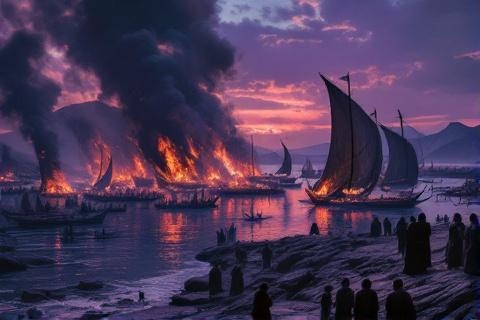
The Burning of the Ships at Losgar
Betrayal and Desperation Among the Noldor
A Tragic Choice at Losgar

The burning of the ships at Losgar stands as a single, terrible act that marks a
sharp turning point in the story of the Noldor, changing their
exile from a bold adventure into a path of sorrow that cannot be undone. Until
that night, there is still a sense that the Noldor might turn back, seek pardon
from the Valar, or at least keep some tie to the light of Aman.
When the flames rise and the ships are destroyed, the last easy road home is cut
off forever, and the Noldor pass from a blessed realm into a dark and uncertain
future. In The Silmarillion, this moment is described as
one of final choice, for after Losgar their fate is bound to
Middle-earth and to the long war against
Morgoth, with all the grief and ruin that follows. Thus
the act at Losgar does not only burn wood and sailcloth, it burns away hope of
return, and fixes the Doom of the Noldor upon them in full.
Fëanor, driven by pride and fear of losing control of his
people, orders the ships destroyed so that no one can easily sail back to Aman,
and this decision condemns many of his kin to a far harsher road into exile.
Only a part of the Noldor have been carried over the sea in the stolen
Telerin ships, and many of those left behind had trusted that
the fleet would return for them. By choosing to burn the vessels, Fëanor denies
them that hope and forces them to seek another path, if any path remains. The
ships could have offered a slower and more merciful movement of the Noldor into
Middle-earth, or even a way to retreat if despair grew too strong. Instead,
Fëanor chooses fire, and with that choice he seals the fate of those who must
later cross the Grinding Ice or remain locked out of the west forever.
The scene at Losgar, though brief in the narrative, is both wide and intimate,
filled with great drama and quiet horror as the ships blaze, smoke rises into
the night, and the Noldor on the shore stand stunned and heart-stricken. Tolkien
shows the beauty of the white ships of the Teleri, once likened to swans, now
turned into torches that light the cold coasts of the north. For those watching,
the fire is not only a practical loss but a terrible vision, a sign that all
ties to the Undying Lands are being consumed. The sons of
Fëanor stand with their father, bound by oath, while
others look on in grief and disbelief, knowing that something sacred has been
destroyed. In this mixture of roaring flames and silent shock, Losgar becomes
one of the most powerful and painful images in the legendarium of the First
Age.
Fëanor's Oath: The Spark of Rebellion
The roots of the fire at Losgar lie in an earlier and even more fearful moment,
when Fëanor swears his dreadful oath to pursue with vengeance anyone who
withholds the Silmarils, whether Valar,
Elf, or any other being in Arda. In The
Silmarillion this oath is spoken in Tirion before a great host
of the Noldor, and its words are terrible and binding, calling upon Ilúvatar to
witness and laying a doom on Fëanor and his seven sons if they fail. They
promise never to rest nor to show mercy to any who might keep the jewels from
them, even if that enemy be of their own kin. This vow turns a personal grief,
the loss of the Silmarils to Morgoth, into a sacred and unbreakable mission that
will echo through all their later deeds.
Once the oath is sworn, it hardens Fëanor’s will, making him deaf to counsel and
closed to the calls for peace that come from the Valar and from the wiser among
his own people. Even when Mandos pronounces the Doom of the Noldor, warning them
that sorrow and tears will be their portion if they depart from Aman, Fëanor
presses on, for he sees any delay as betrayal of his vow. The words he has
spoken do not allow easy compromise or patient waiting, and he comes to view
every obstacle as an enemy to be crushed. As a result, the Valar’s attempts to
restrain or guide the Noldor appear to him not as care but as chains set upon
his rightful quest. The oath becomes the inner iron that directs his choices,
even when reason or mercy might have led him another way.
Because of this, the oath helps explain the desperate urgency and moral
blindness that shape Fëanor’s later choices, including his burning of the ships
at Losgar. He no longer measures actions only by justice or pity but by the
question of whether they will bring him more quickly to Morgoth and the
Silmarils. Those who hesitate, such as Fingolfin and his
followers, seem in his eyes like possible rivals or weak allies, not beloved
kin. The fear that others might claim a share in the recovery of the Silmarils,
or even oppose him, twists his mind until betrayal appears as strategy. Thus,
when he orders the ships burned, it can be seen as the bitter fruit of that
oath, which has closed his heart to all but his own fierce purpose and led him
to sacrifice even his own house’s honor for the sake of his sworn word.
The Kinslaying at Alqualondë: Theft and Blood

Before the ships ever reach Losgar, the Noldor stain their rebellion with blood
at Alqualondë, where they attack the Teleri to seize their
fleet in the dreadful event known as the First Kinslaying. In The Silmarillion
this is described with sorrow, for the Teleri are their own kin, and their haven
by the sea is filled with light and music before the Noldor descend upon it. At
first the Teleri refuse to give up their ships, for they love them as their own
work and will not share in a venture set against the Valar. When fair speech
fails, Fëanor and his followers turn to force, and a battle breaks out on the
white shores, with swords drawn and arrows loosed between Elves who once dwelt
in friendship beneath the light of the Trees. The beauty of the haven is marred
by slaughter, and the sea is darkened with the first Elven blood spilled by
Elven hands.
The assault on Alqualondë leaves a deep wound of guilt and division that spreads
through the Elven kindreds, for the theft of the ships becomes the seed of later
doom and mistrust. Those Noldor who take part in the fighting, or who stand by
and do not resist, come under the shadow of this crime and feel its weight in
their hearts. The Teleri, mourning their dead and their stolen swan-ships, never
fully forgive the Noldor, and their grief is later echoed in the words of Mandos
when he declares the Doom. Even among the Noldor themselves, some cry out
against the slaying, and quarrels begin between the houses of Fëanor and
Fingolfin. This act of violence against kin opens a dark path that later
Kinslayings will follow, so that Alqualondë is remembered as the first crack in
the unity of the Eldar and a sign that great beauty can fall quickly into ruin
when pride and anger rule.
When Fëanor and his followers take the Telerin vessels despite the pleas and
protests of their owners, they create a stain on their honor that no later
heroism can fully wash away. The Teleri do not offer their ships freely, and
even after blood has been shed they beg the Noldor to turn back from their
madness and to leave the fleet. Fëanor will not, for he deems his need and his
oath greater than their rights, and so the white ships become trophies of a sin
rather than gifts between friends. Tolkien later describes how the Noldor feel
the weight of this deed, for even the Valor of their later wars in
Beleriand cannot entirely remove the memory of that first
crime. In this way, every time those ships glide over the darkened sea toward
Middle-earth, they carry not only warriors and princes but also the memory of
stolen lives and broken bonds that will follow the Noldor to Losgar and beyond.
The Voyage and Arrival: From Aman to Losgar
After the bloody seizure of the fleet, Fëanor does not hesitate but quickly
sails with a portion of the Noldor, guiding the stolen ships along the shores of
Aman until they reach the far north and the lonely firth of Losgar. In The
Silmarillion, this journey is briefly told, yet its meaning is heavy, for these
ships bear the first great host of Exiled Elves toward the Hither Lands. They do
not sail straight across the wide ocean but creep along the coast, for the way
to Middle-earth by that route is narrow, where the seas draw close and the land
of Aman bends northward. At last they come to the strait near Araman and Losgar,
where Fëanor brings the fleet to shore and the Noldor land upon the freezing
coasts that lie closest to the outer world. There, for a time, they stand
between the safety of the Blessed Realm behind them and the sorrowful lands
before them.
Yet even as Fëanor reaches Losgar by sea, many of the Noldor remain divided in
will and in place, for not all have come with him on the stolen ships. Fingolfin
and his people, along with Finarfin and their followers, have marched northward
on foot, moving slowly behind along the coasts of Aman. Some of them joined the
rebellion under pressure, or in loyalty to their kin rather than to the Oath
itself, and their hearts are troubled. Others, like Finarfin, will later turn
back. The Noldor are no longer one united people but several hosts, each with
mixed feelings about the journey, caught between love for their kin and dread of
the Doom that has been spoken over them. This split of heart and party sets the
stage for the cruel choice Fëanor will soon make at Losgar.
Thus Losgar becomes the place where Fëanor makes his most irreversible decision,
choosing not only to press onward into Middle-earth but also to cut off any path
of retreat for those who follow him and for those who come behind. The Noldor
have already gone far from Valinor, and Mandos has declared
that pardon will be hard to win, yet until the ships are burned there is still
some hope that the Valar might one day forgive. Standing upon that bleak
northern shore, with the ice of the world’s edge before him and the west behind,
Fëanor fixes his course. His choice at Losgar is not simply to go on but to
force all others, by fire and ruin, to follow or to perish in the attempt. In
this way the geography of that narrow strait becomes a symbol of a narrow moral
path, where a single step in pride traps an entire people in a destiny of
sorrow.
The Burning: Fëanor's Decision

At Losgar, in a moment of anger, mistrust, and fear of being denied his will,
Fëanor orders the white ships burned so that none among the Noldor may sail back
to Aman, and this act seals the fate of both those with him and those left
behind. He suspects that if the fleet returns to fetch Fingolfin’s people, they
may challenge his leadership or urge retreat, and his heart, already hardened by
the Oath, cannot bear such a thought. The Silmarillion tells how his sons carry
out his command, and the fair vessels, once a marvel of the Teleri’s craft, go
up in great flames that shine like a red dawn on the northern seas. By this deed
Fëanor throws away a treasure that could never be remade, for no such ships will
ever again be built in Middle-earth. The burning is not only practical but also
symbolic, for it shows that he has chosen separation from Valinor at any cost.
In Fëanor’s mind, the destruction of the ships serves a dark purpose, for it
both binds his followers to the hard road into Middle-earth and punishes those
who doubted or opposed him by leaving them stranded behind. Those Noldor who
stand with him at Losgar now have no way to turn back, even if their courage
fails, and so they must march forward into Beleriand and face Morgoth with no
hope of pardon across the sea. At the same time, those under Fingolfin, who had
trusted that the ships would come for them, find themselves betrayed when they
see the flames in the distance and understand what has been done. Fëanor, in his
harsh pride, sees this as just, for he believes that only the fiercest and most
loyal should share his war. Yet in truth, he has turned a family dispute into a
vast moral crime, sacrificing the lives and hopes of kin in order to strengthen
his own power.
In this way the burning at Losgar is both an act of stubborn resolve and of
tragic recklessness, for while it seems to solve a present problem for Fëanor it
creates far deeper suffering and division in the years to come. In the short
term, he no longer needs to share command of the fleet or fear that some will
sail back to seek pardon from the Valar, and the path before him seems clear.
Yet he has also ensured that the journey for those left behind will be much more
deadly, and he has deepened the hatred and sorrow between the houses of the
Noldor. Later, when Fingolfin’s people reach Middle-earth after crossing the
Grinding Ice, their anger and pain shape the politics and alliances of Beleriand
in lasting ways. The burning of the ships appears, then, as a choice that values
immediate control over any vision of long-term mercy or unity, and its bitter
consequences reach far beyond that northern shore.
Stranding and the Grinding Ice: The March of Fingolfin

Because the Telerin fleet is destroyed by fire at Losgar and no ships remain to
carry the rest of the Noldor, Fingolfin’s people cannot follow by sea and are
forced to seek another route into Middle-earth, a way that lies over the far
northern lands. When they behold the distant glow of the burning ships, they
understand that Fëanor has abandoned them, and despair settles upon the host.
Yet they will not return to Valinor in shame, for their pride and their own
share in the rebellion drive them onward. Thus they march farther north until
they come to the edge of the Helcaraxë, the great grinding ice that lies between
Aman and Middle-earth. The choice now before them is cruel, for they must either
accept that their journey has failed or attempt a crossing that even the Valar
feared.
The Helcaraxë, called the Grinding Ice, is described in The Silmarillion as a
bitter and deadly passage of broken ice, shifting floes, and freezing seas,
where darkness and storm are constant companions. There the sea is not open
water but a shifting chaos of icebergs and floes that crash together with
terrible force, crushing anything caught between them. The winds howl, the cold
bites even into the bodies of the immortal Elves, and the light is dim, for the
world still lies under the dark left by Ungoliant’s assault on the Trees. No
ship could pass there, and even on foot the way is full of cracks and sudden
chasms, where one misstep can mean being lost beneath the ice forever. This is
the road left to Fingolfin’s host, a path that turns what might have been a
proud march into a grim battle against the raw elements of Arda.
As they go, countless Elves suffer and many die upon that cruel march across the
Helcaraxë, and so the cost of Fëanor’s decision at Losgar is weighed out in
frostbite, exhaustion, and the loss of beloved companions. The Silmarillion
speaks of many who fall into the dark waters or are crushed by grinding ice, and
even those who survive are scarred in body or spirit by what they endure. The
Noldor there know hunger and cold in ways they never did under the light of the
Trees, and their leaders, such as Fingolfin and his children, are marked by
grief and hard-won endurance. By the time they set foot at last in Middle-earth,
they are no longer the bright and eager Exiles who left Tirion but a people
tempered by sorrow and wrath. Every victory they later win, including
Fingolfin’s great ride to Angband and Fingon’s rescue of Maedhros, carries in
its shadow the memory of the dead on the ice and the knowledge that this
suffering began when the ships were set ablaze at Losgar.
Betrayal Among Kin: How Trust Shattered
The burning of the ships at Losgar deepens the breach between the great houses
of the Noldor, for it turns earlier quarrels and rivalry into open resentment
and mistrust toward Fëanor and his sons. Before this time, there had already
been tension between Fëanor and his half-brothers, yet kinship and shared
history still held them together. After Losgar, many among the followers of
Fingolfin and others who learn of the deed see Fëanor not only as proud but as
treacherous, willing to sacrifice his own kin for the sake of his will. Even
those loyal to the House of Fëanor must feel the unease of knowing that their
lord has cut them off from pardon and driven others to misery. The fire at
Losgar thus burns not only wood and rope but also many of the thin threads that
remain between the branches of Finwë’s house.
For Fingolfin and his people, the sense of betrayal is especially sharp, and
this hurt shapes the way loyalties and alliances form among the Noldor once they
reach Middle-earth. Fingolfin had followed Fëanor’s lead out of pride and out of
hope that he might help guide or restrain his brother’s fury, yet Fëanor repays
this trust by stranding him on the wrong side of the sea. When Fingolfin’s folk
finally arrive in Beleriand, half-frozen and grief-stricken from the crossing of
the Helcaraxë, they find that Fëanor is already dead, fallen in his rash assault
upon Morgoth, and the burden of rule passes to Fingolfin. His kingship over the
Noldor in Beleriand is not merely a matter of lineage but also a response to
Fëanor’s failure, and many turn to him because they cannot forget the fire at
Losgar. Still, the bitterness does not vanish, and it will surface later in
disputes such as those between the sons of Fëanor and the sons of Finarfin.
Over time, the notion of kinship among the Noldor becomes twisted by these
wounds into a network of accusations, rigid oaths, and acts of reciprocal
violence that echo from one generation to another. The close bond that once
joined the houses of Finwë is weakened by repeated betrayals, and each new
tragedy seems to grow out of the last. The Oath of
Fëanor demands that his sons act again and again
against their own people, as at Doriath and the Havens of
Sirion, and each such deed adds another layer of grief to the history that began
at Alqualondë and Losgar. Even those who are innocent of the Kinslayings must
live under the shadow of their kin’s crimes, and friendships between different
houses are often strained by memories of old wrongs. Thus, what should have been
a shared heritage becomes instead a burden carried with tears and anger, showing
how one act of betrayal can poison the very idea of family for ages to come.
Consequences: Death, Division, and the Doom of the Noldor
By burning the ships at Losgar, Fëanor causes a sharp rise in the tragic cost of
the Exile of the Noldor, making their journey out of Aman far more ruinous in
both lives and honor than it might have been. The Noldor do indeed reach
Middle-earth and raise mighty realms such as Gondolin and
Nargothrond, and for a time they enjoy victories over
Morgoth’s forces. Yet every such success is shadowed by the knowledge that it
was purchased through the blood spilled at Alqualondë and the suffering of
Fingolfin’s host on the Grinding Ice. The Exile becomes not only a political
separation from the Valar but a moral fall, in which the Noldor must live with
the awareness that their greatness was gained at a terrible price. This gives a
bitter edge to their songs and memories, and even their noblest deeds stand
beside a long list of sorrows that began with the burning of the ships.
The Oath of Fëanor, already a heavy burden at the time it is spoken, grows more
dangerous after Losgar, for it traps his house in an endless chain of strife
that repeatedly brings them into conflict not only with Morgoth but also with
other Elves. Having crossed the sea and cut off retreat, the sons of Fëanor must
press on with greater fury, seeking the Silmarils wherever they may be, as at
the sieges of Angband and later when the jewels are in Doriath
and at the Havens of Sirion. Each time they act, the Oath drives them to harsh
and merciless choices, and even when some feel repentance, they dare not break
their word. Thus the Noldor find themselves not simply at war with the Dark
Enemy of the World but also entangled in a doom of their own making, which
consumes their strength and darkens their names.
Many of the greatest defeats and the fall of strongholds in Beleriand can be
traced back, at least in part, to the choices made at Alqualondë and Losgar,
showing how early sins weaken later defenses. The mistrust sown by the
Kinslayings and the burning makes it harder for the Elven realms to unite fully
against Morgoth, and fear of the Oath of Fëanor keeps some from sharing their
treasures or their plans. The breaking of the Siege of Angband in the Dagor
Bragollach, the ruin of Nargothrond after the pride
of Túrin and the counsels of Gwindor, and even the
disastrous Nirnaeth Arnoediad all unfold in a landscape already darkened by the
Noldor’s divided hearts. When at last Gondolin falls
and the Silmarils bring ruin to Doriath and the Havens, readers can see that the
path to these disasters began not only in Morgoth’s malice but also in the fiery
shores of Losgar, where pride and oath were chosen over mercy and unity.
Origins and Themes: Pride, Oath, and Fate in Tolkien's Work

In Tolkien’s shaping of the legendarium, Losgar stands as a clear moral turning
point where pride and the binding force of an unbreakable oath push noble people
toward their own ruin. Before this event, the Noldor are described as the most
skilled and learned of the Elves, beloved by the Valar and gifted with great
beauty and craft. Their rebellion begins with real grief and injustice, for
Morgoth has slain their king and stolen the Silmarils, yet at Losgar their
response to that wrong tips fully into madness. By choosing to burn the ships
and abandon their kin, they move from being wronged to becoming wrongdoers on a
vast scale. In this way, Tolkien shows how even noble hearts, when fixed on
their own hurts and desires, can choose actions that lead them far away from the
light they once followed.
The burning of the ships also reflects larger themes in Middle-earth, such as
the tension between free will and doom, the corruption of honor by vengeance,
and the heavy price of pride. The Noldor are not puppets, for they freely choose
to follow Fëanor, to seize the ships at Alqualondë, and to set them afire at
Losgar. Yet once these choices are made, the Doom of Mandos seems to unfold with
terrible certainty, as if fate itself is now against them. Their honorable
desire to punish Morgoth and recover the Silmarils is gradually twisted by their
Oath into acts that no longer serve justice but rather their own wounded pride.
Through this, Tolkien explores how even a good cause can be spoiled when it is
pursued without humility or mercy.
Losgar reveals how a single act, done in a moment of anger and fear, can reshape
history and define the character of whole houses and generations. Fëanor likely
thinks only of securing his own power and speeding his war when he commands the
burning, but the results reach far beyond his lifetime, affecting the lives of
Fingolfin, Fingon, Maedhros, Galadriel, and many others.
The Elves who later walk the forests of Beleriand, fight in the great battles,
or rule hidden cities do so in a world shaped by that fiery night. Future
choices, both good and evil, are made in response to the divisions and sorrows
that sprang from it. By tracing these long shadows, readers can see Tolkien’s
belief that history is a web of cause and effect, where even a single fire on a
northern shore can echo through ages as a warning against hasty and proud deeds.
Textual Sources and the Tale's Place in the Legendarium
The core account of the burning of the ships at Losgar appears in The
Silmarillion, especially in the chapter “Of the Flight of the Noldor,” and is
supported by related material in the Annals of Aman and other texts edited by
Christopher Tolkien. In The Silmarillion, the story is presented in a concise
and elevated style, focusing on the main actions and their moral weight. The
Annals, published in The History of Middle-earth series, offer a more
chronological version of events, setting Losgar within a precise timeline of the
Years of the Trees and the early Years of the Sun.
Other writings, such as the Quenta and various drafts, show Tolkien refining the
names, geography, and tone of the narrative, yet Losgar remains a fixed landmark
in the tale of the Noldor. Together, these sources let readers see both the
finished story and the long workshop behind it.
Scholars who study Tolkien’s manuscripts point out that there are variant
versions and details concerning the journey of the Noldor and the use of the
ships, but the central facts, the burning of the vessels and its grave
consequences, stay consistent through the drafts. In some early texts, the path
of the Noldor and the nature of the northern seas differ slightly, and certain
names change as Tolkien adjusts his invented history. Yet, in each version,
Fëanor takes the ships by force from the Teleri, sails north with a chosen host,
and at last orders the fleet to be destroyed, leaving others to face the ice.
These stable points show how important this moment was in Tolkien’s imagination,
for he never removed or softened it, even as he often revised battles,
genealogies, and other episodes. Losgar is therefore one of the fixed pillars
around which the history of the First Age is built.
By looking into the textual history preserved in The History of Middle-earth,
readers can better understand how Tolkien shaped the themes of guilt, exile, and
fate that center on Losgar across many years of rewriting. In some drafts, the
words of the Doom of Mandos are different, or the motives of Fëanor are given
slightly new colors, which helps to reveal how Tolkien wrestled with the balance
between free choice and foreordained doom. The way he consistently links
Alqualondë, Losgar, and the Helcaraxë shows his desire to bind ethical questions
to physical journeys, so that the landscape itself reflects moral states. Seeing
how these patterns are strengthened and clarified over time can deepen a
reader’s sense of the tragedy, making it clear that Losgar is not simply an
exciting scene but a carefully crafted key to the whole legend of the Noldor.
Why the Burning Matters Today — Reading and Further Study

Losgar can be read both as gripping dramatic history and as a powerful moral
lesson, for it shows in vivid form how pride and a binding oath can destroy even
the finest of peoples. The Noldor begin as bright and beloved children of the
Valar, and their skills and beauty are often praised in the text, yet their
unwillingness to accept loss and their fierce desire to have their own way open
the door to great evil. Fëanor’s inability to yield the Silmarils, even when the
Valar ask, and his refusal to forgive any restraint on his will are warning
signs that pride has taken root. When this pride is joined to the Oath and then
to the fire at Losgar, it pulls down not only Fëanor himself but also many who
loved and trusted him. In this way, the story invites readers to see that
greatness without humility can become a path to ruin.
Those who follow the tale through The Silmarillion can trace the consequences of
Losgar into nearly every major tragedy of Beleriand and the downfall of many
houses of the Eldar. The bitterness between the sons of Fëanor and other princes
helps to shape the disastrous choices before the Nirnaeth Arnoediad, the Battle
of Unnumbered Tears. The wandering of Maedhros and Maglor, the ruin of Doriath
when they seek to reclaim the Silmaril, and the final assault on the Havens of
Sirion all flow from the same source, the Oath that drove Fëanor to burn the
ships. Even those who try to heal these wounds, such as Fingon’s rescue of
Maedhros or Finrod’s friendship with Men, must work in a world
already broken by that earlier betrayal. By following these links, readers can
see how one event in the far north leaves marks upon people and places across
all of Beleriand.
For readers who wish to explore this more deeply, a natural next step is to read
or reread the chapters “Of the Flight of the Noldor” and “Of the Return of the
Noldor” in The Silmarillion, then to turn to related material in Unfinished
Tales and the volumes of The History of Middle-earth.
These texts offer fuller pictures of the characters and settings, including the
speeches of the Valar, the hardships on the Helcaraxë, and the settlement of the
Noldor once they reach Middle-earth. Looking at the later battles and
Kinslayings through the lens of Losgar can reveal patterns that might otherwise
be missed, such as how often oaths and pride push characters into choices they
later regret. In this way, Losgar becomes not only one episode among many but a
guiding key to understanding the whole sorrowful splendor of the First Age.