
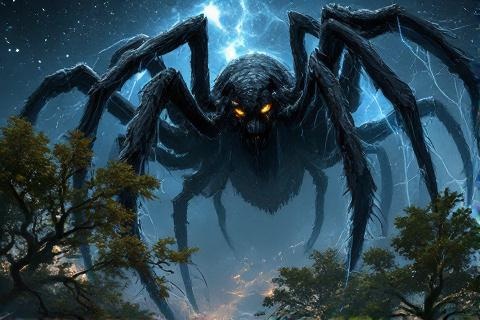
Ungoliant: Devourer of Light
The Spider-Queen of Darkness and Her Deadly Legacy
Origins in Mystery

The true origins of Ungoliant remain one of the most debated topics among the
loremasters of Middle-earth. Some ancient texts suggest
she was originally one of the Maiar, holy spirits who entered
Arda at its beginning, who fell into darkness much like
Melkor and his followers. The
Silmarillion presents this as one possibility, noting her
kinship with other dark spirits who served the first Dark Lord.
Another compelling theory holds that Ungoliant emerged from the Void itself, the
vast nothingness that existed before Eru Ilúvatar began the Music of the Ainur.
This origin would explain her fundamental nature as a being of pure darkness and
her ability to generate webs of Unlight that even the Valar found
difficult to penetrate. The suggestion that she came from outside the Music
would also account for her inexplicable powers that seemed to follow different
rules than those of other beings in Arda.
The mystery of Ungoliant's true nature stands as one of the most enigmatic
elements in Tolkien's legendarium. Unlike other great powers of Arda, her
existence defies easy categorization within the established hierarchy of beings.
The very fact that the loremasters of the Eldar could not definitively trace her
origins speaks to her unique and terrible nature in the world. This uncertainty
adds to her terror, as she represents an unknown force that existed somehow
apart from the ordered structure of Arda.
The Form of Living Darkness
In her physical form, Ungoliant took the shape of a monstrous spider of
tremendous size and terrible aspect. Her body was black as the Void, and she
possessed the ability to weave webs unlike any natural spider. These webs were
not merely physical constructs but were spun from darkness itself, creating
patches of shadow that light could not penetrate. The Silmarillion describes her
as having many eyes and a bloated body that exuded black vapors.
Ungoliant's most terrifying power was her ability to generate and weave Unlight,
a darkness that was more than mere absence of light but rather an active force
that consumed and destroyed light itself. This power was fundamentally different
from normal darkness, as it could not be penetrated by any light of Middle-earth
or Valinor. When she unleashed this power, it created a
Darkness that extinguished all light and smothered the will of those caught
within it.
The defining characteristic of Ungoliant was her insatiable hunger, which drove
her to consume anything and everything in her path. This hunger was not merely
physical but spiritual, compelling her to devour light, life, and even the
substance of the world itself. Nothing could satisfy this endless craving, which
only grew stronger the more she consumed. The Silmarillion tells of how she
would even consume the very air around her, leaving voids of nothingness in her
wake.
Perhaps most frightening was Ungoliant's ability to grow in size and power by
consuming light and life. The more she devoured, the larger and more powerful
she became, with no apparent limit to this growth. This terrible ability meant
that each victory only made her more dangerous, as demonstrated most
dramatically after her consumption of the light of the Two Trees of Valinor. The
power she gained from consuming holy light was proportional to its brightness
and purity, making the holiest lights the most dangerous for her to consume but
also the most rewarding.
Alliance with Melkor

When Melkor returned to Middle-earth after his release from bondage in Valinor,
he discovered Ungoliant dwelling in Avathar, a narrow strip of land in the south
of Aman. This region lay in perpetual darkness beneath the shadows of the Pelóri
Mountains, making it an ideal refuge for the light-hating spider. The
Silmarillion records that even the Valar had forgotten about this dark and
desolate place, allowing Ungoliant to remain hidden there for many years.
Melkor approached Ungoliant with a proposal that would reshape the history of
Arda. He offered her a partnership in his planned assault on Valinor,
specifically targeting the Two Trees that provided light to the Blessed Realm.
The spider, though distrustful of the Dark Lord, was intrigued by the
possibility of consuming such powerful light. Their alliance was one of
convenience, built on mutual desire for destruction rather than any true
loyalty.
The terms of their agreement were simple but significant: in exchange for her
help, Melkor promised Ungoliant whatever she desired from the spoils of their
raid. The Silmarillion notes that he made this promise with the characteristic
dishonesty of his nature, never intending to fulfill it completely. This fateful
promise would later lead to a confrontation between the two dark powers that
would shake the foundations of Middle-earth.
The Darkening of Valinor

The assault on the Two Trees of Valinor marked one of the most catastrophic
events in the history of Arda. Melkor struck the Trees with his great spear
while Ungoliant drained them of their sap and light. The Silmarillion describes
how she pierced their bark with her black beak, drinking the living light and
poisoning what remained. This act of destruction was swift and terrible,
catching the Valar completely unprepared.
Ungoliant's consumption of the Trees' light was total and irreversible. She
drank deeply of both Telperion's silver light and Laurelin's golden radiance,
leaving nothing but withered husks behind. The sacred light that had illuminated
Valinor for ages uncounted was transformed within her into a deadly darkness.
The Silmarillion records that she spewed forth black vapors and webs of Unlight
that even the Valar found difficult to penetrate.
The darkness that fell upon Valinor following the Trees' destruction was unlike
any that had come before. It was not merely the absence of light but an active,
smothering darkness that Ungoliant wove from her own being. The Silmarillion
describes this as the Unlight, which swallowed all light that came into it. This
darkness brought fear and confusion to the Blessed Realm for the first time in
its history.
After consuming the light of the Two Trees, Ungoliant grew to such tremendous
size that even Melkor became afraid of her. The Silmarillion tells that she
became a terror beyond even the Dark Lord's original design. Her form swelled to
monstrous proportions, appearing as a vast spider-shaped mass of palpable
darkness. The power she gained from this act would make her one of the most
formidable beings in all of Arda, if only for a brief time.
Betrayal at Lammoth
Following the destruction of the Two Trees, Melkor and Ungoliant fled northward
to Formenos, where Fëanor had kept the
Silmarils. The Silmarillion recounts how they broke into
the stronghold, slew Finwë, High King of the
Noldor, and stole the precious gems along with many other
treasures. This theft would have far-reaching consequences for all of
Middle-earth.
When they reached the safety of Lammoth, Ungoliant demanded her promised reward
from Melkor. She insisted that he surrender the Silmarils, the greatest
treasures he had stolen from Formenos. The Silmarillion describes how her hunger
had grown even more insatiable after consuming the light of the Two Trees, and
now she desired the even greater light contained within the Silmarils.
The confrontation between Ungoliant and Melkor became a terrible battle. When
Melkor refused to give up the Silmarils, Ungoliant attacked him, ensnaring him
in her webs. Despite his status as the most powerful of the Valar, Melkor found
himself overwhelmed by Ungoliant's increased strength. The Silmarillion tells
that his cries of pain and terror echoed through the mountains of the north.
Melkor's salvation came from the Balrogs, his most fearsome
servants, who had remained hidden in the depths of Angband.
Hearing their master's cries, they rushed to his aid with their whips of flame.
The combined might of multiple Balrogs proved too much for even Ungoliant's
enhanced power, and she fled before their onslaught. This intervention prevented
what might have been a dramatic shift in the balance of power in Middle-earth.
The Reign of Terror in Beleriand

After her defeat by the Balrogs, Ungoliant fled southward to the Mountains of
Terror, known as Ered Gorgoroth. The Silmarillion describes how she made her new
lair in these dark peaks, which would become a place of dread for all living
things. The mountains themselves seemed to absorb her darkness, becoming a
region that even the boldest warriors feared to approach.
In the northern lands through which she passed, Ungoliant left a trail of utter
devastation. The Silmarillion tells of how she devoured every living thing in
her path, from the smallest plants to the largest beasts. Her hunger knew no
bounds, and she consumed not just flesh and blood but the very essence of life
itself. The lands she traversed became barren wastes where nothing would grow
for many years.
As Ungoliant moved through the lands, she consumed everything she encountered
with terrifying efficiency. The Silmarillion records that she drained pools and
streams dry, devoured the flesh and bones of any creatures she found, and even
consumed the earth itself in her madness. Her passage left behind a swath of
destruction so complete that it would take ages for life to return to these
regions.
The Unknown End
The ultimate fate of Ungoliant remains one of the great mysteries of
Middle-earth's history. According to The Silmarillion, she fled into the far
south of Middle-earth, where the legends of her end began to blur with myth.
Some tales suggest she made her final lair in the remote wastes beyond the reach
of Elves and Men, where her hunger continued to grow without satisfaction.
The most widely accepted theory about Ungoliant's end suggests that her
insatiable hunger eventually led her to consume herself. The Silmarillion hints
at this possibility, describing how her endless appetite grew ever more
tormented and desperate in her southern exile. In her madness and eternal
hunger, she is said to have turned her own terrible appetite upon herself when
no other sustenance could be found.
The mystery of Ungoliant's disappearance from Middle-earth has never been fully
resolved in any of Tolkien's writings. The lack of a definitive account of her
end adds to her legendary status and the terror she inspired. Whether she truly
devoured herself or met some other fate in the unknown regions of the south
remains one of the many unanswered questions in the history of Arda.
Legacy of Darkness

Ungoliant's legacy lived on most directly through her offspring, particularly
her daughter Shelob and the great spiders of
Mirkwood. The Silmarillion and The Lord of the
Rings tell us that these creatures inherited some
measure of their mother's power and malice, though none ever achieved her
terrible greatness. These spider-creatures continued to plague Middle-earth for
ages, presenting a constant reminder of their dark ancestor's influence.
The Darkening of Valinor, Ungoliant's most
notorious act, had profound and lasting consequences for the history of Arda.
This event led directly to the exile of the Noldor, the wars of Beleriand, and
countless other pivotal moments in Middle-earth's history. The destruction of
the Two Trees altered the very nature of light in the world, as the Sun and Moon
that followed were but lesser reflections of the original light that Ungoliant
destroyed.
Ungoliant's influence extended beyond physical destruction to shape the fears
and legends of Middle-earth's peoples. Her terrible deeds became cautionary
tales passed down through generations of Elves and Men. The Silmarillion
suggests that the very concept of darkness as an active, malevolent force rather
than merely the absence of light can be traced to Ungoliant's power to create
and wield Unlight. Her legacy endured in the collective memory of Middle-earth
as a symbol of insatiable destruction and the dangers of unchecked hunger for
power.