

Aeglos
The Spear That Pierced the Darkness
Aeglos: The Name and What It Means
Aeglos is a Sindarin name that scholars commonly translate as “snow-point” or
“icicle,” and this meaning comes from the elements “aeg,” linked with sharpness,
and “los,” meaning snow, which also appears in names like Caradhras’ Sindarin
title Barazinbar in related glosses where snow is important, so the word itself
already paints a clear picture of a spear whose very name is cold, white, and
piercing, just as Tolkien often lets the Elvish language hint at an object’s
nature before any description is given.
Because the Sindarin name Aeglos carries the image of snow and sharpness, the
reader can imagine the spear as cold, bright, and deadly, like an icicle that
forms a fine, hard point, and this picture fits easily within Tolkien’s wider
habit of using natural images to suggest the mood of a weapon, so instead of
thinking of a heavy, brutal spear, the audience is led to picture something
keen, clear, and gleaming with a frosty light.
Tolkien often uses names in Elvish to carry layers of meaning beyond simple
labels, and with Aeglos the meaning of “snow-point” links the weapon to ideas of
purity, clarity, and perilous cold that can hurt as well as preserve, so the
name serves both as a physical hint, suggesting how the spear might look, and as
a moral or emotional sign, pointing to its place beside a high, noble king who
stands against the darkening of the world.
The connection of the name Aeglos with snow and piercing cold also ties it, at
least in mood, to the northern coasts where Gil-galad ruled in
Lindon, a realm that faced the Great Sea and lay far from the
warmth of the southern lands, and while Tolkien never states that the climate
itself shaped the weapon, the image of a spear named for snow in the hands of a
sea‑lord of the North deepens the sense that the High King’s power was clean,
bright, and set like a sharp winter star at the edge of
Middle-earth.
Where Aeglos Came From
In the surviving writings, Tolkien never tells the reader exactly when or where
Aeglos was made, and no smith, city, or forge is named in connection with it, so
there is no firm textual ground for placing its origin in any known workshop
like Eregion or Gondolin, and this silence
leaves the spear’s birth as one of many deliberate gaps in his legendarium,
where some heirlooms are carefully traced and others are left in shadow to keep
the focus on their use and meaning rather than their manufacture.
Gil-galad, however, is clearly named in The Lord of the
Rings and related texts as the bearer of Aeglos, and
the spear is linked to him in the poetic fragment that begins “Gil-galad was an
Elven-king” as well as in the prose accounts of the Last Alliance, so the reader
can be sure that, whatever its earlier history may have been, by the height of
the Second Age Aeglos had become the chosen weapon and emblem
of the last High King of the Noldor in Middle-earth.
Because both the name Aeglos and the known wielder Gil-galad belong firmly
within Elvish culture, with a Sindarin title borne by an Elven High King ruling
an Elven realm, scholars reasonably conclude that the spear itself must be of
Elvish make rather than a trophy taken from Men or
Dwarves, and while it cannot be assigned to a particular house
of smiths, its linguistic and cultural setting strongly place it within the long
traditions of Noldorin and Sindarin craft in the West of
Middle-earth.
Any attempt to name a specific maker or workshop for Aeglos goes beyond what
Tolkien actually wrote, since he left no note in The
Silmarillion, The Lord of the
Rings, or the volumes edited by Christopher Tolkien
that connects the spear to a forgemaster like Celebrimbor or to a city such as
Tirion or Eregion, so careful readers must treat all such ideas
as speculation and keep in mind that, for this weapon, the author chose to show
only its bearer and its role, not its beginning.
What Aeglos Likely Looked Like

The meaning of Aeglos as “snow-point” or “icicle” invites the reader to picture
a spearhead that is narrow and very keen, like the tip of hard, frozen ice that
can cut or pierce with little weight, so rather than a broad, leaf-shaped head
often seen on heavy war spears, this weapon is more easily imagined with a long,
slender point designed for thrusting through armor or mail, matching its name
with a shape built for precision and deadly reach.
When Tolkien selects a name that points toward cold and snow rather than fire
and gold, it suggests that the metal of Aeglos should be imagined as pale and
bright, perhaps like silver or white steel, catching light in a clear, sharp way
instead of gleaming with warm colors, and this fits well with many of his other
Elvish items, which are often fair and shining yet not showy, more like
starlight on water than like the rich treasures of Dwarves and Men.
The shaft of Aeglos, though never described, can reasonably be imagined in
harmony with the spearhead and with Gil-galad’s royal dignity, so it would
likely be long, straight, and finely made, neither thick and clumsy nor short
and crude, but shaped for the skillful use of an Elf-lord in battle, perhaps
with smooth, well-balanced wood and simple fittings that show craft without
excess, the kind of weapon that serves as both a king’s emblem and a soldier’s
trusted tool.
Tolkien does not say in any surviving passage that Aeglos glowed, burned, or
changed shape, and there is no direct mention of spells or runes laid upon it,
so if it possessed any special power beyond ordinary sharpness and fine make,
that power is not placed before the reader; instead, its greatness is closely
tied to the stature of Gil-galad himself and to the high tale in which he bore
it, where courage, kingship, and doom give the spear its weight in the story.
For visual artists, the safest way to honor Tolkien’s hints is to design Aeglos
with clean, simple lines, using pale metals and cool colors so that the head
looks like an icy shard catching the light, while keeping the shaft slim and
poised to suggest the grace of Elvish hands, and if decoration is added at all,
it should be light and flowing, so that the final impression remains that of a
frost-bright spear rather than a heavily jeweled showpiece.
Gil-galad and His Spear

Gil-galad, whose full name is Ereinion Gil-galad, appears in The Silmarillion
and in the appendices to The Lord of the Rings as the final High King of the
Noldor in Middle-earth, ruling in Lindon after the ruin of
Beleriand, and in him Tolkien gathers the long history of
the Exiled Noldor into one last figure of authority and wisdom, a leader who
stands at the end of a proud but often tragic line that began with
Fingolfin and the crossing of the Grinding Ice.
In the well-known verses spoken by Sam in The Lord of the Rings, Aeglos is named
as Gil-galad’s spear, and this connection is echoed in later prose accounts of
the Last Alliance, which show Gil-galad entering the great war against
Sauron armed with that weapon, so that the spear is not
just a tool at his side but a part of the way readers picture him, as if he is
never fully imagined without its pale point ready in his hand.
When the reader thinks of Gil-galad standing against the rise of Sauron, Aeglos
naturally appears as an extension of his role as a bringer of light into dark
times, its cold brightness answering the spreading shadow of
Mordor, and so the weapon helps shape the image of a king who
does not hide in safety but goes out armed into the peril of the world, bearing
a spear that looks like a shard of clear winter sky set against smoke and flame.
In Tolkien’s legendarium, Gil-galad and Aeglos do not form a story of personal
feats or boastful victories, since the texts give no proud list of enemies slain
by the spear, but instead they stand together as a sign of noble resistance
offered by the Elves at the end of their high days, so that when
readers remember the Last Alliance and its heavy cost, the image of the king
with his frost-like spear carries feelings of honor, duty, and loss rather than
of simple triumph.
Aeglos in Battle — A Short Summary
The surviving texts mention Aeglos only briefly when they describe the great
wars of the Second Age, and there is no detailed account that lists specific
battles in which it was used or the tactics by which Gil-galad wielded it, so
the reader sees the spear through short notices and passing references rather
than as a constantly described object, much as many famous weapons in Tolkien’s
legendarium are known more by name and bearer than by a long record of
individual strokes in combat.
Still, it is clear from the passages that do exist, especially those concerning
the Last Alliance, that Aeglos is the weapon borne by Gil-galad during the
climactic struggle that follows Sauron’s rise to power and his attempt to
dominate Elves and Men through the One Ring, so when the
armies of the West gather upon the plain of Dagorlad and later lay siege to
Barad-dûr, the reader can imagine the spear present among the host as the
personal arm of the High King in the forefront of the war.
When Tolkien and, later, Christopher Tolkien recount the battles of the Second
Age, they tend to focus on the wide movement of peoples, the long years of
siege, and the fall of great lords like Gil-galad and Elendil, rather than on a
blow-by-blow history of any single weapon, so Aeglos remains part of the
background of a vast campaign where strategy, alliances, and the fate of the
Rings are more important than the recording of each thrust, and this choice
keeps the spear’s story woven into the larger tapestry of the age rather than
standing alone as a separate tale.
Why Aeglos Mattered — Importance and Symbolism

Because Aeglos belongs to Gil-galad and bears a name that speaks of cold light,
it naturally comes to stand as a sign of resistance to the darkness of Sauron,
whose power grows from fire, oppression, and fear, and just as winter’s sharp
air can clear away decay, the image of a snow-pointed spear suggests a clean and
unwavering defiance that refuses to bend before the heat and smoke of Mordor, so
in the imagination of readers it becomes a kind of banner for all those who hold
firm against evil in the Second Age.
As the named weapon of the last High King of the Noldor in Middle-earth, Aeglos
gathers up centuries of Elven pride, sorrow, and skill, and so it can be seen
not only as a personal arm but also as a sign of the final bright stand of the
Eldar before their power fades and many of them depart over the Sea, and in this
way the spear becomes a quiet symbol of Elven dignity at the very moment when
that dignity is tested in the hardest war since the days of
Morgoth.
The icy image carried by the name Aeglos contrasts strongly with the fiery and
shadowy imagery that often surrounds Sauron, whose realm is marked by the glare
of Mount Doom and the blackness of Barad-dûr, so the clash
between Gil-galad’s spear and Sauron’s power can be felt not only on a
battlefield but also in the meeting of cold and heat, clarity and smoke, white
and black, which gives the war of the Last Alliance a vivid shape in the mind
even where Tolkien does not linger over detailed visual scenes.
Later readers and poets, building on Tolkien’s own fragment “Gil-galad was an
Elven-king,” often use the name Aeglos as a quick way to recall both the purity
of Gil-galad’s character and the sorrowful weight of the Second Age, since the
mention of the spear immediately brings with it thoughts of high courage,
faithful friendship with Men, terrible loss before the Black
Gate, and the fading of the Elves’ open rule in Middle-earth
once the war is done.
For this reason, the importance of Aeglos in the legendarium is more symbolic
than technical, because Tolkien does not present it as a catalogued artifact
with a list of powers or measurements; instead, the spear serves as a marker of
an ideal of kingship and resistance, reminding readers that some weapons matter
less for the metal they are made from than for the honor, grief, and hope that
gather around them in a great tale.
Where Tolkien Mentions Aeglos
In the core stories of the Second Age and their later summaries, Aeglos appears
when Gil-galad is named as a leader in the wars against Sauron, especially in
reference to the Last Alliance described in The Silmarillion and in the
appendices to The Lord of the Rings, so the spear is firmly anchored to that
period when Elves and Men combined their strength in one final effort to
overthrow the Dark Lord and bring a hard-won peace to Middle-earth.
Tolkien’s own references to Aeglos are short and to the point, giving the name
of the spear and its bearer but leaving aside extended physical descriptions or
long digressions on its making, and this matches his usual practice with many
arms and heirlooms, where a few key words and a powerful context are enough to
fix the object in the reader’s mind without turning the narrative into a kind of
museum display.
After Tolkien’s death, Christopher Tolkien’s careful editing and publication of
manuscripts in works such as Unfinished Tales and the
volumes of The History of Middle-earth preserved the association between
Gil-galad and Aeglos by repeating and explaining the scattered notes in which
the spear is mentioned, so that modern readers can trace its place through the
evolving drafts and better see how firmly it belongs to the High King and to the
closing chapters of the Second Age.
How Later Readers and Artists Remember Aeglos
Many modern artists who draw or sculpt Aeglos choose to emphasize its
icicle-like nature by giving the spearhead a long, translucent or glassy
appearance, sometimes colored with very pale blues or silvers, and they often
pair this with a slim, almost weightless shaft that suggests Elvish grace, so
that the whole weapon looks more like a shard of winter lightning than like the
heavy war spears used by Men in the Third Age.
Readers who reflect on the Second Age and on the fall of Gil-galad often treat
Aeglos as a compact symbol for the lost brightness of the Eldar, since the spear
can be seen as the last sharp beam of Elven light thrust into the deepening
night of the world, and remembering it calls to mind not only the Last Alliance
but also the many smaller, brave stands made by Elves and their allies long
before the War of the Ring.
Because Tolkien left the physical details of Aeglos sparse, modern
interpretations differ widely, with some imagining intricate Elvish knot-work,
jewels, and flowing patterns running along the spear’s length to show the high
skill of Noldorin smiths, while others keep it stern and almost plain except for
its shining point, arguing that the name “snow-point” suggests simplicity and
purity much more than rich and crowded ornament.
Notes for Editors and Artists: Bringing Aeglos to Life
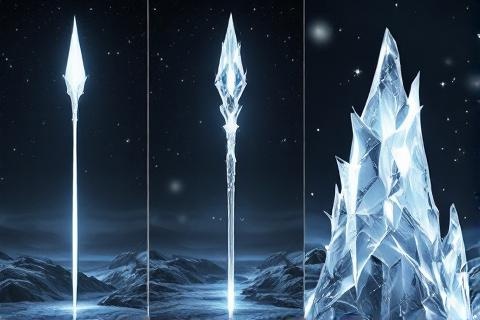
For anyone trying to imagine or depict Aeglos, it is wise to stay close to the
Sindarin meaning of its name and to favor images of ice, snow, and a piercing
point, since these are the strongest and clearest clues Tolkien gives, and
adding too many invented patterns or bright colors can easily distract from the
spear’s character as a cold, sharp light set against darkness, which seems to
fit the mood of Gil-galad’s last stand far better than a crowded design would.
Designs that respect the spirit of Tolkien’s work will usually keep Aeglos
simple and refined, with pale metal tones in the head, a long and narrow tip,
and a slender but strong shaft, and they will show the wielder, Gil-galad or
another Elf-lord, standing with calm, upright dignity rather than in a showy or
exaggerated pose, because in the books the king’s greatness lies more in quiet
authority and steadfast courage than in displays meant to draw attention to
himself.
Since the texts do not describe the spear’s exact length, decorations, or
fittings, it is best for readers and artists to avoid claiming any one look as
the final word, and instead to explore several tasteful options that remain
faithful to the ideas of cold brightness and Elven craft, perhaps offering
versions that range from very plain to slightly adorned, while always being
honest that these are interpretations built on hints and not detailed blueprints
left by Tolkien.