
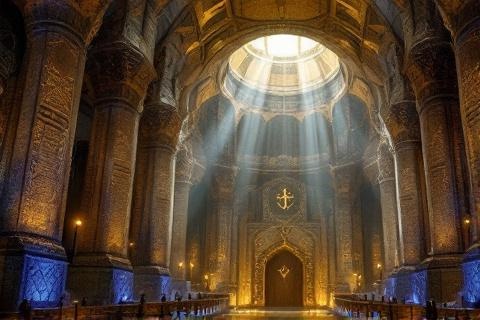
Durin's Folk: Lords of Stone and Legend
The Saga of the Longbeards in Tolkien's Middle-earth
The Creation of the Dwarven Race
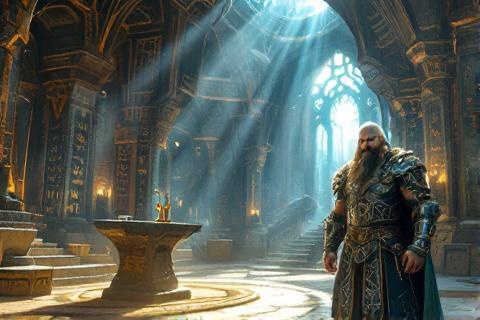
In the depths of time, before the awakening of the Elves, the
Vala Aulë grew impatient for beings to teach his crafts and
created the Seven Fathers of the Dwarves in secret. These
beings were made strong and unyielding, resistant to domination by evil, and
possessed of great skill with their hands. Aulë fashioned them in a hall under
the mountains of Middle-earth, giving them hardy bodies
and stubborn spirits that would endure through ages of toil.
When Ilúvatar discovered Aulë's creation, He initially rebuked the Vala for this
presumption, but seeing Aulë's humility and willingness to destroy his work, He
granted the Dwarves true life and independence. Ilúvatar placed the Dwarves into
a deep sleep, to awaken only after the Firstborn Elves, and gave them their own
unique destiny separate from His original design for Arda. This
blessing ensured the Dwarves would remain free-willed beings with their own
unique place in the Music of the Ainur.
Among the Seven Fathers, Durin the Deathless was the first to awaken at Mount
Gundabad in the Misty Mountains. He arose alone, during the Years of the
Trees when the Elves were awakening in the far west at
Cuiviénen. Looking upon the reflection of his crown of stars
in Kheled-zâram, the Mirrormere, Durin took this as a sign to establish his
kingdom in the caves above these waters. His solitary awakening and long life
earned him the epithet 'the Deathless,' though he would eventually pass into
sleep like all his kin.
The Kingdom of Khazad-dûm
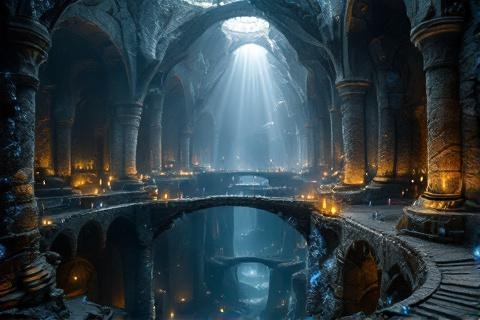
Under the three peaks of the Misty Mountains, Durin founded
Khazad-dûm, the greatest of all dwarf realms in
Middle-earth. The Dwarves delved deep into the living rock, creating vast halls,
soaring archways, and intricate chambers that would become legendary throughout
all the ages that followed. This mighty realm stretched from the eastern to the
western sides of the mountains, with its main entrance facing the sacred lake
Kheled-zâram.
The discovery of mithril beneath the foundations of Khazad-dûm brought
unprecedented wealth and power to Durin's Folk. This precious silver-steel,
valued beyond the price of gold, was lighter than iron yet harder than tempered
steel. The Dwarves became masters at mining and working this rare metal,
creating works of extraordinary beauty and strength that were sought after by
all peoples of Middle-earth.
The architectural achievements of Khazad-dûm represented the pinnacle of dwarven
craftsmanship. The great halls were supported by mighty pillars hewn from the
living rock, while countless lamps of crystal and gold illuminated the vast
networks of passages and chambers. The city featured multiple levels connected
by grand staircases, with the deeper halls dedicated to mining and smithing,
while the upper levels housed living quarters, feast halls, and markets.
During the Second Age, the Dwarves of Khazad-dûm formed a
close alliance with the Elven smiths of Eregion, led by
Celebrimbor. This partnership resulted in extraordinary technological and
artistic achievements, including the creation of the Doors of Durin, which bore
inscriptions in both Elvish and Dwarvish. The Dwarves shared their knowledge of
metallurgy with the Elves, while learning new secrets of craftsmanship from
their allies.
The Line of Durin and Its Kings
The line of Durin's heirs maintained an unbroken succession throughout the Ages
of Middle-earth, with each king ruling from the throne of Khazad-dûm and later
from other realms. From Durin I through Durin VI, each ruler contributed to the
expansion and prosperity of their people, though some reigns were marked by
hardship and loss. The kingship passed from father to son, maintaining the
direct lineage of the first Father of the Dwarves.
Throughout their history, the kings of Durin's line created or commissioned
numerous legendary items. These included the famous dragon-helm of
Dor-lómin, the necklace Nauglamír, and
countless weapons and armor of extraordinary quality. Each king also contributed
to the expansion and beautification of their realms, with some focusing on
military strength while others emphasized craft and trade.
The tradition of naming heirs after Durin the Deathless arose from the dwarven
belief that Durin would return seven times to his people. Each king named Durin
was considered to be the reincarnation of the first Father, possessing his
memory and wisdom. This belief was central to the culture and identity of the
Longbeards, distinguishing them from the other dwarf clans and reinforcing their
status as the eldest and most noble of all dwarf houses.
Relations with Other Races
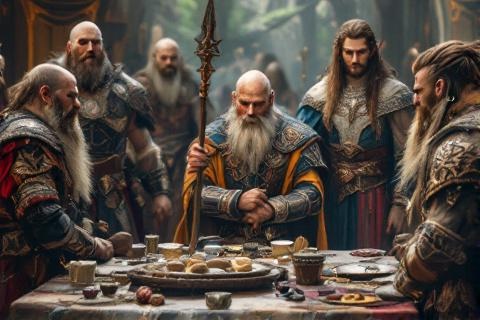
The friendship between the Dwarves of Khazad-dûm and the Elves of Eregion
flourished during the Second Age, marking a rare period of close cooperation
between the two races. This alliance led to the creation of extraordinary works,
including the western gate of Khazad-dûm, and facilitated a golden age of craft
and commerce. The Dwarves provided the Elven-smiths with precious metals and
gems, while receiving knowledge and artistic inspiration in return.
The Longbeards maintained extensive trade networks with the Men of the
North throughout their history, exchanging crafted goods, precious
metals, and weapons for food and other resources they could not produce in their
underground realms. These economic ties proved crucial for the survival and
prosperity of both peoples, particularly in the harsh northern regions of
Middle-earth.
Despite periods of tension and conflict, particularly following the fall of
Doriath in the First Age, the Dwarves of
Durin's line generally maintained diplomatic relations with their neighbors.
Disputes over payment, ownership of artifacts, and territorial rights
occasionally led to armed conflicts, but these were typically resolved through
negotiation or mutual necessity.
During times of great peril, Durin's Folk proved to be steadfast allies against
the forces of darkness. They fought alongside Men and Elves in the War of the
Last Alliance, contributed to the defense of the northern realms against Angmar,
and joined the coalition that opposed Sauron in the War of
the Ring. Their military prowess and sturdy armor proved invaluable in these
conflicts, though they often paid a heavy price in lives and resources.
The Fall of Khazad-dûm
In the Third Age, during the reign of Durin VI, the Dwarves
delved too deeply beneath Khazad-dûm and awakened an ancient evil, a Balrog of
Morgoth that had hidden in the depths since the First Age. This
creature, which the Dwarves named Durin's Bane, slew
King Durin VI and his son Náin I in successive years, bringing an end to the
golden age of Khazad-dûm.
The awakening of the Balrog forced the abandonment of Khazad-dûm in 1981 of the
Third Age. The surviving Dwarves fled their ancient home, leaving behind
countless treasures and the source of their wealth, the mithril mines. This
exodus marked the end of nearly seven thousand years of continuous habitation in
the greatest of all dwarf realms.
The loss of Khazad-dûm profoundly affected dwarven society and culture. The
Longbeards became a wandering people, their pride wounded but not broken. They
maintained their crafts and traditions while seeking new homes, though none
would match the glory of their ancient mansion. The fall of Khazad-dûm became a
defining moment in their history, remembered in songs and tales passed down
through generations.
Following the evacuation, many of Durin's Folk relocated to the Grey Mountains,
while others sought refuge in scattered settlements. This period marked the
beginning of centuries of wandering, during which the Dwarves maintained their
identity and culture despite lacking a permanent homeland. The memory of
Khazad-dûm remained a constant source of longing and inspiration for future
generations.
Exile in the North

After years of wandering, Thráin I established the Kingdom under the
Mountain at Erebor in 1999 of the Third Age. This new realm,
while more modest than Khazad-dûm, was strategically located and blessed with
rich mineral deposits. The Dwarves carved deep into the mountain, creating grand
halls and fortifications that would become legendary in their own right.
Under the leadership of successive kings, Erebor grew into a wealthy and
powerful kingdom. The Dwarves developed extensive trade networks, exchanging
their crafted goods with the men of Dale and distant realms. The strategic
location of Erebor at the intersection of major trade routes contributed to its
prosperity and influence.
The discovery and shaping of the Arkenstone marked the
pinnacle of Erebor's early history. This extraordinary gem, found deep within
the mountain, was cut and shaped by dwarven craftsmen to enhance its natural
beauty. Known as the Heart of the Mountain, it became the symbol of the king's
right to rule and the most prized possession of Durin's Folk in Erebor.
The relationship between Erebor and the city of Dale proved mutually beneficial,
creating a prosperous region that attracted traders from across Middle-earth.
The Dwarves provided crafted goods and protection, while the Men of Dale
supplied food, textiles, and other necessities. This partnership lasted until
the coming of Smaug, demonstrating the potential for
cooperation between Dwarves and Men.
Arts and Crafts of the Longbeards
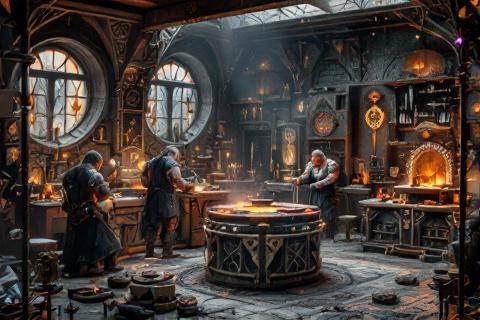
The metalworking skills of Durin's Folk were unmatched in Middle-earth,
particularly in the working of precious metals and the rare mithril. Their
techniques, passed down through generations, allowed them to create items of
exceptional strength and beauty. The Dwarves developed specialized methods for
tempering steel, inlaying precious metals, and creating alloys that remained
secrets known only to their master craftsmen.
Among the legendary items created by the Longbeards were mail shirts of mithril,
axes of the finest steel, and swords that would glow in the presence of enemies.
The crafting of weapons and armor was considered both an art and a sacred duty,
with master smiths passing their knowledge to carefully chosen apprentices. Each
piece was marked with the maker's personal runes and often imbued with
protective spells.
Khuzdul, the secret language of the Dwarves, was created by Aulë himself and
taught to the Seven Fathers. This ancient tongue remained largely unchanged
through the ages, used primarily for ceremonial purposes and the preservation of
craft-secrets. The Dwarves developed their own runic script, the Cirth, which
they used for public writings and inscriptions while keeping their sacred
language private.
Despite their reputation for practicality, the Dwarves maintained rich musical
and artistic traditions. Their songs told of ancient deeds, the creation of
beautiful things, and the depths of the earth. They excelled in the creation of
geometric patterns, the carving of stone, and the making of jewelry. Their halls
were adorned with intricate tapestries and sculptures that celebrated their
history and achievements.
Legacy in the Fourth Age
The prophecies of Durin's Folk speak of Durin VII, who would restore the ancient
realms of the Dwarves in the Fourth Age. According to these
traditions, he would lead his people back to Khazad-dûm and reestablish it as
the capital of a renewed dwarven kingdom. This promised restoration would mark
the fulfillment of long-held hopes for the return of their greatest realm.
Throughout their history, Durin's Folk maintained their distinct cultural
identity and traditions despite displacement and hardship. They preserved their
crafting techniques, their secret language, and their ancient lore through oral
tradition and carefully guarded written records. The Dwarves' commitment to
their heritage ensured the survival of their unique civilization through the
Ages of Middle-earth.
The influence of Durin's Folk continued to shape Middle-earth well into the
Fourth Age. Their architectural and craft techniques were studied and adapted by
other peoples, while their role in the great events of history became the stuff
of legend. The legacy of the Longbeards lived on in the foundations of cities,
in masterworks of metal and stone, and in the tales of their great deeds passed
down through generations.