
Dol Guldur: The Hill of Dark Sorcery
Unearthing the secrets of Sauron's haunted fortress in Mirkwood, from its ancient origins as Amon Lanc to the Necromancer's rise and the White Council's final assault.
Dol Guldur and Its Place in the Forest

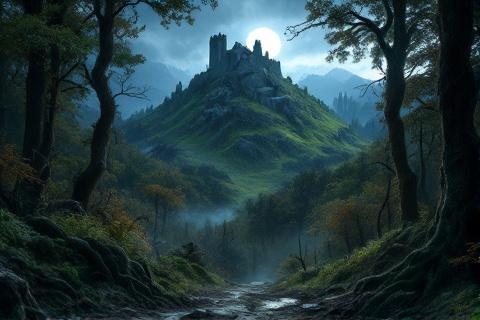
Dol Guldur stands on the southern edge of Greenwood the
Great, later called Mirkwood, as the lone high hill that
breaks the endless roll of trees, and in Tolkien’s maps and descriptions it
rises like a dark crown above the deep forest, close to the
Anduin valley and the Old Forest Road, so that it watches both
the great river and the north–south ways through the wood, turning what might
have been only a natural height into a place of strong strategic power and
brooding fear for all who pass nearby.
In Tolkien’s later writings the name Dol Guldur appears as the sinister title
given to the hill that was once known as Amon Lanc, with “Dol” meaning hill and
“Guldur” carrying a sense of sorcery and black magic, so that the change of name
itself marks the corruption of the place, as if the fair Elvish
history of Amon Lanc had been buried under a new story of fear, secrecy, and the
return of Sauron in a hidden form as the Necromancer.
Descriptions in The Hobbit and The Lord of the
Rings suggest that Dol Guldur does not rise like a
proud city-wall above a cleared plain but seems to grow out of the forest
itself, with its fortress built into the slopes and shoulders of the hill until
stone and shadow mix with trunk and branch, so that travellers on the forest
paths feel a looming presence that belongs to the landscape rather than a
distant, separate stronghold on open ground.
Trees press right up to the dark sides of the hill, so that Dol Guldur seems to
burst up from the surrounding wood in a single sudden mass, its base hidden by
thick trunks and undergrowth while the crown of the hill, with its battlements
and broken tower, lifts sharply from the sea of leaves, making it feel cut off
and self-contained even though it is wrapped on every side by the vast, dim
forest of southern Mirkwood.
Amon Lanc — The Ancient Hill

Before it ever knew the name Dol Guldur, the height was Amon Lanc, an ancient
mound that stood out among the low ridges of southern Greenwood, and in
Tolkien’s notes it is tied to the early history of the Silvan Elves and later to
the short-lived realm of Oropher, so that the hill has a deep past of Elvish
settlement and royal dwelling long before Sauron chose it as a seat for his
secret return to power.
The slopes of Amon Lanc are described and implied as steep and heavily clothed
in thickets and tall trees, especially once the forest became Mirkwood, so that
any approach would be hidden under tangled boughs and dark undergrowth, allowing
spies, orcs, and darker servants of the Necromancer to move unseen up the hill
while giving almost no clear sight to anyone trying to look inward from the
forest paths below.
Nothing in Tolkien’s texts suggests that Amon Lanc was a great artificial mound
like a Númenórean tomb; instead it reads as a natural rise of
earth and rock, shaped by time and then adapted by Elves and later by Sauron’s
servants into a fortified site, with foundations and tunnels cut into what was
already there rather than a man-made hill raised from flat land.
Because it is higher than the surrounding woodland, Amon Lanc quietly dominates
the view over a small region of southern Greenwood, standing above the chaotic
tangle of branches so that, from its crown, one might see the dark tops of the
trees stretching outward in all directions, and this modest command of height is
exactly what gives the hill its long importance as both an Elvish seat and later
as a strategic citadel for Sauron’s watch on the Anduin and
Lorien.
The Fortress: Stonework and Concealment
Tolkien hints that the masonry of Dol Guldur is darker and seems older than much
of what surrounds it, whether through soot, weathering, or the taint of its
master, and it is laid in such a way that it appears to grow from the hill
itself, with walls and foundations fitted to the rock so closely that the
fortress looks like the hardened shell of the mound rather than a bright,
foreign structure set upon it.
The stronghold does not spread widely like Minas Tirith
or a great Númenórean port; instead it is compact, pressed tight around the
summit and upper shoulders of the hill, using the natural steepness for its
outer defence while its inner strength lies in depth, with the bulk of its power
hidden in chambers and pits cut down into the heart of Amon Lanc rather than in
broad surface courts and towers.
Where Tolkien mentions ruins and the later state of Dol Guldur, the reader is
shown broken buttresses and leaning walls where roots have found their way
between stones, moss has crept over edges, and the forest has started to reclaim
the fortress, so that the line between built structure and living earth grows
soft and suggests long ages of use, neglect, and final overthrow.
Most travellers in Mirkwood would not see a full city on a hilltop but only
short, disturbing views: a jag of battlement above the trees, a slant of dark
wall glimpsed through branches, or a shadowed gate half-hidden by trunks,
because the close-set forest hides much of Dol Guldur from distant sight and
reveals it only in fragments that add to its fearful mystery.
The Watchtower and the Outlook

Above the clustered halls and walls of Dol Guldur rises a single watchtower,
often mentioned as the chief visible sign of the fortress when seen from afar,
thrusting up from the hill’s crown like a black finger against the pale sky, and
it is this tower that makes the name “Hill of Dark Sorcery” feel real, for it
seems like the eye and spear-point of the Necromancer’s hidden strength.
From the top of that tower, if one were bold or foolish enough to stand there,
the view would not be of wide lands and open seas but of a boundless roof of
tree-tops, broken only by a low and distant horizon of grey, so that even at
such a height the world feels shut in, as though the forest itself is a second
wall around the fortress, hemming in sight and giving the whole scene a sense of
heavy enclosure.
In later times, after the assaults of the White Council and the passing of
Sauron to Mordor, the tower of Dol Guldur is spoken of as
broken and ruinous, its upper works shattered so that its outline is jagged and
harsh, like a snapped tooth, and this battered shape stands as a visible sign
that the power that once filled the hill has been cast down, even if evil
shadows still linger for a time in the dungeons below.
Within such a tower, Tolkien’s broader descriptions of strongholds allow the
reader to imagine steep stone steps winding upward and narrow embrasures that
serve as lookouts and arrow slits, where orcish watchers or darker servants once
stood to spy northward toward Thranduil’s halls, westward over the Anduin, and
southward toward the lands that led at last to Mordor.
The Surrounding Wood: How the Landscape Reads
The forest around Dol Guldur, especially by the late Third
Age, is one of the darkest and oldest parts of Mirkwood, with
trees that have grown huge and close together, forming a roof that lets in
little light, and the paths that pass near the hill, such as the old Elf-road
turned dangerous, twist and break so often that they become more like guesses
through undergrowth than true roads, leaving travellers trapped in a maze of
trunks and thorns.
Tolkien’s descriptions of Mirkwood speak of a strange quiet and a sense that
living things avoid the areas near Dol Guldur, as if the presence of the
Necromancer spreads a fear that presses down on birds and beasts, so that fewer
songs are heard, fewer animals move, and the wood itself seems to hold its
breath in a long, uneasy silence.
The trees here are often described as gnarled, their trunks bent and close-set,
so that they form thick pillars that shut out the sky and break light into thin
shafts that fall like pale spears through the gloom, and instead of wide sunny
clearings there are only cramped spaces where dim beams touch the forest floor
before being swallowed again by shadow.
Underfoot, the ground is layered with deep leaf-mold, crossed by thick nets of
roots that twist out of the soil, and the slow spread of moss over stones and
fallen branches gives everything a soft, muffled feel, as if sound itself is
being absorbed, while the earth smells old and heavy from long centuries of rot
and growth beneath the dark boughs.
At the edges of the few small clearings that do exist near the hill, the lines
of trees are often sharp and looming, with mist pooling in the hollows and a
chill hanging close to the ground even when the air above is milder, adding to
the sense that the very air around Dol Guldur is colder and more secretive than
the rest of the forest.
Underground Halls, Vaults, and the Hill's Heart

In several of Tolkien’s notes and inferences about Dol Guldur, there is a strong
sense that the true strength of the fortress lies not in high halls but in deep
interior spaces, carved into the hill so that many of its chambers, armouries,
and prisons lie under stone rather than open to light, making it a place of
caves and tunnels instead of lofty towers and shining courts.
Within Amon Lanc, stone corridors can be imagined running like veins through the
mound, narrow and low-ceilinged, forcing any who pass along them to move in
single file, and the air in these ways is close and stale, carrying the echo of
distant footsteps and the faint sound of water dripping from unseen heights into
unseen pools.
The vaults and inner halls of Dol Guldur would be cool and damp, with slimy
trickles running down rough-cut walls, the smell of wet rock and rusted iron
chains or bars lingering in the dark, and the sense that many prisoners, like
Thráin son of Thrór, had wasted away there in madness and grief, far from sun or
star, under the unpitying will of the Necromancer.
Light in these under-ways is rare by design, and Tolkien’s hints of guarded
doors and hidden pits suggest that any openings to the surface or the outer
courts are few, small, and closely watched, with torches or guttering lamps
giving only red and shifting glows that never reach far into the blackness of
Dol Guldur’s deepest dungeons.
Scars of Time: Ruin, Overgrowth, and Memory
On the outer slopes of the hill, the stonework of Dol Guldur shows many signs of
strain and defeat in the later Third Age, with long fractures running through
old blocks, whole sections of wall slipped or leaning, and gaps where stones
have fallen away and the soil behind has spilled forward, while thick roots
prise the joints wider each year.
Moss and lichen spread over much of this masonry, greening and then greying the
once-raw edges, while young saplings find purchase in cracks and ledges, so that
their roots thread through the stones and slowly widen every flaw, softening
sharp corners and making the fortress seem less like a solid, single thing and
more like a crumbling shell being taken back piece by piece by the living
forest.
Paths that circle or climb the hill are broken and uneven, interrupted by blocks
of fallen stone, sudden dips where old tunnels or cellars have sunk, and places
where rubble has slid down to choke the way, so that movement around Dol Guldur
in its ruin must pick through hazards and reminders of the violence that helped
to bring the stronghold down.
Scattered about the lower slopes and into the outer woods lie fragments of wall
and broken battlement, half-sunk into the soil and leaf-litter, so that they
appear as stony hummocks or ridges under moss, and travellers might walk over
the buried bones of the fortress without at first knowing that the forest floor
itself is made from its shattered remains.
Water and Low Ground Around the Hill

At the base of the hill and in the hollows of the surrounding wood, water
gathers and lingers, forming shallow, mist-filled dips where the ground is soft
and treacherous, and these low places hold the night’s damp long into the day,
encouraging growths of slime and dark moss that add to the chill impression of
the land under Dol Guldur’s shadow.
Through the thick undergrowth creep small pools and slow-running streams, their
surfaces often filmed and dull because so little light reaches them, and where
they bend and twist they catch and reflect thin streaks of pale sky or the faint
glow of stars, offering broken mirrors of the dim world above the roots.
The edges of these wet patches are choked with reeds, snagged branches, and
tangled mats of dead leaves and fine roots, making the line between firm ground
and bog uncertain, and any foot placed carelessly might sink into black mud or
slide on hidden slime, so that the very approach to the hill feels uncertain and
unsafe.
This mingling of wet soil, standing water, and deep shadow around the base of
Amon Lanc creates a borderland that feels marshy and secretive, as though the
hill is wrapped in a natural moat of mire and gloom that hides tracks, muffles
sound, and suits the secret movements of spies and servants in the service of
the Necromancer.
Light, Sound, and the Atmosphere of Place
Near Dol Guldur, light that would be clear elsewhere in
Middle-earth becomes thin and strained, since the high
canopy of Mirkwood breaks the sun into weak beams that fall only here and there,
leaving most of the forest floor in a steady twilight even at noon, and this
dimness grows deeper as one comes closer to the haunted hill.
Silence is one of the most striking features of the land around the stronghold,
and Tolkien notes that birds seldom sing and few other creatures give voice
there, so that the stillness feels heavy and watchful, as though the woods have
learned to hold their tongues under the gaze of the Necromancer, and any sudden
sound seems loud and out of place.
The noises that do reach a traveller’s ear around Dol Guldur are small and
muted: the slow creak of old branches swaying, the soft drip of water somewhere
inside unseen stone halls, and the faint rustle of leaves and dry twigs
underfoot, all of which blend into a low, continuous murmur rather than a lively
woodland chorus.
The air is full of the smell of damp earth, thick moss, and decaying leaves,
with an edge of cold stone and old metal from the hidden works within the hill,
and there is little of the sweet or spicy scent of flowers and herbs, so that
the place seems ruled by age, rot, and rock rather than by fresh growth or open
fields.
The Hill in Later Ages: Ruin and Renewal

In the late days of the Third Age, after the White Council’s final assault and
Sauron’s withdrawal to Mordor, the stoneworks of Dol Guldur stand cracked and
broken, and new growth surges up around them, with saplings, bracken, and briar
rising through shattered pavements and scattered blocks, so that the
once-fearful silhouette of the fortress is now ragged and half-veiled by young
trees.
Where walls have tumbled or towers have partly collapsed, soil, seeds, and
wind-blown leaves settle in the gaps, and seedlings root in this new earth, so
that over time bushes and slender trunks climb through what were once
battlements, gradually blurring the line between ruin and forest and reminding
readers of Tolkien’s theme that even the worst strongholds of evil are not
beyond the quiet healing of the natural world.
As the years pass and the memory of the Necromancer fades from daily speech,
only broken fragments of Dol Guldur remain clearly above ground, appearing as
low stony ridges or mounds covered in moss and fern, and someone passing by who
did not know its fearsome history might take the ruins for ancient barrows or
old, forgotten farm-works swallowed by the forest.
Even so, the hill of Amon Lanc does not fully vanish, for it still rises above
the trees and carries a sense of age and deep memory, and in the Fourth
Age it stands as a landmark that has seen both Elvish kingship
and Sauron’s secret power come and go, while the forest slowly wraps it in green
once more, turning the Hill of Dark Sorcery back toward a quieter place in the
long story of Middle-earth.