
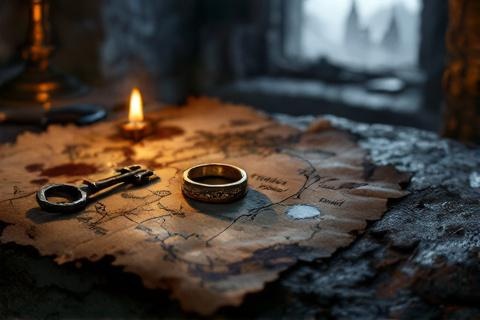
Ring of Thrain
The Dwarf King's Burden
A Dwarf's Burden
The Ring of Thráin was one of the Seven Rings of Power
given to the Dwarf-lords in Tolkien’s
legendarium, a quiet yet heavy presence beneath the grand
tales of Elves and Men. Counted among the Seven
Dwarven Rings, it belonged to the royal line of Durin and passed down through
the kings of Erebor until it came to Thráin II. Though it never
shone as brightly in the stories as the One Ring, its
history still shaped the fates of people and kingdoms. As part of the Seven, it
shared in the strange mixture of blessing and curse that clung to all the
Dwarven Rings, and its journey shows how even lesser-known rings could bear
great weight in Middle-earth.
For the line of Thráin, this ring was both a token of royal authority and a
silent mark of sorrow. It represented the dignity of Durin’s
House and the memory of long-lost glory in
Khazad-dûm and Erebor, yet it also followed Thráin through
exile, wandering, and madness. Instead of lifting him back to his throne, it
became bound up with his failures and his final captivity in the dungeons of
Dol Guldur. In this way, the Ring of Thráin stood as a
burden as much as a crown, a reminder that power in Tolkien’s world often
carries tragedy at its core.
The story of the Ring of Thráin invites a closer look at where it came from,
what it looked like, and how it shaped both its bearers and their realms. By
tracing its origin in the Second Age, its plain yet
meaningful appearance, and the way it affected Dwarven hearts and hopes, one can
see how it fits into the vast struggle against Sauron. Its
path touches many threads of Middle-earth’s history, from the forging of the
Rings to Gandalf’s secret journeys and the later Quest of
Erebor, and its quiet influence helps explain why some
quests end in ruin and others in hard-won victory.
Forged in Shadow

The Seven Dwarven Rings were first wrought in the days when Sauron still wore a
fair form and walked among the Elven-smiths of Eregion under
the name Annatar, the Lord of Gifts. In that time, he taught the smiths much
about ring-lore and the making of powerful artifacts, pretending to be a
generous ally. The Elves forged many Rings of Power under his guidance, and from
that hidden craft came the rings that would later pass into the hands of
Dwarf-lords and mortal kings. The Seven thus arose from a mix of Elven skill and
Sauron’s secret design in the later years of the Second Age.
Tolkien’s writings explain that the Seven Rings were given as gifts to great
Dwarf-lords, each ruling an important house or realm, in keeping with Sauron’s
plan to influence and bind the Free Peoples. In The Lord of the Rings and in
Unfinished Tales, readers learn that Sauron hoped to
use the rings to bring dwarves under his control or at least to make their power
serve his long war against Elves and Men. To a proud Dwarf-king, such a ring
would appear as a treasure of honor and authority, but behind the gift lay the
design of the Dark Lord. The Ring of Thráin was one such present, passed down
long after its first giving but never free of its dark origin.
Yet the Dwarven Rings did not fall entirely under Sauron’s will, and this
difference sets them apart from the Nine Rings of Men and from
lesser works. Tolkien notes that, although Sauron made or shaped these rings
with his own dark knowledge, the dwarves proved too sturdy in spirit to become
wraiths as Men did. Their rings could stir greed and strengthen desire, but they
did not enslave their minds in the same direct way as the One Ring or the Nine.
The Ring of Thráin belonged to this group: dangerous and twisted by Sauron’s
craft, but never a complete channel of his direct command.
The giving of the Seven Rings must be seen as part of Sauron’s wider deception
during the Second Age, when he tried to master Middle-earth by gifts and
guidance rather than open war. He taught the smiths of Eregion, secretly forged
the One Ring in Orodruin, and then spread the other rings
among Elves, Men, and Dwarves to snare them in his net. The Dwarf-lords took
their rings and used them to enrich their hoards and strengthen their halls, yet
all the while a shadow grew behind such gains. The Ring of Thráin is only one
thread in this pattern, but it shows how deeply Sauron’s long plan reached, even
into the mountain fastnesses of Durin’s folk.
What the Ring Looked Like

Tolkien never gives a lavish description of the Ring of Thráin, but from what is
known of the Seven and of Dwarven taste, it can be imagined as a simple band of
gold, strong and weighty rather than delicate. It likely lacked the fine Elven
grace of rings such as Narya or Vilya and instead matched the
solid, practical beauty loved by Durin’s people. A Dwarf-king would not need a
sparkling gem to prove his rank when the very metal on his hand spoke of deep
craft and long work. In the tales, the ring is remembered more for the fate tied
to it than for any gleam or ornament.
Long years of use would have left their mark upon such a ring, and Tolkien hints
that the Seven passed through many hands and hardships. The Ring of Thráin may
have shown slight darkening of the gold from the sweat and toil of generations,
with tiny scratches and dents earned in exile and wandering. Its feel would have
been dense and compact, shaped to fit the thick fingers of Dwarf-lords who
labored as well as ruled. In this way, the ring would mirror its bearers, not a
fragile jewel but a stout circle of metal that could endure grief, travel, and
battle.
Unlike the One Ring, which revealed its terrible power in fiery letters when
heated, the Ring of Thráin bore no known blazing inscription that burst forth to
the eye. Tolkien never describes runes kindling upon its surface or any open
sign that betrayed its deeper nature. Its power worked in ways that were hidden,
through the slow turn of thoughts and desires rather than with a glow or visible
script. This quietness suits the Dwarven Rings, which were never the center of
the great drama in Mordor yet still helped bend the course of
Middle-earth from within the treasuries of kings.
A Greed Unleashed: How Dwarf-rings Worked
The Dwarven Rings, including the Ring of Thráin, did not make their wearers
invisible, nor did they turn them into wraiths under Sauron’s direct rule as the
Nine did to Men. Tolkien is clear that the nature of dwarves, tough and stubborn
in both body and spirit, resisted such complete bending of being. A Dwarf-king
who put on his ring remained visible in the world, still himself in form and
mind. The danger lay not in vanishing into shadow at once but in becoming
trapped by desires that slowly grew too large to manage.
Instead of granting invisibility or outright slavery, the Dwarven Rings
amplified what was already strong in dwarves: their deep love of craft, craving
for rich things made by hand, and pride in their work and lineage. The ring on
Thráin’s finger would not change him into something unlike a dwarf; rather, it
would sharpen his hunger for gold, jewels, and the mastery of metal.
Stubbornness would harden into unyielding will, and careful craft might slide
toward obsession. Through such changes, a gift that seemed to honor Dwarf-kind
actually pulled them closer to the edge of ruin.
As these traits grew stronger, the Dwarf-realms under the Seven became more
secretive and closed, drawing in wealth but not friendship. Kings hoarded their
treasures and trusted less in allies, hiding behind doors of stone while their
hearts clung to gold and heirlooms. This inward turning deepened loneliness,
even in crowded halls, for the ring-fed desire kept them fixed on what they
owned rather than on shared bonds. In Erebor and other strongholds, such
attitudes helped build hoards that were impressive to see yet dangerous to
guard, for they tempted enemies and fed fear.
Tolkien notes that the wealth gathered under the Seven often ended in fire and
loss, as dragons and other disasters swept down upon
Dwarf-hoards. The very riches called forth by the rings drew ruin upon their
keepers, with dragons like Smaug serving as living judgments
on greed and pride. In this way, the Ring of Thráin took part in a pattern where
growing treasure did not bring lasting joy but set the stage for disaster. The
rings magnified the desire to possess, but they could not protect what they
helped amass, and so hoards and kings alike were often “consumed” by
dragon-fire, war, or slow decay.
Thráin's Burden

Thráin II, son of Thrór and father of Thorin Oakenshield, was the last king of
Durin’s line to bear the ancient ring before its loss, and he carried it during
the most troubled years of his people. After his father’s death outside Moria,
where Thrór’s body was hewn and branded with the name of Azog, Thráin led the
dwarves through a dreadful war in vengeance. In time, his folk settled in
Erebor, and the ring passed to him as the sign of his kingship. By the days
described in The Hobbit’s background, he was a weary ruler who held both the
memories of old halls and the weight of an heirloom that could not save them.
The exile of Thráin was sealed when Smaug the Golden descended on Erebor,
driving out the dwarves in flame and terror and scattering them far across
Wilderland. Stripped of his kingdom and hoard, Thráin became the leader of a
wandering people, moving from place to place in poverty, while the ring sat
useless on his hand. The shadow that was rising again in
Mirkwood, at Dol Guldur, also hung over his path, and
whispers of a darker will seemed to stir his restless heart. His losses fed the
ring’s power to deepen despair and longing, pushing him toward risky choices and
lonely roads.
In Unfinished Tales, Tolkien describes how Thráin finally set out alone from his
followers, driven by a sudden urge to reclaim Erebor, and vanished without word.
Captured by the servants of the Necromancer, he was taken to Dol Guldur, where
he was tormented and slowly broken in mind and body over long years. There in
the pits of that dark fortress, Sauron, still hidden under another name,
squeezed out what secrets Thráin still held. By the time
Gandalf found him, he was a wasted, half-mad dwarf, hardly
able to remember his own name, much less the proud king he had been.
The Ring of Thráin went with him into these harsh years, turning from a royal
emblem into a cruel reminder of everything he had lost. It could not restore his
city or defend him from Sauron, yet it remained a token of the doomed hope that
had driven him onto the road. When it was taken from him in Dol Guldur, the ring
became tied completely to his failure to reclaim Erebor and to the triumph of
the shadow over his last attempt at kingship. In this sense, his ring was no
longer a promise of destiny but a mark of how far a great house could fall.
Tolkien presents Thráin’s end not as a scene filled with bright sorcery, but as
a slow, sad fading of a broken dwarf under the grinding will of a hidden Dark
Lord. There are no grand displays of the ring’s magic, no blazing powers
unleashed in Dol Guldur. Instead, readers see a personal decline: a king who
wanders, is captured, loses his ring and his wits, and finally dies nameless in
a dungeon. The tragedy lies in the quiet details of suffering and loss, which
make the Ring of Thráin feel more like a burden that hastened his ruin than a
weapon that ever won him glory.
Why the Ring Matters in the Wider Tale
The Ring of Thráin may appear as a minor relic when set beside the One Ring, yet
its story forms a small but revealing thread woven into the larger war against
Sauron. It links distant ages, from the forging of the Seven in Eregion to the
final struggles of dwarves in the late Third Age. Every time
it changes hands, it shows how even lesser rings helped shape choices and fates.
Through Thráin’s downfall and Thorin’s later quest, this single ring bears
witness to how the shadow of Sauron reached quietly into many corners of
Middle-earth.
Its mere existence in the house of Durin is proof that Sauron’s long schemes
stretched into Dwarven affairs, even when dwarves mistrusted him and resisted
his control. By giving these rings in the Second Age, he sought to twist noble
goals into traps, so that a Dwarf-king who desired to protect and enrich his
people might instead grow possessive and blind. The Ring of Thráin did not turn
its bearer into a slave, yet it helped bend good intentions toward ruin by
feeding traits that could be corrupted. In this way, Sauron’s gifts showed
themselves as snares wrapped in gold.
The ring also works as a hidden link between decayed Dwarf-kingdoms, Gandalf’s
secret searches, and the later Quest of Erebor told in The
Hobbit. Thráin’s fall in Dol Guldur drew Gandalf into the
fortress and revealed the growing threat of the Necromancer, which in turn
shaped the wizard’s later advice to Thorin. The taking of the ring by Sauron and
the handing on of the map and key to Gandalf set paths in motion that would
eventually lead a small company of dwarves and a hobbit back to the Lonely
Mountain. Thus, even in loss, the ring stands in the chain of events that led to
Smaug’s end.
More broadly, the Ring of Thráin reflects one of Tolkien’s central themes: that
objects can carry long histories and heavy moral meaning, even when they seem
small and plain. The ring is not just a piece of treasure but a witness to the
pride, grief, and stubborn hope of Durin’s line. Its presence colors how readers
see Thráin’s choices and the fate of his house. Through it, Tolkien shows that
power is not neutral; it gathers the marks of every hand that holds it, and
those marks often tell a story of damage rather than triumph.
A Short Chronicle
The Ring of Thráin began its long journey when it was forged in the Second Age
among the Seven Rings created for Dwarf-lords as part of the greater making of
the Rings of Power. It passed into the hands of a mighty Dwarf-king early in
that age and, through war, exile, and the fall of older realms, eventually came
down to the royal house of Durin. By the Third Age, it had become the chief ring
of that line, resting finally with Thráin II as a sign of his claim to be King
under the Mountain, even though his kingdom lay in dragon-ruled ruin.
Thráin’s later life turned the ring’s story toward disaster, as his exile after
the coming of Smaug and his restless desire to recover Erebor drove him into
peril. When he left his people and wandered secretly, the ring went with him, an
heirloom that could no longer command armies or open doors. His capture by the
servants of the Necromancer and imprisonment in Dol Guldur ended his active
quest, and there the ring was taken, becoming part of Sauron’s recovered hoard
of the Seven. Tied to his madness and death in that dark place, the ring’s
history became one of ruin rather than restoration.
After Thráin’s death, Gandalf’s discovery of his wretched state and of the map
and key he still carried helped spark a new attempt to reclaim Erebor, though
without the ring’s help. The wizard later passed these items to Thorin
Oakenshield in Bree, guiding him toward a more carefully planned
quest involving thirteen dwarves and one hobbit. This chain of events, set off
in part by Gandalf’s concern over what he had learned in Dol Guldur, led to the
Quest of Erebor and the slaying of Smaug. Thus, the end of Thráin’s road and the
loss of his ring became a strange beginning for a new chapter in his people’s
history.
Aftermath: Map, Key, and the Quest of Erebor

The tale of the Ring of Thráin cannot be told without also speaking of the map
and key that he gave to Gandalf in the darkness of Dol Guldur, for these items
replaced the ring as the real tools of hope. In his brief return to sense before
he died, Thráin entrusted to Gandalf the means by which Erebor might someday be
entered again. These simple objects, worn and carried like the ring had been,
passed then from the ruined father to the uncertain keeper who would later guide
the son. Their journey, more than that of the ring, carried the promise of a
renewed kingdom.
When Gandalf met Thorin Oakenshield years later at the Prancing Pony, he brought
forth the map and key as the seed of a new plan, while the Ring of Thráin lay
lost to Sauron and no longer shaped events for good. It was these practical
tools, not a magical ring, that gave Thorin and his companions a way into the
Lonely Mountain in The Hobbit. The map showed the secret door, and the key could
open it at the right time. Through them, Thráin’s last act of giving helped his
heir act with purpose, putting courage and knowledge together instead of relying
on hidden power.
The stripping of the ring from Thráin in Dol Guldur also marked the end of his
ability to lead or decide his people’s future; from that point, he was a broken
captive whose will had been taken. Without his ring and with his mind in
tatters, he could no longer carry the quest he had begun. The burden and the
chance passed instead to Thorin, who had to choose what to do with the legacy
left by a ruined father. The line of Durin thus moved from an age of secret
rings to an age of open choices made with maps, allies, and perilous journeys.
In this shift, Tolkien shows a familiar pattern in Middle-earth: small, tangible
artifacts, such as a map, a key, or even a simple ring, can steer the fates of
peoples and realms. Though they are inanimate, they gather stories and
obligations around them, and those who hold them must decide how to respond. The
map and key from Thráin reopened not only a physical path into Erebor but also a
political and moral contest over who had the right and the wisdom to rule there.
The Ring of Thráin fades from sight, yet its loss clears the stage for choices
based on courage and character rather than on inherited power.
How the Ring Differed from the One Ring
Unlike the One Ring that Bilbo found in Gollum’s
cave, the Ring of Thráin had no glowing rune-inscription
that flamed into view when heated and did not cast its bearer into invisibility.
Tolkien never grants it such dramatic signs, and there is no scene in which
someone puts it on and vanishes from sight. It shares none of the showy
qualities that make the Master Ring so terrifying and remarkable. Instead, it
remains outwardly plain, its danger hidden beneath a simple golden surface.
Its power lay in its subtle influence on dwarven nature rather than in direct
mind-control or physical tricks. By deepening the greed, pride, and stiff-necked
resolve that already lived in the hearts of Durin’s folk, it nudged them toward
decisions that placed wealth and ancient rights above prudence or mercy. A
Dwarf-king who wore it might feel a growing urgency to gather treasure, fortify
halls, and remember old grudges, all of which could harden his rule. The ring
did not whisper commands from Sauron but bent the bearer toward ends that served
the Dark Lord’s wider designs.
Because of this, the Ring of Thráin posed a danger that was more cultural and
moral than immediately magical. It was like a slow poison in the customs and
habits of a people, encouraging hoarding, isolation, and unbending pride over
many generations. The ruin it brought did not come in a single spell or sudden
fall into shadow, but in centuries of choices shaped by warped desires. In the
end, such a ring left its bearers with broken kingdoms and bitter memories,
showing that creeping corruption can be as deadly as open enchantment.
Interpretations and Legacy

Readers may see the Ring of Thráin as a symbol of how gifts that seem fair and
powerful can in truth be snares, especially when they appeal to pride and the
wish to possess. Sauron’s present to the Dwarf-lords offered honor and wealth,
yet it carried within it a pull toward obsession and loss. Even for a noble
house like Durin’s, the ring turned gradually into a trap that bound hopes to
gold and old claims rather than to living relationships or wise judgment. In
this way, the ring mirrors Tolkien’s broader warnings about how clinging to
power and property can lead to downfall.
Scholars of Tolkien often point out that the Dwarven Rings helped push dwarves
toward lonely glory and tragic ends, even though they did not enslave them as
the Nine did Men. The Seven encouraged kings to shut themselves away in stone
halls filled with treasure, where fear of loss and distrust of others grew
strong. The Ring of Thráin belongs to this pattern, linked to Erebor’s hoard,
Smaug’s coming, and the stubborn pride that later haunted Thorin at the Battle
of Five Armies. Through it, Tolkien shows how a
people can be wounded from within by a power that seems to strengthen them.
Even when it is not on the page, the ring’s quiet history adds depth to the
world of Middle-earth, reminding readers that many ancient objects carry long
shadows. The story of Thráin’s ring connects distant times and places, hinting
at older wars, forgotten smiths, and the secret dealings of Sauron. Its presence
makes the struggles of a wandering dwarf-king feel part of a much older tale. In
this way, the ring helps to fill out the tapestry of the legendarium, where
almost every heirloom has a story behind it.
Taken as a whole, the tale of the Ring of Thráin stands as a compact example of
Tolkien’s moral storytelling, in which the use and desire for power often leave
ruin where they hoped for greatness. The ring does not bring its bearer the
restoration of his kingdom or honor in battle; instead, it travels with him into
madness, prison, and death. What little good comes from its story arises only
when it is gone and other, humbler objects guide new choices. Through this
small, tragic ring, Tolkien again suggests that true healing seldom lies in
powerful tools but in courage, pity, and the hard path away from greed.