
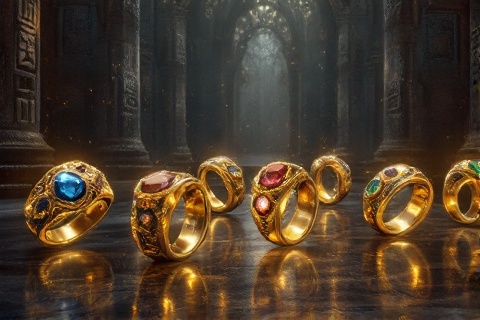
The Seven Dwarven Rings: Gems of Ambition
How the Dwarves' Rings Shaped Middle-earth's Fate
The Forging of the Seven

In the Second Age around the year 1500, the legendary
Elven-smith Celebrimbor and his guild of craftsmen, the
Gwaith-i-Mírdain, forged the Seven Rings of Power in
their workshops in Eregion. These masterpieces of craft
represented the pinnacle of Elven artifice and dwarven
aesthetics combined into instruments of power. The creation of
these rings marked a pivotal moment in Middle-earth's
history, setting in motion events that would echo through thousands of years.
The creation of the Seven was made possible through the guidance of Sauron, who
had taken on the fair form of Annatar, the Lord of Gifts.
In this guise, he shared deep knowledge of ring-making with the Elven-smiths,
teaching them secrets and techniques that would allow them to create objects of
tremendous power. The Elves of Eregion, eager to preserve and enhance their
works, welcomed this knowledge without recognizing the dark purpose behind these
teachings.
Each of the Seven Rings was crafted with specific properties that resonated with
the nature and desires of the dwarven lords who would bear them. The rings were
imbued with powers of crafting, wealth-gathering, and domain-building, aligning
perfectly with dwarven ambitions and skills. These properties were deliberately
chosen to appeal to the natural inclinations of the dwarven race, making the
rings particularly effective tools for their intended bearers.
Physical Description and Properties
The Seven Rings were forged from the purest gold, each one adorned with precious
gems chosen specifically for their bearer. The rings featured intricate patterns
and runes that reflected dwarven artistic sensibilities while incorporating the
sophisticated magical craftsmanship of the Elves. Their physical appearance made
them objects of great beauty, worthy of the mighty lords who would possess them.
When wielded by their dwarven masters, the rings amplified their natural talents
for mining, crafting, and accumulating wealth. The bearers found their skills
enhanced, allowing them to create works of unprecedented beauty and
sophistication. Their judgment in matters of precious metals and gems became
nearly infallible, and their ability to locate new veins of valuable materials
was heightened beyond normal dwarven abilities.
The magical properties of the Seven were uniquely attuned to dwarven nature,
drawing upon and enhancing their innate connection to stone and precious
materials. The rings responded to the dwarves' inherent magical resistance and
their strong ties to the physical world. This resonance made them particularly
effective tools for their bearers, though in ways that Sauron had not fully
anticipated.
Distribution to the Dwarf Lords

The Seven Rings were distributed among the most powerful dwarf-lords of the
time, representing different houses and realms across Middle-earth. These lords
were chosen for their influence and the strategic importance of their domains,
with each ring intended to bind its bearer to Sauron's influence. The
distribution of the rings created a network of powerful dwarven rulers, each
enhanced by their ring's power.
Under the influence of their rings, the dwarven realms experienced unprecedented
prosperity. The lords oversaw the creation of vast treasure hoards, magnificent
halls, and powerful kingdoms. Their wealth grew beyond measure, and their works
became legendary even by the high standards of dwarven craftsmanship. The rings'
power manifested in tangible ways, turning their domains into centers of power
and commerce.
The locations of the Seven became closely guarded secrets, known only to the
rings' bearers and their most trusted advisors. Each lord recognized the value
and power of their ring, taking extensive measures to protect it from theft or
discovery. This secrecy would later prove crucial in preventing Sauron from
quickly reclaiming the rings, though it also makes tracking their individual
histories challenging for scholars.
The Ring of Durin's Folk

Among the Seven, the ring given to the kings of Khazad-dûm
became the most renowned and historically significant. This ring played a
crucial role in elevating Khazad-dûm to its position as the greatest of all
dwarven realms. Under its influence, the kingdom's wealth and power grew to
legendary proportions, and its works became the standard by which all other
dwarven achievements were measured.
The ring of Khazad-dûm passed from king to king through the line of Durin, each
bearer adding to the glory and prosperity of their realm. This succession
maintained a continuous line of ring-bearers who understood and could fully
utilize the ring's powers. The transfer of the ring became an important part of
the royal succession, symbolizing the continuation of Durin's line and their
authority over Khazad-dûm.
Throughout the Second Age and into the Third, the ring contributed to making
Khazad-dûm the most splendid and prosperous of all dwarven realms. Its influence
could be seen in the unparalleled architectural achievements, the vast wealth
accumulated, and the powerful position the kingdom held in Middle-earth's
politics. This prosperity continued until the awakening of the
Balrog and the subsequent abandonment of Khazad-dûm, marking
the end of an era in dwarven history.
Resistance to Sauron's Dominion
The dwarven race demonstrated remarkable resilience to the corrupting influence
of their rings, frustrating Sauron's original plans. Their natural resistance to
domination, granted to them by Aulë their maker, prevented the rings from fully
subjugating their wills. This resistance manifested as a stubborn defiance
against external control, though the rings still affected their bearers in
subtle ways.
While the rings failed to dominate the dwarves, they amplified certain aspects
of their personalities, particularly their stubbornness and their desire for
wealth. The bearers became more possessive of their treasures and more
suspicious of outsiders. Their natural inclination toward material wealth grew
stronger, though this hunger for gold manifested differently from the corruption
seen in Men.
Unlike the Nine Rings given to Men, the Seven failed to transform their bearers
into wraiths subject to Sauron's will. The dwarven lords
maintained their physical forms and independent wills, though they suffered from
increased greed and isolation. This unexpected resistance proved to be a
significant setback to Sauron's plans for dominating the dwarven kingdoms
through their rings.
Dragon Fire and Loss

The fate of several of the Seven Rings was sealed in the great dragon attacks on
the dwarven realms. The dragons, drawn by the vast hoards of
wealth accumulated by the ring-bearers, launched devastating attacks on dwarven
strongholds. Some of the rings were consumed by dragon-fire, their power ending
in the bellies of these great wyrms who had an insatiable appetite for precious
things.
The dragons of the North, led by creatures like Scatha and their kin, played a
particularly destructive role in the loss of the Seven. These ancient and
powerful beings, drawn by the magic of the rings and the wealth they helped
accumulate, destroyed an unknown number of the Seven through their attacks. The
exact count of rings lost to dragon-fire remains a matter of historical debate.
The destruction of the rings by dragons marked a turning point in dwarven
fortunes. Without the power of their rings, many dwarven realms began to
decline, their great works becoming harder to maintain and their wealth more
difficult to protect. This period coincided with increasing challenges to
dwarven power, including the rise of other threats and the gradual diminishment
of their kingdoms.
The Final Fate

During the Third Age, Sauron managed to recover three of the
Seven Rings, adding their power to his growing strength. These recoveries came
through various means, including warfare and negotiation, though the specific
circumstances of each ring's return to Sauron remain unclear in historical
records. The Dark Lord's partial success in reclaiming these rings represented a
significant victory in his campaign to gather all the Rings of Power.
The final ring to be taken was seized from Thráin II during his imprisonment in
Dol Guldur. This tragic event occurred when Thráin, father of Thorin
Oakenshield, was captured and tortured by
Sauron, who had taken the form of the Necromancer. The loss of this last ring
marked the end of the free dwarven rings in Middle-earth.
By the time of the War of the Ring, all Seven Dwarven Rings had been either
consumed by dragons or reclaimed by Sauron. Those that Sauron recovered were
ultimately destroyed with the One Ring's unmaking in the
fires of Mount Doom. This marked the final end of the Seven
Rings' influence on Middle-earth, closing a chapter in dwarven history that had
begun thousands of years earlier in Eregion.