

Narsil: Blade of the Last Alliance
The Sword That Cut Down Sauron
The Forging of Narsil
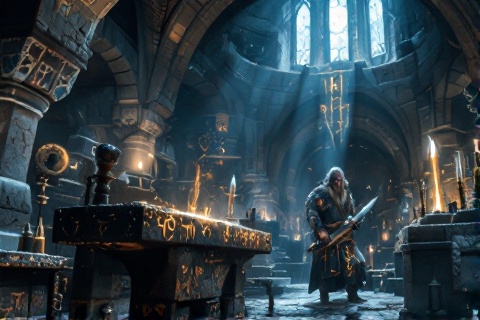
In the peaceful realms of the First Age, the legendary
Dwarf-smith Telchar of Nogrod forged what would become one of the most renowned
swords in the history of Middle-earth. Telchar, whose
craftsmanship also produced the knife Angrist and the helm
Haudh-en-Ndengin, created Narsil during the height of cooperation between
Dwarves and Elves, applying his unmatched skill
in metallurgy and enchantment to create a masterwork that would endure for ages
to come.
The name Narsil carried deep meaning in its etymology, drawing from the ancient
Quenya tongue of the High Elves. The elements 'Nar' meaning fire or sun, and
'Sil' referring to the white light of the moon, combined to create a name that
embodied the celestial radiance the blade would come to be known for throughout
its storied history.
The forging of Narsil took place during a time of relative peace in the First
Age, allowing Telchar to devote his full attention and considerable skill to its
creation. The blade was crafted using techniques known only to the greatest
Dwarf-smiths of Nogrod, incorporating materials and methods that would later be
lost to time, resulting in a weapon whose like would not be seen again until the
forging of the great Elven-blades of later ages.
Physical Description and Properties
Narsil was crafted as a magnificent two-handed sword, its blade gleaming with a
distinctive silver-white sheen that set it apart from lesser weapons. The
blade's unique metallic composition, achieved through Telchar's mastery of
Dwarvish smithing techniques, gave it an unmistakable brightness that would
later prove significant in its service against the forces of darkness.
The sword's surface bore intricate engravings depicting symbols of the sun and
moon, masterfully worked into the blade by Telchar himself. These celestial
markings ran along the fuller of the sword, complementing its name and enhancing
both its beauty and its symbolic significance as a weapon of light.
Through Telchar's craft and the inherent properties of its specially chosen
materials, Narsil possessed an inner light that manifested particularly strongly
in times of great need. This magical quality was not merely decorative but
served as a sign of the blade's power and its opposition to the forces of evil
in Middle-earth.
The sword's edge maintained a keenness that seemed to defy the normal laws of
metallurgy, capable of cutting through armor and remaining sharp despite heavy
use in battle. Its durability surpassed that of normal blades, owing to both the
skill of its maker and the exceptional materials used in its forging, making it
a weapon that could withstand centuries of use without diminishing.
Legacy of the Kings
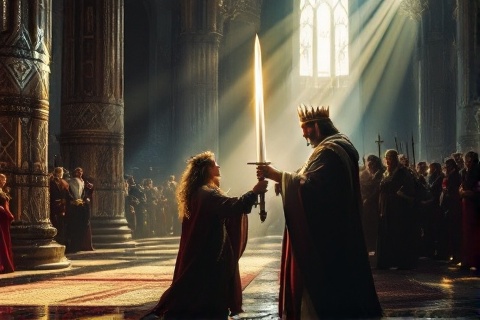
Over the centuries of the Second Age, Narsil passed through
the hands of successive generations of Númenórean lords,
becoming an increasingly important symbol of their lineage and authority. Each
bearer of the blade added to its legacy, though records of its specific deeds
during this period remain largely in shadow.
As the power of Númenor grew and its influence spread across
Middle-earth, Narsil became specifically associated with the authority of the
Kings of Arnor. The sword's reputation grew alongside the realm
it represented, becoming as much a symbol of leadership as a weapon of war.
When darkness fell upon Númenor and its people divided between the Faithful and
the King's Men, Narsil remained in the possession of Elendil, leader of the
Faithful. The sword accompanied him during the great exodus to Middle-earth,
where it became a symbol of hope and continuity as the Númenóreans established
their realms in exile.
The Last Alliance
During the final years of the Second Age, as the Last Alliance of Elves and Men
marshaled their forces against Sauron, Elendil bore Narsil
as the High King of both Arnor and Gondor. The sword's presence
on the battlefield served as a rallying point for the armies of the West, its
gleaming blade a beacon of hope in the darkness of war.
The climactic battle on the slopes of Mount Doom brought
Elendil face to face with Sauron himself, with Narsil playing a crucial role in
this momentous confrontation. The sword's inherent properties as a weapon of
light made it particularly effective against the Dark Lord, though the full
extent of its power in this battle remains the subject of much lore and
speculation.
In the final moments of this legendary duel, as Elendil fell beneath Sauron's
mace, Narsil shattered beneath him. The breaking of the blade became a powerful
symbol of the terrible cost of victory, though even in its broken state, the
sword retained enough of its power to play one final, crucial role in the
battle's outcome.
The Shards of Narsil
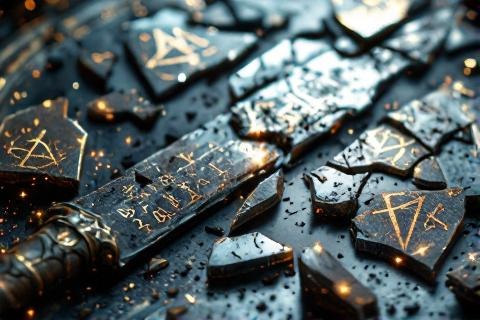
Though Narsil lay in pieces, the shards retained a significant portion of their
original power, particularly the hilt-shard that remained in the grip of the
fallen Elendil. The blade's innate magical properties persisted even in its
broken state, a testament to the extraordinary craftsmanship of Telchar.
In what would become one of the most significant moments in the history of
Middle-earth, Isildur took up the broken hilt of his father's sword and, with
it, managed to cut the One Ring from Sauron's hand. This
act, made possible by the enduring power of Narsil even in its broken state,
brought about the Dark Lord's defeat and ended the Second Age.
Following this momentous event, the shards of Narsil became a cherished heirloom
of Isildur's line, passed down through generations as a symbol of their heritage
and their right to rule. The broken sword served as both a reminder of past
glory and a testament to the sacrifices made in the war against Sauron.
Preservation in Rivendell
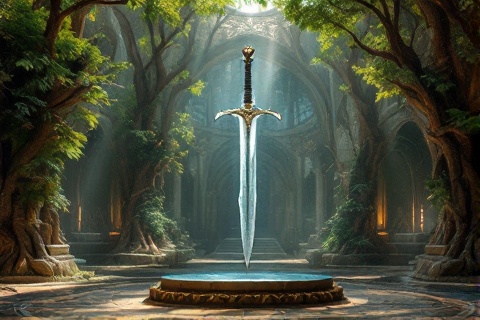
After the fall of the North-kingdom, the shards of Narsil found their way to
Imladris, the Last Homely House East of the Sea, where
Elrond became their keeper. In his halls, the broken blade
was treated with great reverence, preserved with all the skill and care the
Elves could provide.
The shards were displayed upon a wall in the House of Elrond, serving as a
poignant reminder of both the great victory against Sauron and the tragic cost
of that triumph. This display became a place of reflection for those who
understood its significance, a physical link to one of the most important
moments in the history of Middle-earth.
Through the long centuries of the Third Age, the shards
remained in Imladris, carefully preserved by Elrond's people. Their preservation
was not merely an act of remembrance but a preparation for the future, as
ancient prophecies spoke of a time when the sword would be needed again.
Cultural Impact and Symbolism
The broken sword became a powerful symbol of the simultaneous fall and endurance
of the line of kings in the North. Its very existence represented both the
tragedy of Elendil's death and the hope that his line would one day be restored,
maintaining a delicate balance between loss and promise that resonated
throughout the ages.
Throughout the Third Age, the shards of Narsil served as a symbol of resistance
against the growing shadow in Middle-earth. The broken blade represented not
just the past victory over Sauron, but the potential for future triumph,
inspiring those who opposed evil to maintain their vigil and their hope.
Ancient prophecies spoke of the sword that was broken and its eventual
reforging, linking it inextricably with the return of the king to Gondor and
Arnor. These prophecies kept alive the hope of restoration and renewal, even in
the darkest times of the Third Age.
The tale of Narsil inspired countless songs and stories throughout the Third
Age, particularly among the Dúnedain of the North and the loremasters of Gondor.
These works kept alive the memory of both the sword's glory and its breaking,
ensuring that its significance would not be forgotten even as centuries passed.